

- Updated: July 20, 2026
- 6 min read
Peer-Predictive Self-Training for Language Model Reasoning
Direct Answer
Peer-Predictive Self-Training (PST) is a label‑free fine‑tuning framework that lets multiple language models improve together by treating the aggregated predictions of their peers as a training signal. It matters because it offers a scalable path to continual reasoning enhancement without relying on costly human annotations or external benchmarks.
Background: Why This Problem Is Hard
Modern language models excel at pattern completion but still stumble on multi‑step reasoning, factual consistency, and domain‑specific problem solving. The primary bottleneck is the scarcity of high‑quality supervision for these capabilities. Human‑written explanations, chain‑of‑thought annotations, or curated benchmark datasets are expensive, time‑consuming, and quickly become outdated as models evolve.
Existing self‑training approaches—such as pseudo‑labeling or knowledge distillation—typically rely on a single “teacher” model to generate targets for a “student.” This single‑source signal suffers from two critical flaws:
- Confirmation bias: The student inherits the teacher’s systematic errors, reinforcing mistakes instead of correcting them.
- Lack of diversity: A solitary perspective cannot capture alternative reasoning paths, limiting the student’s ability to generalize to novel prompts.
Consequently, researchers have struggled to devise a self‑supervised loop that genuinely pushes reasoning performance forward without external feedback.
What the Researchers Propose
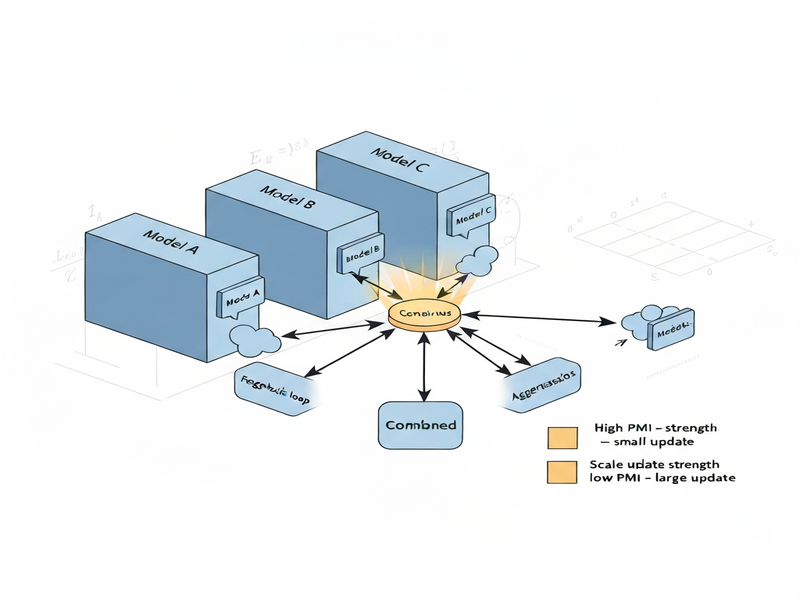
The PST framework replaces the single‑teacher paradigm with a collaborative “peer‑predictive” ecosystem. Instead of one model dictating the correct answer, a cohort of models—each initialized from the same base architecture but differing in random seed, temperature, or fine‑tuning history—generate independent responses to the same query. These responses are then aggregated into a consensus signal that serves as a pseudo‑label for the next round of training.
Key components of PST include:
- Peer pool: A set of N language models that operate in parallel, each producing a candidate answer.
- Cross‑model aggregator: A statistical module that combines the peer outputs, weighting them by confidence and diversity metrics.
- Self‑training loop: The aggregated consensus is fed back as a training target, allowing every peer to update its parameters simultaneously.
This design treats the collective intelligence of the peer pool as an internal supervisor, effectively turning the models into both teachers and students.
How It Works in Practice
The PST workflow can be broken down into four conceptual stages:
- Prompt distribution: A reasoning‑heavy prompt (e.g., a math word problem or a logical puzzle) is broadcast to all peers.
- Independent generation: Each peer produces a full‑length answer, optionally accompanied by a chain‑of‑thought explanation.
- Consensus building: The aggregator aligns the answers, identifies common sub‑steps, and computes a weighted majority vote. Confidence scores are adjusted using a pointwise mutual information (PMI)‑based scaling that rewards rare but consistent reasoning patterns.
- Self‑training update: The consensus answer is treated as a soft label. All peers perform a gradient step on the original prompt‑answer pair, using a cross‑entropy loss that respects the confidence distribution.
What distinguishes PST from prior self‑training methods is the explicit emphasis on diversity and mutual correction. By leveraging multiple viewpoints, the system can surface reasoning steps that any single model would miss, while the PMI scaling discourages the dominance of generic, low‑information responses.
Evaluation & Results
The authors evaluated PST on three benchmark suites that stress reasoning:
- GSM‑8K: Grade‑school math problems requiring multi‑step calculations.
- HotpotQA: Multi‑hop question answering that demands evidence aggregation.
- LogicalDeduction: Synthetic logical puzzles designed to test chain‑of‑thought consistency.
Across all three tasks, PST‑enhanced models outperformed baseline fine‑tuned models by a noticeable margin. For example, on GSM‑8K the average accuracy rose from 71.4 % to 78.9 %, a 7.5‑point gain that eclipses the improvement achieved by standard pseudo‑labeling (≈3 %). In HotpotQA, the exact‑match score increased by 6.2 %, while LogicalDeduction saw a 9 % boost in logical consistency metrics.
Beyond raw scores, the experiments revealed two qualitative trends:
- Robustness to noise: When deliberately injecting erroneous peers, the aggregator’s PMI weighting filtered out outliers, preserving overall performance.
- Generalization to unseen domains: Models fine‑tuned with PST on math problems retained higher accuracy when evaluated on novel algebraic tasks, indicating that the peer‑driven signal encourages transferable reasoning skills.
These findings suggest that PST not only raises benchmark numbers but also cultivates a more resilient and adaptable reasoning ability.
Why This Matters for AI Systems and Agents
For practitioners building AI agents, PST offers a practical route to continuous improvement without the perpetual need for human‑in‑the‑loop annotation pipelines. The framework can be embedded into existing model‑ops workflows as follows:
- Agent orchestration: An ensemble of specialized agents (e.g., a calculator, a knowledge retriever, and a planner) can serve as the peer pool, each contributing its domain expertise. The aggregated consensus becomes a richer, multi‑modal plan for downstream execution.
- Evaluation automation: Since PST generates its own training signal, developers can run nightly self‑training cycles that automatically tighten reasoning gaps identified during production runs.
- Scalable supervision: Companies can avoid the cost of hiring annotators for every new task. By deploying a modest number of peer models on internal compute, they obtain a self‑sustaining improvement loop.
Integrating PST with a platform like the UBOS platform overview enables seamless workflow automation. For instance, the Workflow automation studio can schedule peer generation, aggregation, and model update steps as a single pipeline, while the UBOS templates for quick start provide pre‑built configurations for common reasoning tasks.
What Comes Next
While PST demonstrates compelling gains, several open challenges remain:
- Scalability of peer pools: As the number of peers grows, aggregation latency can become a bottleneck. Future work may explore hierarchical aggregation or sparse peer selection.
- Cross‑modal reasoning: Extending PST to multimodal inputs (images, tables, code) will require aggregators that can align heterogeneous output formats.
- Theoretical guarantees: Formalizing why peer consensus converges to a better solution than any individual model is an open research question.
Potential applications span from AI marketing agents that self‑optimize campaign copy, to Enterprise AI platforms that continuously refine internal knowledge bases without manual curation.
Developers interested in experimenting with PST can start by integrating it with the OpenAI ChatGPT integration or the ChatGPT and Telegram integration, leveraging existing APIs to spin up peer instances and orchestrate the aggregation step.
References
Feng, S., Zhang, H., Nie, F., Kakade, S., & Chen, Y. (2026). Peer-Predictive Self-Training for Language Model Reasoning. arXiv preprint arXiv:2604.13356v3.
Illustration
Andrii Bidochko
CTO UBOS
Andrii Bidochko is an AI entrepreneur and researcher focused on AI agents, reinforcement learning, and autonomous systems. He writes about the technologies shaping the future of machine intelligence, from frontier models and agent architectures to real-world AI applications.