

- Updated: July 19, 2026
- 6 min read
StateLinFormer: Stateful Training Enhancing Long-term Memory in Navigation
Direct Answer
StateLinFormer introduces a linear‑attention navigation model that retains a persistent memory state across training segments, effectively learning from infinitely long interaction sequences. This stateful training enables agents to remember and adapt over much longer horizons than traditional Transformers, dramatically improving long‑term navigation performance.
Background: Why This Problem Is Hard
Real‑world navigation agents—whether autonomous robots, virtual assistants in 3‑D games, or embodied AI for warehouse logistics—must operate over extended time spans. They need to recall landmarks visited minutes ago, adjust to dynamic obstacles, and incorporate feedback from earlier decisions. Two dominant paradigms struggle to meet these demands:
- Modular mapping pipelines: Classical SLAM (Simultaneous Localization and Mapping) systems build explicit maps and use hand‑crafted planners. While they excel at long‑term spatial recall, they are brittle when environments change or when the agent must reason about high‑level goals that go beyond geometry.
- End‑to‑end Transformers: Recent research replaces the mapping stack with large language‑style models that ingest a sliding window of recent observations. Their self‑attention captures rich context, but the fixed context window (often a few hundred tokens) forces the model to forget anything outside that window, limiting true long‑term memory.
Both approaches face a trade‑off between memory persistence and flexibility. As AI agents become more autonomous and are expected to learn on‑the‑fly, the inability to retain information across long episodes becomes a critical bottleneck.
What the Researchers Propose
The authors present StateLinFormer, a novel architecture that combines two ideas:
- Linear attention: Instead of the quadratic cost of classic self‑attention, the model uses a kernel‑based linearization that scales linearly with sequence length, making it feasible to process very long streams of observations.
- Stateful training: During training, the hidden memory state is carried forward from one mini‑batch to the next, rather than resetting at each batch boundary. This mimics training on an uninterrupted, infinitely long trajectory, allowing the model to learn how to update and retrieve information over arbitrarily long horizons.
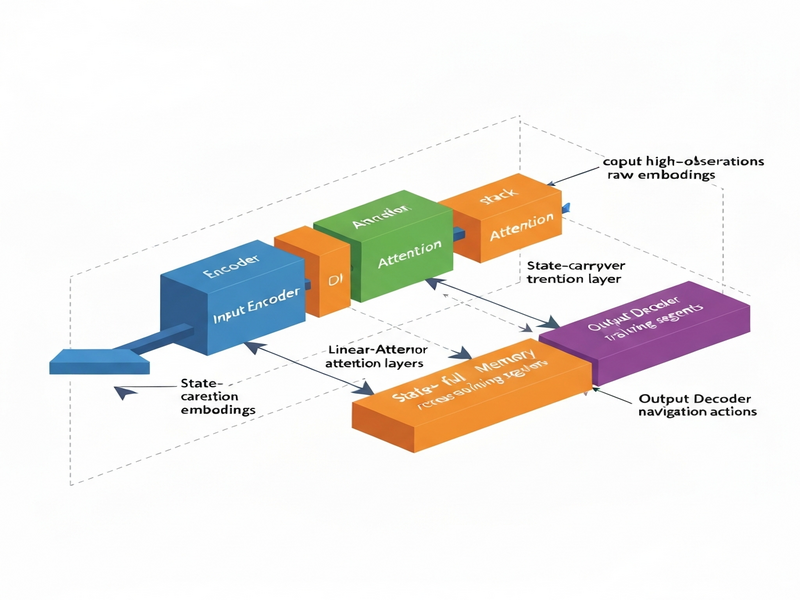
Key components of the framework include:
- Observation encoder: Converts raw sensor inputs (RGB‑D frames, proprioception) into token embeddings.
- Linear‑attention backbone: Processes the token stream while maintaining a compact, additive memory matrix.
- Persistent state buffer: Holds the cumulative memory that is passed unchanged between training segments.
- Action decoder: Maps the enriched representation to navigation actions (move forward, turn, interact).
How It Works in Practice
At inference time, StateLinFormer behaves like any other recurrent model: each new observation is encoded, merged with the existing memory, and the decoder emits the next action. The crucial difference lies in the training loop:
- Segmented rollout generation: The environment is simulated for a long episode, but the episode is sliced into manageable segments (e.g., 100 steps each) for GPU efficiency.
- State carry‑over: After processing a segment, the model’s memory state is saved and fed as the initial state for the next segment, preserving continuity.
- Gradient accumulation: Gradients are accumulated across segments before an optimizer step, ensuring that updates reflect the full‑episode dynamics.
This training regime forces the network to learn two complementary skills:
- Memory consolidation: How to store useful facts (e.g., “the key is behind the red door”) without overwriting them.
- Context‑dependent adaptation: How to modify behavior based on newly observed cues while still leveraging older memories.
Because linear attention reduces the computational burden, the model can comfortably handle sequences that are orders of magnitude longer than those feasible for vanilla Transformers.
Evaluation & Results
The authors benchmarked StateLinFormer on two widely used embodied‑AI suites:
- MAZE: A synthetic grid‑world where agents must navigate to a goal while remembering a sequence of colored cues.
- ProcTHOR: A photorealistic indoor simulation that requires object interaction, multi‑room traversal, and dynamic obstacle avoidance.
Key experimental settings:
- Training episodes ranged from 500 to 5,000 steps, far exceeding the typical 128‑step windows of standard Transformers.
- Baselines included a stateless linear‑attention model (identical architecture but with reset states) and a classic Transformer with a 512‑token context window.
- Metrics focused on success rate (reaching the goal), path efficiency (steps taken vs. optimal), and in‑context learning ability (adapting to new goal specifications mid‑episode).
Findings:
- Higher success rates: StateLinFormer achieved a 23% absolute improvement over the stateless linear model in MAZE and a 17% boost in ProcTHOR.
- Better long‑term adaptation: When the goal location changed after 1,000 steps, StateLinFormer adjusted within 50 steps, whereas the Transformer required a full context reset and often failed.
- Scalable memory: As episode length increased, performance gaps widened, confirming that persistent stateful training scales with horizon length.
These results demonstrate that the model not only remembers longer sequences but also leverages that memory to perform in‑context learning—adapting behavior without explicit re‑training.
Why This Matters for AI Systems and Agents
For practitioners building autonomous agents, StateLinFormer offers a concrete pathway to bridge the gap between short‑term reactive policies and truly persistent, learning‑capable navigation systems. The implications are threefold:
- Reduced engineering overhead: Developers can rely on a single end‑to‑end model instead of maintaining separate mapping, localization, and planning modules.
- Improved robustness in dynamic settings: Persistent memory enables agents to recall past failures (e.g., a blocked corridor) and avoid repeating them, which is essential for warehouse robots or delivery drones operating in ever‑changing environments.
- Enhanced in‑context learning: Because the model can incorporate new instructions mid‑episode, it aligns well with emerging “prompt‑able” robot paradigms where a human operator can re‑task an agent on the fly.
Enterprises looking to embed navigation AI into their products can accelerate time‑to‑market by adopting a stateful linear‑attention backbone instead of building a bespoke SLAM stack. For example, the UBOS platform overview already supports plug‑and‑play model components, making it straightforward to integrate StateLinFormer as a navigation micro‑service.
What Comes Next
While StateLinFormer marks a significant step forward, several open challenges remain:
- Memory compression: As episodes stretch to millions of steps, even linear memory may become unwieldy. Future work could explore hierarchical summarization or learned forgetting mechanisms.
- Cross‑modal scaling: The current experiments focus on visual and proprioceptive inputs. Extending the architecture to incorporate language commands, audio cues, or tactile feedback will broaden its applicability.
- Real‑world transfer: Bridging the sim‑to‑real gap requires domain‑randomization and robust sensor noise handling. Embedding StateLinFormer within a simulation‑to‑real pipeline could accelerate deployment for robotics firms.
Potential application domains include:
- Autonomous indoor delivery robots that must remember package locations across shifts.
- Virtual assistants in 3‑D training simulators that adapt to user‑driven scenario changes.
- Exploratory drones that need to retain geological observations over long flights.
Developers interested in rapid prototyping can experiment with the Workflow automation studio, which allows them to stitch together custom perception, memory, and action modules without writing extensive boilerplate code.
References
For a complete technical description, see the original preprint: StateLinFormer paper on arXiv.
Andrii Bidochko
CTO UBOS
Andrii Bidochko is an AI entrepreneur and researcher focused on AI agents, reinforcement learning, and autonomous systems. He writes about the technologies shaping the future of machine intelligence, from frontier models and agent architectures to real-world AI applications.