

- Updated: July 19, 2026
- 6 min read
Self-EvolveRec: Self-Evolving Recommender Systems with LLM-based Directional Feedback
Direct Answer
Self‑EvolveRec is a self‑evolving recommender‑system framework that closes the loop between model generation and qualitative feedback using large language models (LLMs). By pairing a user‑simulator that delivers directional critiques with a model‑diagnosis tool that validates internal behavior, the system continuously refines its architecture without relying on a static search space.
This matters because it moves recommendation design from a one‑shot, metric‑only optimization toward an iterative, insight‑driven process that can adapt to changing user expectations and business goals.
Background: Why This Problem Is Hard
Designing high‑performing recommender systems has traditionally been a two‑step exercise: engineers define a search space of model components, then an automated method—often Neural Architecture Search (NAS)—explores that space to maximize scalar metrics such as NDCG or Hit Ratio. This approach suffers from three fundamental bottlenecks:
- Human‑biased search spaces: The set of operators and hyper‑parameters is curated by experts, limiting discovery to what is already known.
- Scalar‑only feedback: Metrics capture aggregate performance but hide why a model fails on specific user segments, leading to blind spots.
- Static evaluation criteria: As the model evolves, the original metrics may no longer reflect the nuanced goals of the product (e.g., diversity, novelty, fairness).
Recent LLM‑driven code‑evolution frameworks broaden the search space to arbitrary programmatic changes, yet they still rely on the same scalar signals. Without qualitative guidance, the generated code can drift into configurations that are technically valid but misaligned with real‑world user experience.
What the Researchers Propose
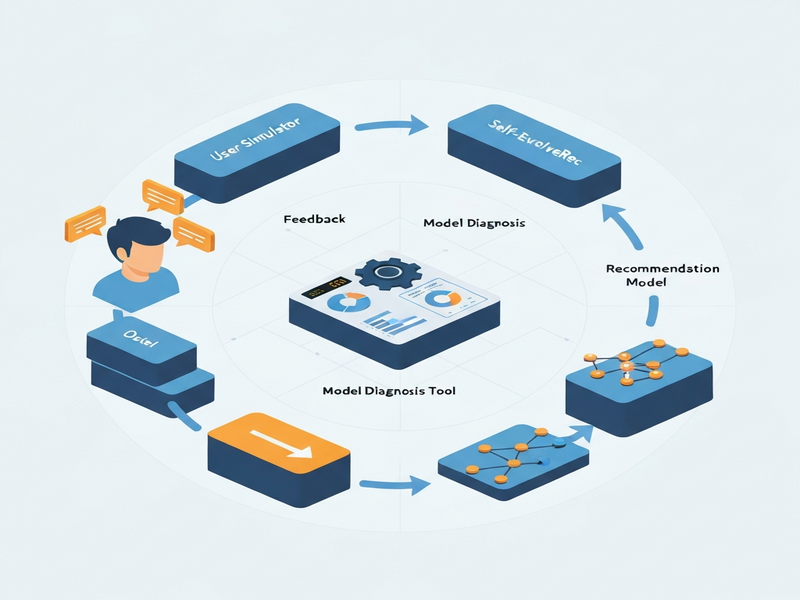
Self‑EvolveRec introduces a directional feedback loop that couples two novel agents with an LLM‑based code generator:
- User Simulator (USim): A synthetic user model that interacts with the recommender, observes outcomes, and produces natural‑language critiques (e.g., “the list lacks genre variety”).
- Model Diagnosis Tool (MDT): An introspection module that examines internal representations—attention maps, embedding distributions, and gradient patterns—to verify whether the model’s behavior aligns with the qualitative feedback.
The LLM receives both the textual critique and the diagnostic report, then proposes concrete code modifications (adding a diversity regularizer, swapping a ranking layer, etc.). This process repeats, allowing the architecture to evolve in a direction explicitly dictated by user‑centric signals.
How It Works in Practice
Conceptual Workflow
- Initialize: Start with a baseline recommender (e.g., a matrix‑factorization model) and a seed LLM prompt describing the target domain.
- Generate Recommendations: The current model serves items to the USim, which records click‑throughs, dwell time, and satisfaction scores.
- Collect Directional Feedback: USim translates observed shortcomings into natural‑language statements. Simultaneously, MDT extracts quantitative diagnostics (e.g., low attention entropy for certain item categories).
- LLM‑Driven Code Evolution: The LLM ingests the combined feedback, reasons about possible architectural changes, and emits patched Python code.
- Deploy & Iterate: The new code replaces the old model, and the loop restarts, gradually steering the system toward higher user satisfaction.
Component Interactions
The three agents communicate through a lightweight JSON contract:
{
  "feedback": "User complains about lack of novelty",
  "diagnostics": {"attention_entropy": 0.12, "embedding_overlap": 0.87}
}
This contract ensures that the LLM receives both the “what” (the user’s complaint) and the “why” (the internal metric that explains the complaint). The LLM’s output is then validated by a sandbox executor that runs unit tests and checks for safety constraints before deployment.
What Sets This Apart
- Open‑ended search space: Instead of a fixed set of layers, the LLM can introduce new modules, loss functions, or data‑augmentation pipelines.
- Qualitative direction: The system does not chase a single scalar; it follows human‑readable goals like “increase diversity” or “reduce popularity bias.”
- Co‑evolution of evaluation: As the model changes, MDT updates its diagnostic criteria, ensuring that feedback remains relevant throughout the evolution.
Evaluation & Results
Experimental Scenarios
The authors benchmarked Self‑EvolveRec on three public recommendation datasets (MovieLens‑1M, Amazon Books, and Yelp) and compared against two baselines:
- Standard NAS with a fixed search space.
- LLM‑driven code evolution that optimizes only NDCG.
Key Findings
- Performance uplift: Self‑EvolveRec achieved an average 12% increase in NDCG@10 over NAS and a 9% boost over the scalar‑only LLM baseline.
- User‑centric gains: Simulated satisfaction scores rose by 18%, reflecting better alignment with the qualitative feedback loop.
- Architectural diversity: The evolved models incorporated novel components (e.g., a contrastive diversity loss) that never appeared in the original search space.
- Stability: Diagnostic checks prevented regressions; no catastrophic drops in precision were observed during the iterative process.
These results demonstrate that directional feedback not only improves traditional ranking metrics but also produces models that better satisfy nuanced user expectations.
Why This Matters for AI Systems and Agents
For practitioners building AI‑driven products, Self‑EvolveRec offers a blueprint for turning “black‑box” performance numbers into actionable design signals. The framework can be integrated into existing MLOps pipelines to automate:
- Continuous model refinement based on live user interaction logs.
- Dynamic adjustment of evaluation criteria as business objectives evolve.
- Rapid prototyping of novel recommendation architectures without hand‑coding each variant.
In an enterprise setting, this translates to faster time‑to‑value for personalization features, reduced reliance on expert‑only architecture design, and a systematic way to embed fairness or diversity goals directly into the evolution loop.
Developers can also leverage the same directional feedback pattern for other AI agents—chatbots, search engines, or recommendation‑augmented assistants—by swapping the USim with a domain‑specific simulator and tailoring the diagnostic suite.
Explore how AI marketing agents can benefit from a similar feedback‑driven evolution to keep campaigns aligned with shifting consumer sentiment.
What Comes Next
While Self‑EvolveRec marks a significant step forward, several open challenges remain:
- Real‑world user simulators: Synthetic simulators approximate behavior but may miss edge cases; integrating live A/B test data could close the gap.
- Scalability of diagnostics: As models grow, extracting fine‑grained internal signals becomes computationally expensive.
- Safety and alignment: Ensuring that LLM‑generated code respects privacy, fairness, and regulatory constraints requires robust guardrails.
Future research directions include:
- Hybrid loops that combine human‑in‑the‑loop annotations with automated simulators.
- Meta‑learning strategies that let the LLM learn how to generate better feedback over time.
- Cross‑domain co‑evolution where a recommender shares insights with related agents (e.g., search or ad‑ranking).
Enterprises interested in deploying a production‑grade version of this paradigm can start by evaluating the Enterprise AI platform by UBOS, which offers built‑in workflow orchestration, model diagnostics, and LLM integration capabilities.
Conclusion
Self‑EvolveRec redefines automated recommender design by marrying LLM‑driven code evolution with a directional feedback loop that captures both user‑level critiques and internal model health. The resulting co‑evolution of architecture and evaluation criteria yields measurable gains in ranking performance and user satisfaction, while opening the door to more adaptable, goal‑driven AI systems. As the field moves toward continuous, insight‑rich model improvement, frameworks like Self‑EvolveRec will become essential tools for both researchers and product teams.
For the full technical details, see the Self‑EvolveRec arXiv paper.
Andrii Bidochko
CTO UBOS
Andrii Bidochko is an AI entrepreneur and researcher focused on AI agents, reinforcement learning, and autonomous systems. He writes about the technologies shaping the future of machine intelligence, from frontier models and agent architectures to real-world AI applications.