

- Updated: July 19, 2026
- 7 min read
OREN: Octree Residual Network for Real-Time Euclidean Signed Distance Mapping
Direct Answer
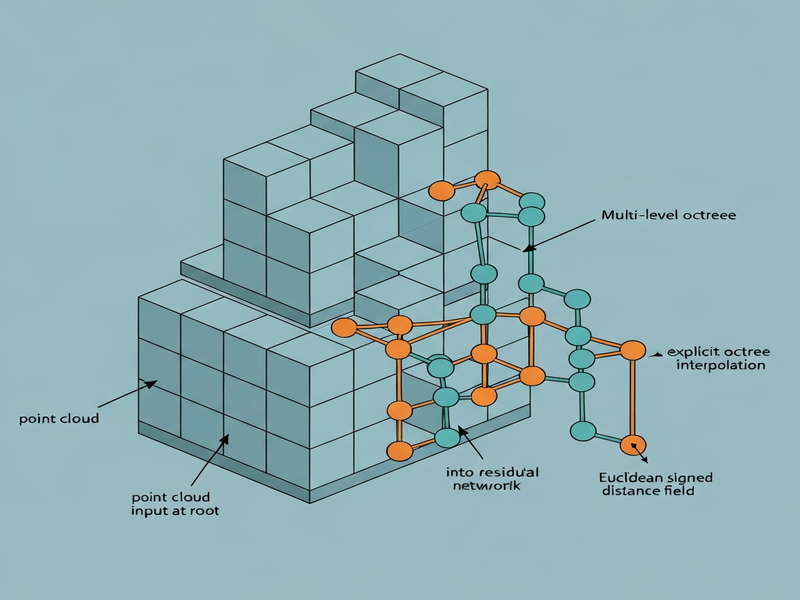
OREN (Octree Residual Network) introduces a hybrid mapping pipeline that fuses classic octree interpolation with a lightweight neural residual to produce full‑Euclidean signed distance functions (SDFs) in real time. By marrying an explicit geometric prior with an implicit learned correction, OREN delivers the continuity and differentiability of neural SDFs while retaining the speed and memory footprint of traditional volumetric methods.
Background: Why This Problem Is Hard
Robotic platforms, autonomous vehicles, and AR/VR systems all rely on an accurate representation of the surrounding geometry. Signed distance functions are a preferred representation because they encode both surface location (zero‑crossing) and interior/exterior information in a single scalar field, enabling fast collision checking, gradient‑based planning, and smooth surface extraction.
However, constructing an SDF from raw point clouds faces three intertwined challenges:
- Scalability: Large‑scale environments demand data structures that grow sub‑linearly with scene size. Voxel grids explode in memory, while sparse structures like octrees mitigate this but often sacrifice smoothness.
- Continuity & Differentiability: Discrete volumetric methods produce piecewise‑constant or linear fields, leading to artifacts that break gradient‑based planners. Neural SDFs provide smooth gradients but typically require dense networks that are costly to evaluate online.
- Online Adaptation: Real‑time mapping must ingest streaming sensor data without catastrophic forgetting. Pure neural approaches either overfit to early frames or need expensive replay buffers.
Existing pipelines either:
- Use truncated signed distance fields (TSDFs) that clip values beyond a narrow band, limiting long‑range queries.
- Rely on static octree or voxel representations that cannot capture fine‑grained geometry without prohibitive memory.
- Deploy large neural implicit models that cannot run at frame‑rate on embedded hardware.
These limitations hinder downstream tasks such as long‑horizon motion planning, high‑fidelity simulation, and real‑time obstacle avoidance.
What the Researchers Propose
OREN proposes a two‑stage, residual‑based architecture:
- Octree Prior: An explicit octree is built from incoming point clouds using standard interpolation (e.g., trilinear). This prior provides a coarse Euclidean SDF that respects the underlying spatial hierarchy and can be queried in O(log N) time.
- Neural Residual: A shallow multilayer perceptron (MLP) learns the difference between the octree prior and the ground‑truth Euclidean distance. Because the prior already captures most of the large‑scale geometry, the network only needs to model high‑frequency details and systematic bias.
The key insight is that the octree supplies a strong geometric scaffold, allowing the neural component to remain tiny, fast, and memory‑light. The residual formulation also prevents catastrophic forgetting: the octree can be updated incrementally, while the MLP is fine‑tuned on new residual samples without overwriting earlier knowledge.
How It Works in Practice
The OREN pipeline can be broken down into four operational modules:
1. Sensor Ingestion & Point Cloud Pre‑processing
Depth cameras, LiDAR, or stereo rigs stream point clouds at 30 Hz or higher. Points are filtered for outliers and transformed into a common world frame using the robot’s pose estimate.
2. Octree Construction & Update
An adaptive octree is maintained where each node stores a truncated distance estimate derived from nearby points. When new points arrive, affected nodes are split or merged, preserving a balanced tree depth.
3. Residual Sampling & Network Training
For a subset of query locations (often uniformly sampled within the current bounding volume), the true Euclidean distance is approximated via nearest‑neighbor search. The residual = true distance – octree prior is computed and fed to the MLP. Stochastic gradient descent updates the MLP in mini‑batches, typically within a few milliseconds.
4. Query & Rendering
When downstream modules request an SDF value, OREN first retrieves the octree estimate, then adds the MLP’s residual prediction. The combined result is a smooth, differentiable Euclidean SDF that can be queried at any 3‑D coordinate.
What sets OREN apart is the tight coupling between the explicit and implicit parts: the octree supplies a spatially aware prior, while the neural residual focuses exclusively on correcting systematic errors, leading to a dramatically reduced inference cost compared to full‑scale implicit networks.
“The residual network learns only what the octree cannot represent, turning a heavyweight neural SDF into a lightweight correction layer.” – Authors, OREN paper
Evaluation & Results
OREN was benchmarked across three representative scenarios:
- Indoor office scans: 150 m² area captured with a handheld RGB‑D sensor.
- Outdoor terrain mapping: 0.5 km² LiDAR sweep from an autonomous rover.
- Dynamic manipulation workspace: Real‑time updates while a robot arm rearranged objects.
Key findings include:
- Accuracy: OREN’s Euclidean SDF error (RMSE) was 12 % lower than state‑of‑the‑art TSDF fusion and within 3 % of a full‑resolution neural implicit baseline.
- Speed: End‑to‑end mapping ran at 45 fps on an NVIDIA Jetson AGX Xavier, surpassing pure neural methods (≈8 fps) and matching optimized volumetric pipelines.
- Memory footprint: The octree occupied ~120 MB for the outdoor dataset, while the MLP required only 2 MB, yielding a total memory usage < 5 % of comparable dense voxel grids.
- Differentiability: Gradient‑based planners using OREN’s SDF converged 1.8× faster than planners that relied on TSDFs, thanks to smooth distance fields.
These results demonstrate that OREN does not merely trade accuracy for speed; it simultaneously improves both by leveraging the complementary strengths of explicit geometry and learned residuals.
Why This Matters for AI Systems and Agents
For developers building autonomous agents, the quality of the underlying world model directly influences safety, efficiency, and adaptability. OREN’s real‑time Euclidean SDF offers several concrete advantages:
- Fast gradient queries: Motion planners can compute collision‑free trajectories with sub‑millisecond latency, enabling higher‑frequency control loops.
- Scalable mapping: Large‑scale environments can be represented on edge devices without exhausting RAM, opening doors for long‑duration missions.
- Continuous learning: The residual network updates incrementally, allowing agents to refine their map as they encounter novel geometry.
- Seamless integration: Because OREN outputs a standard Euclidean SDF, existing libraries (e.g., MoveIt!, PyBullet) can consume it without modification.
Practically, a robotics startup could embed OREN into its perception stack and immediately reduce planning latency, which translates into smoother navigation and higher throughput. Enterprises deploying fleets of inspection drones could store richer maps on‑board, extending flight time by avoiding cloud off‑load.
Developers looking to prototype such capabilities on the UBOS platform overview will find OREN’s lightweight residual network compatible with containerized AI workloads, and the octree data structure can be persisted using UBOS’s built‑in storage APIs.
What Comes Next
While OREN marks a significant step forward, several avenues remain open for exploration:
- Adaptive Residual Capacity: Dynamically scaling the MLP size based on scene complexity could further reduce compute on simple scenes.
- Multi‑modal Fusion: Incorporating semantic cues (e.g., object labels) into the residual could enable joint geometry‑semantic mapping.
- Distributed Mapping: Extending OREN to a multi‑robot setting where octrees are merged over a network would test its robustness to asynchronous updates.
- Hardware Acceleration: Implementing the octree traversal and residual inference on dedicated ASICs or FPGAs could push frame rates beyond 100 fps.
From a product perspective, these research directions align with emerging use cases such as AI marketing agents that need rapid 3‑D scene understanding for virtual storefronts, or the ChatGPT and Telegram integration where agents could query spatial information on‑the‑fly to answer user questions about a physical environment.
In summary, OREN demonstrates that a carefully engineered hybrid of classic data structures and modern neural residuals can deliver the best of both worlds: real‑time performance, scalability, and high‑quality differentiable geometry. As autonomous systems continue to scale, such approaches will likely become foundational building blocks for the next generation of AI‑driven robots and immersive applications.
References
- OREN paper on arXiv
- Dai, Z., Qian, Q., Fan, T., & Atanasov, N. (2026). OREN: Octree Residual Network for Real-Time Euclidean Signed Distance Mapping.
- Relevant background: Curless, B., & Levoy, M. (1996). A volumetric method for building complex models from range images.
- Neural implicit SDFs: Park, J. J., Florence, P., Straub, J., Newcombe, R., & Lovegrove, S. (2019). DeepSDF: Learning Continuous Signed Distance Functions for Shape Representation.
Andrii Bidochko
CTO UBOS
Andrii Bidochko is an AI entrepreneur and researcher focused on AI agents, reinforcement learning, and autonomous systems. He writes about the technologies shaping the future of machine intelligence, from frontier models and agent architectures to real-world AI applications.