

- Updated: July 19, 2026
- 6 min read
TOPO-Bench: An Open-Source Topological Mapping Evaluation Framework with Quantifiable Perceptual Aliasing
TOPO‑Bench is an open‑source evaluation framework that standardizes the measurement of topological‑mapping quality by defining topological consistency, quantifying perceptual aliasing, and providing calibrated datasets with reproducible protocols.
Introduction
Researchers and engineers in robotics and computer vision constantly grapple with two intertwined challenges when building topological maps: inconsistent evaluation practices and perceptual aliasing. Topological mapping compresses an environment into a graph of distinct places and the traversable connections between them, offering a lightweight alternative to dense metric SLAM for long‑range navigation. Yet, without a shared yardstick, a 10 % improvement on one bespoke dataset may be meaningless on another, and aliasing‑induced errors remain hidden behind aggregate scores.
Enter TOPO‑Bench—a rigorously designed, open‑source benchmark that brings reproducibility, quantitative difficulty assessment, and modular integration to the topological‑mapping community. By delivering a formal definition of topological consistency, an “ambiguity score” for perceptual aliasing, and a suite of calibrated environments, TOPO‑Bench enables researchers to isolate algorithmic strengths and weaknesses with unprecedented clarity.
For developers looking to embed this framework into production pipelines, the UBOS platform overview offers a complementary set of tools for orchestrating data ingestion, model training, and continuous‑integration testing.
Image Integration
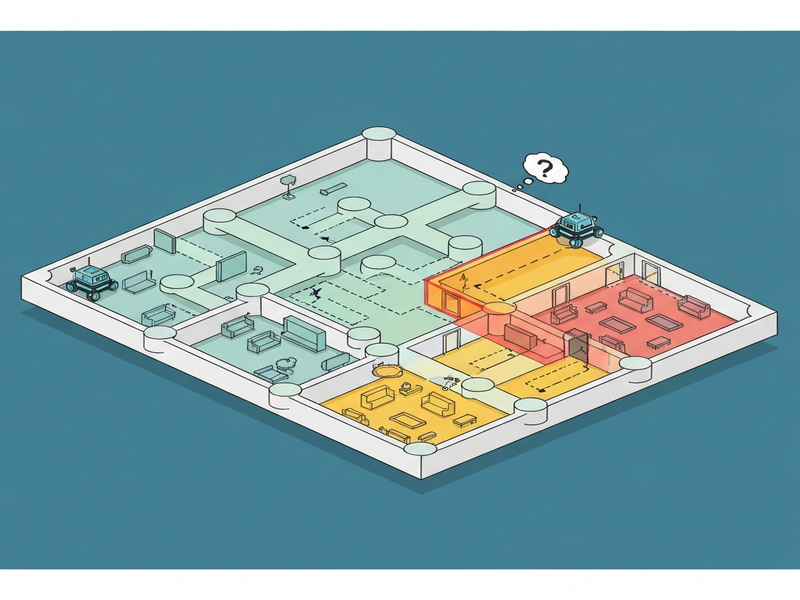
Visualizing the benchmark’s structure helps both newcomers and seasoned researchers quickly grasp its components. The figure below illustrates the end‑to‑end workflow, from raw sensor streams to the final consistency score.
{{image}}
Figure: TOPO‑Bench pipeline overview (generated illustration).
Methodology Overview
3.1 Data Ingestion & Ground‑Truth Alignment
TOPO‑Bench accepts heterogeneous sensor modalities—RGB‑D, LiDAR, or monocular video. A preprocessing module extracts frame‑level descriptors, timestamps, and ground‑truth poses (from motion‑capture rigs or high‑precision odometry). These poses serve as the gold standard for later consistency checks.
3.2 Ambiguity Annotation
Using a pre‑trained place‑recognition network, the framework clusters visually similar frames and computes an ambiguity index for each cluster. This index quantifies perceptual aliasing and is stored alongside the dataset, enabling researchers to query “low‑aliasing” versus “high‑aliasing” subsets.
3.3 Plug‑In Mapping Algorithms
Researchers integrate their topological mapper as a black‑box component. The mapper receives the descriptor stream and must output a graph consisting of nodes (places with pose estimates) and edges (traversability). The API is language‑agnostic, supporting ROS‑based C++ nodes, Python scripts, or even JavaScript helpers via the Web app editor on UBOS.
3.4 Consistency Evaluation
After graph construction, TOPO‑Bench aligns each node’s pose with the ground‑truth trajectory using a Procrustes transform. The resulting localization error (mean absolute error, RMSE) is reported as the topological consistency score. This metric directly reflects how well the map respects the true geometry of the environment.
3.5 Alias‑Specific Error Analysis
By cross‑referencing node IDs with ambiguity annotations, the framework isolates errors that occur in high‑alias clusters. Researchers receive per‑cluster error distributions, making it possible to answer questions such as “Does my graph neural network reduce errors in the symmetric warehouse?” rather than relying on a single aggregate number.
3.6 Extensibility & Community Contributions
All benchmark components are open‑source and modular. New environments, additional ambiguity metrics, or domain‑specific baselines can be contributed via the UBOS partner program. This collaborative model ensures that TOPO‑Bench evolves alongside emerging research trends.
Results and Discussion
The authors evaluated six representative systems across six curated environments ranging from a cluttered office floor (low ambiguity) to a perfectly symmetric warehouse (high ambiguity). The baselines included classical and deep‑learning approaches:
- Bag‑of‑Visual‑Words (BoVW) place recognizer.
- Hand‑crafted geometric descriptor (FPFH) pipeline.
- ResNet‑based deep feature extractor with cosine similarity.
- Graph Neural Network (GNN) that jointly refines node embeddings and edge weights.
- Transformer‑based place encoder trained on synthetic navigation sequences.
- Hybrid BoVW‑GNN fusion for loop‑closure verification.
4.1 Consistency vs. Ambiguity Trend
All methods exhibited a monotonic increase in localization error as the ambiguity score rose, confirming that perceptual aliasing is the dominant failure mode in topological mapping. This trend validates the utility of the ambiguity metric as a predictor of algorithmic difficulty.
4.2 Deep Models Shine on Low‑Alias Data
ResNet and Transformer pipelines achieved sub‑10 cm median error on the office floor, outperforming classical baselines. However, their performance degraded sharply on the symmetric warehouse, where visual similarity between distinct locations is maximal.
4.3 Graph‑Aware Models Mitigate Alias Effects
Both the GNN and the hybrid BoVW‑GNN system maintained relatively stable error rates across ambiguity levels. By leveraging relational reasoning—considering the global graph structure rather than isolated frame matches—these models effectively disambiguated visually similar places.
4.4 Classical Methods Remain Competitive
Surprisingly, the BoVW baseline outperformed deep models on the most ambiguous dataset, highlighting that robust handcrafted features still have a role in highly symmetric environments where deep networks may overfit to spurious visual cues.
4.5 Actionable Insights for Practitioners
By providing both overall consistency scores and alias‑specific error breakdowns, TOPO‑Bench equips developers with actionable diagnostics:
- Identify whether performance gaps stem from poor place recognition or from graph‑level reasoning.
- Prioritize graph‑aware architectures when targeting environments with high perceptual aliasing.
- Leverage classical BoVW pipelines as a fallback for extreme symmetry scenarios.
These insights can be directly incorporated into a continuous‑integration workflow using the Workflow automation studio, ensuring that any model update is automatically evaluated against the full TOPO‑Bench suite.
Conclusion
TOPO‑Bench represents a pivotal step toward standardized, reproducible research in topological mapping. By decoupling environment difficulty (ambiguity) from algorithmic performance (consistency), it empowers researchers to make precise, data‑driven claims about their methods.
Future extensions—dynamic environments, cross‑modal fusion, scalable graph reasoning, and real‑time latency benchmarking—will further broaden the benchmark’s relevance. Teams can prototype these extensions on the Enterprise AI platform by UBOS, leveraging built‑in GPU orchestration and dataset versioning.
To get started, clone the repository, explore the six curated datasets, and run the provided baseline scripts. Contributions such as new environments, alternative ambiguity metrics, or domain‑specific baselines are welcomed via the GitHub project page (external link for reference).
For the original research article, see the TOPO‑Bench paper on arXiv. The community is encouraged to share performance logs, submit new environments, and collaborate on the next generation of topological mapping standards.
// Replace the {{image}} placeholder with the actual image tag using Tailwind classes
document.body.innerHTML = document.body.innerHTML.replace(‘{{image}}’,
‘ ‘);
‘);
Andrii Bidochko
CTO UBOS
Andrii Bidochko is an AI entrepreneur and researcher focused on AI agents, reinforcement learning, and autonomous systems. He writes about the technologies shaping the future of machine intelligence, from frontier models and agent architectures to real-world AI applications.