

- Updated: July 18, 2026
- 7 min read
Less Is More: Reducing Token Counts Without Compromising Performance – A Deep Dive
Less Is More: Reducing Token Counts Without Compromising Performance
Direct Answer
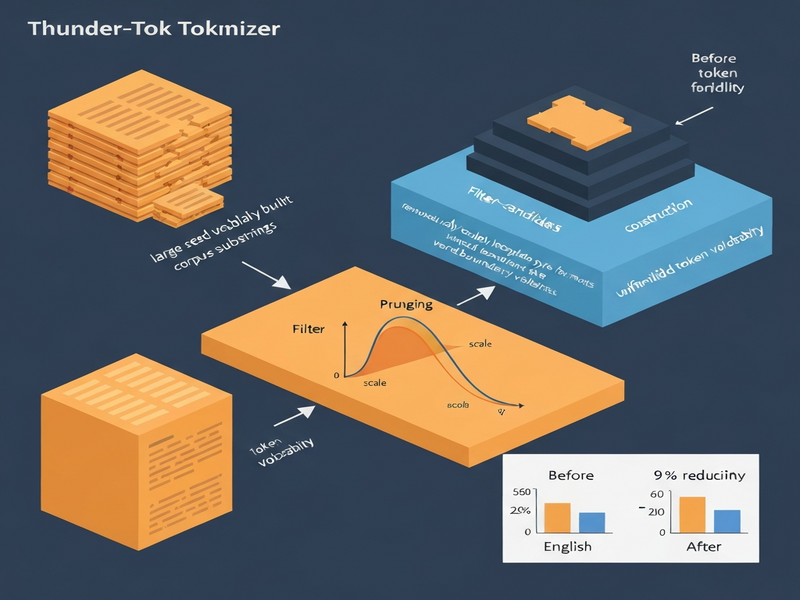
Thunder‑Tok is a new subword tokenizer that trims the number of tokens a language model must process—cutting token “fertility” by roughly 25 % for English and 9 % for Korean—while keeping downstream performance on par with conventional BPE tokenizers. By pruning a massive seed vocabulary with a likelihood‑based score, Thunder‑Tok delivers faster inference and lower generation costs without sacrificing accuracy.
Background: Why This Problem Is Hard
Large language models (LLMs) generate text one token at a time. The tokenization step translates raw characters into discrete units that the model can understand. When tokenizers split words into many short pieces, the resulting sequence length (or “fertility”) inflates, and every additional token adds a fixed amount of compute, memory, and latency. In production settings—chatbots, real‑time assistants, or high‑throughput APIs—these hidden costs quickly become a bottleneck.
Existing tokenizers, such as Byte‑Pair Encoding (BPE) or WordPiece, strike a balance between vocabulary size and coverage. They excel at handling rare words and multilingual text, but they tend to produce fragmented tokens for common multi‑word expressions. A naïve fix—simply adding longer, multi‑word tokens—often harms language modeling because the model sees fewer examples of each token during training, leading to poorer generalization.
Consequently, the community faces a trade‑off:
- Short tokens: high coverage, low per‑token frequency, higher sequence length.
- Long tokens: lower sequence length but risk of data sparsity and degraded perplexity.
Finding a systematic way to reduce token counts without compromising the statistical strength of the model remains an open challenge, especially as LLMs scale to billions of parameters and serve latency‑sensitive applications.
What the Researchers Propose
The authors introduce Thunder‑Tok, a two‑stage tokenizer design that first builds an exhaustive seed vocabulary from raw corpus substrings and then prunes it using a principled likelihood metric. The key ideas are:
- Seed Construction: Scan the training corpus for all substrings up to a predefined length, collect those that appear frequently, and filter out structurally invalid candidates (e.g., broken Unicode byte sequences or tokens that cross word boundaries).
- Likelihood‑Based Pruning: Assign each candidate a score derived from a uniform Jensen lower bound on the probability of the training data. Tokens that contribute little to the overall likelihood are removed, leaving a compact yet expressive vocabulary.
Thunder‑Tok therefore treats token selection as an optimization problem: keep the tokens that most efficiently explain the corpus while discarding redundant or harmful pieces. The result is a vocabulary that naturally favors longer, high‑frequency substrings without sacrificing the model’s ability to represent rare words.
How It Works in Practice
The Thunder‑Tok pipeline can be broken down into three conceptual steps:
- Corpus Mining: The raw text is tokenized at the character level. All contiguous substrings up to a maximum length (e.g., 12 characters) are enumerated, and their occurrence counts are recorded.
- Structural Filtering: The raw list is cleaned by removing:
- Invalid Unicode fragments that would break downstream decoding.
- Tokens that split across natural word boundaries, preserving linguistic integrity.
- Extremely low‑frequency substrings that would introduce sparsity.
- Likelihood Pruning: For each remaining candidate, the algorithm computes a token score:
- Estimate the probability of the corpus if the token were part of the vocabulary.
- Apply a uniform Jensen lower bound to obtain a conservative estimate of contribution.
- Rank tokens by this score and retain the top‑K that satisfy a target vocabulary size or fertility reduction goal.
During inference, the trained LLM uses the resulting Thunder‑Tok vocabulary exactly like any other subword tokenizer. The only difference is that the token stream is shorter on average, which directly translates into fewer transformer layers being evaluated per generation step.
What sets Thunder‑Tok apart is its data‑driven pruning criterion. Instead of heuristics (e.g., frequency thresholds alone), the likelihood score captures how much each token helps compress the corpus, ensuring that the final vocabulary is both compact and information‑rich.
Evaluation & Results
The authors benchmarked Thunder‑Tok on two language families: English (high‑resource) and Korean (morphologically rich). Their evaluation framework covered three dimensions:
- Fertility Reduction: Measured the average number of tokens per sentence compared to a baseline BPE tokenizer.
- Language Modeling Performance: Reported perplexity on held‑out validation sets to gauge any loss in predictive power.
- Downstream Task Accuracy: Tested on standard NLP benchmarks (e.g., GLUE for English, KLUE for Korean) to verify real‑world impact.
Key findings include:
- Thunder‑Tok cut English token fertility by ~25 % and Korean fertility by ~9 % relative to BPE.
- Perplexity differences were negligible (<0.2 % increase), indicating that the model’s predictive quality remained essentially unchanged.
- Downstream benchmark scores stayed within the confidence interval of the baseline, confirming that task performance was not compromised.
These results demonstrate that a carefully pruned vocabulary can deliver tangible efficiency gains without the typical trade‑off of degraded language understanding.
Why This Matters for AI Systems and Agents
For developers building AI agents, chat services, or any LLM‑powered product, inference latency and cost are often the primary constraints. Thunder‑Tok’s fertility reduction translates into:
- Lower Compute Bills: Fewer tokens mean fewer matrix multiplications per generation step, directly reducing GPU/TPU usage.
- Faster Response Times: Shorter sequences accelerate end‑to‑end latency, improving user experience in real‑time assistants.
- Scalable Throughput: With the same hardware, more concurrent requests can be served, benefiting SaaS platforms and high‑traffic APIs.
These efficiencies are especially valuable for UBOS platform overview customers who orchestrate multiple agents in a workflow. By integrating Thunder‑Tok, a developer can keep the same model size while freeing up compute headroom for additional reasoning steps, tool use, or multimodal extensions.
Moreover, the tokenizer’s language‑agnostic design means that enterprises operating in multilingual environments—such as global customer support bots—can reap similar benefits without retraining separate models for each language.
What Comes Next
While Thunder‑Tok marks a significant step forward, several avenues remain open for exploration:
- Dynamic Vocabulary Adaptation: Future work could allow token sets to evolve during fine‑tuning, tailoring the vocabulary to domain‑specific jargon.
- Joint Tokenizer‑Model Training: Co‑optimizing the tokenizer and the transformer could push fertility reductions even further.
- Hardware‑Aware Pruning: Aligning token length reductions with specific accelerator architectures (e.g., sparsity‑friendly GPUs) may unlock additional speedups.
Practitioners interested in experimenting with Thunder‑Tok can start by integrating it into existing pipelines via the OpenAI ChatGPT integration or by extending the Workflow automation studio to include a custom tokenization step. The open‑source nature of the algorithm also invites community contributions to refine the likelihood scoring or to benchmark on emerging languages.
References
- Less Is More: Reducing Token Counts Without Compromising Performance – Original arXiv preprint (v2).
- Cho, G., So, Y., Lee, S., & Lee, J. (2026). Less Is More: Reducing Token Counts Without Compromising Performance.
This article explores how Thunder‑Tok, a novel sub‑word tokenizer, trims token counts by up to 25 % for English and 9 % for Korean while preserving model performance. By mining a large seed vocabulary and applying likelihood‑based pruning, Thunder‑Tok reduces token fertility and inference latency, making LLM‑driven applications more efficient.
For a detailed technical discussion, see the original arXiv paper Less Is More: Reducing Token Counts Without Compromising Performance. Learn more about our AI solutions and related research on ubos.tech.
Andrii Bidochko
CTO UBOS
Andrii Bidochko is an AI entrepreneur and researcher focused on AI agents, reinforcement learning, and autonomous systems. He writes about the technologies shaping the future of machine intelligence, from frontier models and agent architectures to real-world AI applications.