

- Updated: July 18, 2026
- 7 min read
InvestPhilBench: A Multi-Layer Benchmark for Evaluating Large Language Model Procedural Reasoning in Expert Investment Philosophy
Direct Answer
InvestPhilBench is a newly released, eight‑tier benchmark that measures how well large language models (LLMs) can reconstruct and apply the step‑by‑step decision frameworks used by top‑tier investment professionals. It matters because it shifts evaluation from generic knowledge recall to procedural reasoning that directly impacts real‑world portfolio construction and risk management.
Background: Why This Problem Is Hard
Financial institutions increasingly rely on LLMs as research assistants, idea generators, and even preliminary trade‑signal providers. Yet the core of expert investing is not just factual recall; it is a disciplined, multi‑stage process that blends macro analysis, sector allocation, valuation modeling, and behavioral safeguards. Existing benchmarks—such as MMLU, BIG‑Bench, or domain‑specific question sets—focus on isolated facts or single‑turn reasoning, leaving a critical gap:
- Procedural depth: Expert investors follow a hierarchy of cognitive steps, each dependent on the output of the previous one.
- Contextual continuity: Real‑world investment work requires maintaining a coherent narrative across dozens of prompts, data sources, and time horizons.
- Risk‑aware judgment: Decisions must respect risk limits, regulatory constraints, and portfolio‑level objectives, which are rarely captured in static QA formats.
Current evaluation pipelines struggle to capture these dimensions because they lack a structured, layered test harness that mirrors the actual workflow of a seasoned portfolio manager. Consequently, developers cannot reliably gauge whether an LLM will behave safely and profitably when embedded in an investment pipeline.
What the Researchers Propose
The authors, Mingguang Chen and Bo Qu, introduce InvestPhilBench, a multi‑layer benchmark that decomposes expert investment philosophy into eight cognitive tiers. Each tier isolates a distinct reasoning skill, ranging from high‑level market sentiment synthesis to low‑level trade‑execution checks. The framework consists of three key components:
- Tiered Task Generator: Automatically creates scenario‑specific prompts that reflect the decision‑making stage (e.g., “Identify macro drivers” vs. “Validate position sizing”).
- Procedural Ground‑Truth Engine: Encodes the canonical workflow of a veteran investor, providing step‑by‑step reference outputs for comparison.
- Scoring & Attribution Module: Evaluates LLM responses on correctness, logical consistency, and adherence to risk constraints, while attributing errors to the responsible tier.
By mapping each LLM output to a concrete procedural step, the benchmark makes it possible to pinpoint exactly where a model’s reasoning breaks down—information that is invaluable for model selection, fine‑tuning, and safety‑layer design.
How It Works in Practice
When an LLM is subjected to InvestPhilBench, it follows a workflow that mirrors a human analyst’s day‑to‑day routine. The process can be visualized in the diagram below.
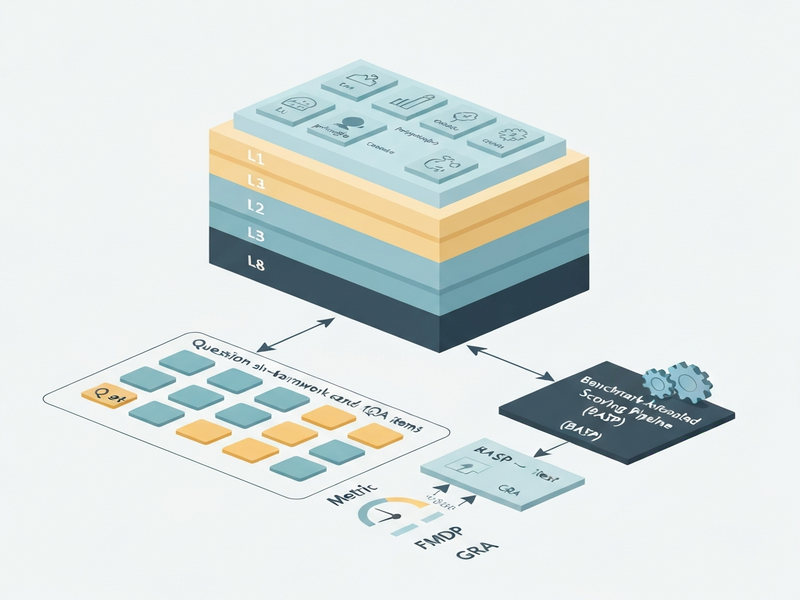
Figure: The eight‑tier architecture of InvestPhilBench, showing the flow from macro assessment to execution validation.
The interaction proceeds as follows:
- Step 1 – Context Ingestion (Tier 1): The benchmark feeds the model a market snapshot, macro indicators, and a client mandate.
- Step 2 – Sentiment Synthesis (Tier 2): The model generates a narrative of prevailing market sentiment, which is cross‑checked against a curated sentiment index.
- Step 3 – Sector Allocation (Tier 3): Using the sentiment output, the model proposes sector weightings, respecting predefined exposure caps.
- Step 4 – Security Selection (Tier 4): The model selects individual equities or bonds, providing valuation rationales and expected return estimates.
- Step 5 – Risk Modeling (Tier 5): It runs a Monte‑Carlo simulation or factor‑model analysis, reporting VaR, drawdown, and stress‑test outcomes.
- Step 6 – Compliance Check (Tier 6): The response is screened for regulatory breaches, ESG constraints, and internal policy violations.
- Step 7 – Trade‑Sizing (Tier 7): The model calculates position sizes that align with risk budgets and liquidity limits.
- Step 8 – Execution Validation (Tier 8): Finally, the model produces an execution checklist, confirming order routing, slippage estimates, and post‑trade reconciliation steps.
What distinguishes this approach from prior benchmarks is the enforced continuity across tiers. The model must remember its own earlier outputs, adapt them to new constraints, and justify each transition. This “procedural memory” requirement pushes LLMs toward the kind of chain‑of‑thought reasoning that is essential for trustworthy financial agents.
Evaluation & Results
Chen and Qu evaluated three leading LLM families—OpenAI’s GPT‑4, Anthropic’s Claude‑2, and a fine‑tuned LLaMA‑2 70B—across the full InvestPhilBench suite. The experiments covered two dimensions:
- Zero‑Shot Performance: Models received the tiered prompts without any domain‑specific fine‑tuning.
- Few‑Shot Adaptation: Models were provided with 5 exemplar workflows per tier to gauge rapid learning capability.
Key findings include:
- Tier‑Specific Gaps: All models performed well on Tier 1 (context ingestion) and Tier 2 (sentiment synthesis) but showed steep accuracy drops from Tier 5 onward, especially on risk modeling and compliance checks.
- Few‑Shot Gains: Providing a handful of examples improved Tier 5‑8 scores by 12‑18 %, indicating that procedural reasoning can be accelerated with targeted exemplars.
- Model Size vs. Procedural Fidelity: The larger LLaMA‑2 70B matched GPT‑4 on early tiers but lagged on later tiers, suggesting that sheer parameter count does not guarantee deep procedural competence.
- Error Attribution: The scoring module pinpointed that most failures stemmed from “context drift” (loss of earlier information) and “constraint violation” (ignoring risk limits), offering actionable diagnostics for developers.
These results demonstrate that InvestPhilBench can surface nuanced weaknesses that generic benchmarks miss, providing a roadmap for targeted model improvement and safety‑layer engineering.
Why This Matters for AI Systems and Agents
For practitioners building AI‑driven investment assistants, the benchmark offers three immediate benefits:
- Targeted Model Selection: By revealing tier‑specific strengths, firms can choose a model that excels at the most critical stages of their workflow (e.g., risk modeling) rather than relying on overall accuracy scores.
- Fine‑Tuning Guidance: The error‑attribution framework tells engineers exactly where to inject domain data or reinforcement signals, reducing costly trial‑and‑error cycles.
- Safety & Compliance Assurance: Demonstrating compliance‑tier performance on InvestPhilBench can serve as a regulatory artifact, showing that an AI system respects risk limits and policy constraints before deployment.
Integrating InvestPhilBench into an UBOS platform overview workflow enables continuous benchmarking as models evolve. Moreover, the benchmark’s modular design aligns with the Workflow automation studio, allowing teams to automate the generation of tiered scenarios and ingest results into dashboards for real‑time monitoring.
From an agent‑orchestration perspective, the tiered structure mirrors the “chain‑of‑thought” prompting patterns that have become best practice for complex decision‑making agents. By embedding InvestPhilBench as a validation layer, developers can ensure that each orchestrated sub‑agent respects the procedural contract defined by the benchmark.
What Comes Next
While InvestPhilBench marks a significant step forward, several limitations and open research avenues remain:
- Domain Generalization: The current benchmark focuses on equity‑centric investment philosophy. Extending the framework to fixed‑income, derivatives, or alternative assets will broaden its applicability.
- Dynamic Market Data: Real‑time price feeds and order‑book snapshots are not yet incorporated. Future versions could integrate streaming APIs to test an agent’s ability to react to live market movements.
- Human‑in‑the‑Loop Evaluation: Adding expert analyst reviews to the scoring pipeline would provide a richer, qualitative assessment of model explanations.
- Cross‑Model Collaboration: Investigating how multiple specialized LLMs can jointly tackle different tiers (e.g., a risk‑focused model for Tier 5) could unlock modular agent architectures.
Potential applications extend beyond pure investment research. For instance, the benchmark’s procedural scaffolding can be adapted to any domain that requires stepwise compliance, such as legal contract drafting or medical treatment planning. Companies interested in building such domain‑specific procedural benchmarks can leverage the UBOS templates for quick start to prototype their own tiered evaluation suites.
Finally, the authors have released the benchmark code under an open‑source license, inviting the community to contribute new tiers, datasets, and scoring heuristics. Collaborative expansion will be essential to keep pace with the rapid evolution of LLM capabilities and the ever‑changing regulatory landscape of finance.
For a deeper dive into the methodology and full experimental details, consult the original InvestPhilBench paper.
Andrii Bidochko
CTO UBOS
Andrii Bidochko is an AI entrepreneur and researcher focused on AI agents, reinforcement learning, and autonomous systems. He writes about the technologies shaping the future of machine intelligence, from frontier models and agent architectures to real-world AI applications.