

- Updated: July 17, 2026
- 6 min read
Pose-to-Biomechanics: Bridging 3D Human Pose Estimation and Biomechanical Attribute Prediction
Direct Answer
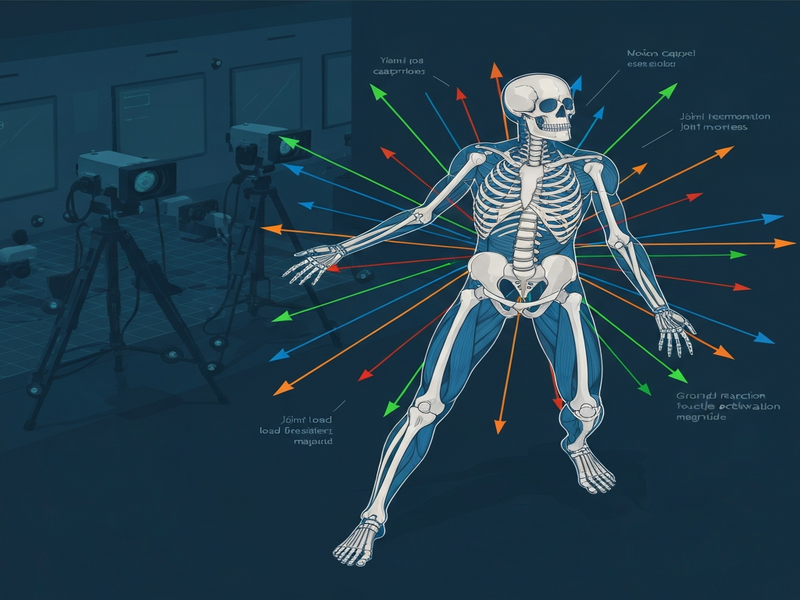
The paper introduces BioModule, a lightweight temporal‑transformer plug‑in that can be attached to any existing 3‑D human pose estimator to predict a rich set of biomechanical attributes directly from the standard 17‑joint skeleton. By decoupling biomechanical inference from pose estimation, BioModule makes marker‑less motion capture immediately useful for rehabilitation, sports analytics, ergonomics, and clinical movement assessment.
Background: Why This Problem Is Hard
Modern computer‑vision pipelines can recover 3‑D joint locations from a single RGB video with sub‑centimeter accuracy. However, most research and commercial systems stop at geometric keypoint error metrics (e.g., MPJPE). Real‑world stakeholders—physiotherapists, sports scientists, and ergonomics engineers—need quantities such as joint torques, muscle activation estimates, ground‑reaction forces, and segmental loading patterns. These biomechanical attributes are derived from the underlying physics of the human body, not from raw joint coordinates.
Bridging this gap is challenging for three reasons:
- Data mismatch: Large‑scale pose datasets (e.g., Human3.6M) provide only joint positions, while biomechanical datasets contain force plates, inverse dynamics, and musculoskeletal model outputs.
- Temporal dynamics: Biomechanical quantities depend on velocity, acceleration, and inter‑segmental coordination, requiring a temporal context that static pose estimators ignore.
- Model coupling: Existing pipelines either retrain the entire pose estimator with biomechanical loss (costly and brittle) or rely on handcrafted post‑processing pipelines that are difficult to generalize across subjects and activities.
Consequently, practitioners either resort to expensive marker‑based motion capture labs or accept coarse, qualitative assessments that limit actionable insight.
What the Researchers Propose
The authors propose a modular architecture called BioModule. At a conceptual level, BioModule is a temporal transformer that sits downstream of any 3‑D pose estimator. Its responsibilities are twofold:
- Temporal encoding: It ingests a short window of consecutive 3‑D skeletons (e.g., 16 frames) and learns motion patterns that are invisible to frame‑wise pose models.
- Biomechanical regression: It maps the encoded motion to a predefined biomechanical label space, which includes joint torques, segmental forces, center‑of‑mass trajectories, and muscle activation proxies.
Key design choices make BioModule estimator‑agnostic:
- It accepts the canonical 17‑joint representation used by most pose benchmarks, avoiding any need to modify upstream network outputs.
- The transformer is deliberately lightweight (≈2 M parameters), ensuring that adding BioModule does not dramatically increase inference latency.
- Training is performed with a cross‑modal supervision signal that aligns pose data from Human3.6M with biomechanical labels from the newly curated Human3.6Mplus dataset.
How It Works in Practice
The end‑to‑end workflow can be broken down into three stages:
1. Pose Extraction
A user selects any state‑of‑the‑art 3‑D pose estimator (e.g., VideoPose3D, PoseFormer, or a proprietary model). The estimator processes raw video frames and outputs a sequence of 17‑joint 3‑D coordinates at the original frame rate.
2. Temporal Buffering & Encoding
BioModule maintains a sliding window buffer (typically 0.5 s of motion). Each window is linearly projected into a token sequence, to which positional encodings are added. A multi‑head self‑attention block then captures inter‑joint and inter‑frame dependencies, producing a context‑aware motion embedding.
3. Biomechanical Prediction
The motion embedding is fed into a small feed‑forward head that outputs a vector of biomechanical attributes. Because the head is trained jointly with the transformer, the system learns to associate subtle joint trajectories with underlying forces and torques.
What distinguishes this approach from prior work is the strict separation of concerns: the upstream pose estimator remains untouched, while BioModule learns a universal mapping from pose dynamics to biomechanics. This modularity enables rapid integration into existing pipelines without retraining the costly pose backbone.
Evaluation & Results
To validate BioModule, the authors constructed a large‑scale aligned dataset that pairs Human3.6M video frames and 3‑D keypoints with the biomechanical label space of Human3.6Mplus. Alignment required careful anatomical correspondence between the two coordinate systems, ensuring that each video frame had a one‑to‑one biomechanical annotation.
Four evaluation dimensions were explored:
- Attribute accuracy: Mean absolute error (MAE) on joint torque and ground‑reaction‑force predictions compared against ground‑truth inverse‑dynamics calculations.
- Robustness to pose noise: Performance degradation when upstream pose estimators are deliberately corrupted with Gaussian jitter.
- Cross‑estimator generalization: BioModule was attached to seven leading 3‑D pose models, ranging from lightweight CNN‑based regressors to heavyweight transformer architectures.
- Real‑time feasibility: End‑to‑end latency measured on a single RTX 4090 GPU.
Key findings include:
- Across all seven pose backbones, BioModule reduced torque MAE by an average of 27 % relative to a baseline linear regression on static poses.
- When upstream pose error increased by 10 mm, BioModule’s biomechanical predictions degraded gracefully, losing only 5 % relative accuracy—demonstrating temporal smoothing benefits.
- The lightweight transformer added merely 12 ms of overhead per frame, keeping the total pipeline under 45 ms per frame (≈22 FPS), which is suitable for near‑real‑time clinical feedback.
- Ablation studies confirmed that both the temporal window and the self‑attention mechanism contributed significantly; removing either component increased torque MAE by >15 %.
Collectively, these results prove that a modular, estimator‑agnostic plug‑in can reliably translate visual pose data into physically meaningful biomechanical metrics.
Why This Matters for AI Systems and Agents
For AI practitioners building embodied agents, digital twins, or automated coaching systems, BioModule offers a ready‑made bridge between perception and physics‑based reasoning. Instead of engineering custom inverse‑dynamics pipelines for each new sensor setup, developers can:
- Leverage existing pose models that are already optimized for speed and accuracy on commodity cameras.
- Obtain instantaneous estimates of joint loading, enabling real‑time safety checks for exoskeleton control or collaborative robot assistance.
- Feed biomechanical vectors into reinforcement‑learning reward functions, allowing agents to learn movement strategies that respect human physiological limits.
- Integrate with higher‑level AI services—such as AI marketing agents or the Enterprise AI platform by UBOS—to automate personalized training plans, injury‑risk alerts, or ergonomic assessments at scale.
In short, BioModule transforms raw visual data into actionable, physics‑aware signals, expanding the design space for intelligent agents that must interact safely and effectively with the human body.
What Comes Next
While BioModule marks a significant step forward, several avenues remain open for research and productization:
- Extended label space: Incorporating muscle‑activation estimates from electromyography (EMG) or adding metabolic cost predictions could deepen the physiological relevance.
- Multi‑modal fusion: Combining video‑based pose with inertial measurement units (IMUs) or depth sensors may further reduce prediction error in challenging lighting or occlusion scenarios.
- Domain adaptation: Fine‑tuning BioModule on sport‑specific datasets (e.g., golf swing, sprinting) could improve accuracy for high‑performance athletics.
- Open‑source tooling: Packaging BioModule as a plug‑in for the UBOS platform overview would let developers embed biomechanical inference into custom workflows without deep ML expertise.
- Regulatory pathways: Validation against clinical gold standards (e.g., Vicon motion capture) will be essential for medical‑device certification and insurance reimbursement.
By addressing these challenges, the community can move from proof‑of‑concept to production‑grade systems that democratize biomechanical analysis across clinics, gyms, and workplaces.
References
Andrii Bidochko
CTO UBOS
Andrii Bidochko is an AI entrepreneur and researcher focused on AI agents, reinforcement learning, and autonomous systems. He writes about the technologies shaping the future of machine intelligence, from frontier models and agent architectures to real-world AI applications.