

- Updated: July 16, 2026
- 1 min read
ADORN: Adaptive Drift handling for Open RAN using Reinforcement Learning
ADORN: Adaptive Drift Handling for Open RAN using Reinforcement Learning
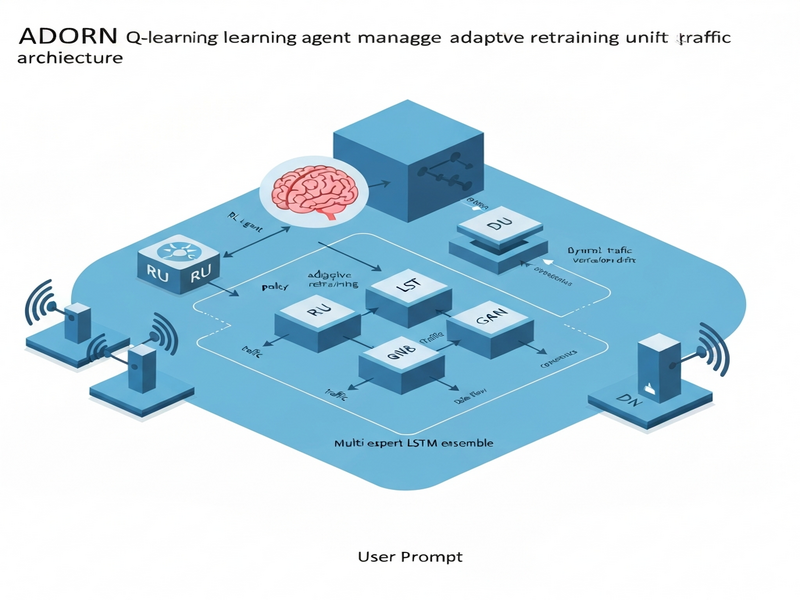
Dynamic traffic variations in Open Radio Access Networks (O‑RAN) introduce drift that degrades AI/ML model performance. The ADORN framework tackles this challenge with a Q‑learning‑based adaptive retraining strategy, a multi‑expert LSTM ensemble, and seamless O‑RAN integration. By formulating retraining decisions as a Markov Decision Process, ADORN balances forecasting accuracy against computational cost, ensuring Service Level Agreement (SLA) compliance while reducing unnecessary retraining overhead.
Key innovations include:
- Reinforcement Learning (RL) Agent: Learns optimal retraining policies via Q‑learning, adapting to real‑time traffic dynamics.
- Multi‑Expert LSTM Ensemble: Mitigates catastrophic forgetting and enhances robustness across diverse traffic patterns.
- O‑RAN Context Awareness: Directly leverages O‑RAN telemetry for informed decision‑making.
Experimental results demonstrate that ADORN significantly lowers retraining costs compared to greedy and random baselines while maintaining system performance within predefined limits.
For a visual overview of the ADORN architecture, see the illustration below:
Read more about the research and its implications on our Ubos Tech blog.
Andrii Bidochko
CTO UBOS
Andrii Bidochko is an AI entrepreneur and researcher focused on AI agents, reinforcement learning, and autonomous systems. He writes about the technologies shaping the future of machine intelligence, from frontier models and agent architectures to real-world AI applications.