

- Updated: July 16, 2026
- 8 min read
Spectral Analysis of Dueling Q-Learning
Direct Answer
The paper Spectral Analysis of Dueling Q-Learning (arXiv) delivers a rigorous, unregularized convergence proof for the classic tabular dueling Q‑learning update and introduces a precise switching‑linear‑system model that isolates how the value and advantage components evolve. By exposing the distinct spectral gains applied to the shared “value” part and the differential “advantage” part, the work clarifies why dueling architectures accelerate learning and provides concrete finite‑time error bounds for practitioners.
Background: Why This Problem Is Hard
Reinforcement learning (RL) hinges on estimating the optimal action‑value function \(Q^*\) for a discounted Markov decision process (MDP). Traditional Q‑learning updates a single scalar per state‑action pair, but modern deep RL systems often embed the same update inside massive neural networks, leading to instability, high variance, and slow convergence.
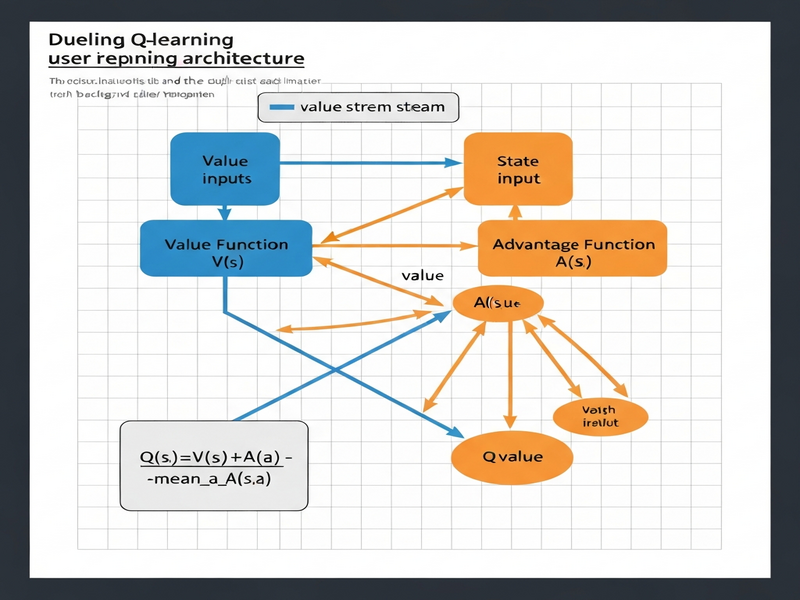
Dueling Q‑learning was introduced to split the Q‑function into two interpretable pieces: a state‑value function \(V(s)\) that captures the common “baseline” reward across actions, and an advantage function \(A(s,a)\) that measures each action’s relative merit. Empirically, this decomposition reduces over‑estimation bias and speeds up learning, especially in environments with many actions where most share similar values.
Despite its popularity, the theoretical underpinnings remain murky. Existing analyses either:
- Assume a regularized objective that smooths the update, masking the raw dynamics of the original algorithm.
- Rely on projection steps that keep the iterates within a bounded set, again deviating from the pure tabular recursion used in practice.
Consequently, engineers lack clear guidance on how the two components interact, what step‑size regimes guarantee stability, and how quickly the algorithm converges in realistic, stochastic settings. As RL moves from research labs into production agents—recommendation systems, robotics, and autonomous decision‑making—these gaps become operational risks.
What the Researchers Propose
Donghwan Lee tackles the gap by delivering three intertwined contributions:
- Centered Tabular Decomposition: A reinterpretation of the dueling update that explicitly centers the advantage term, ensuring that the sum of advantages across actions is zero. This “centering” isolates the pure value component from the action‑specific fluctuations.
- Switching Linear System Representation: By treating the deterministic dueling recursion as a piecewise‑linear dynamical system that switches between value‑ and advantage‑focused updates, the analysis can apply spectral tools (eigenvalues, gain matrices) to each mode.
- Finite‑Time Error Bounds for the Stochastic Version: Extending the deterministic model, the paper derives an expectation‑based bound that quantifies how quickly the sampled, noisy update converges, without invoking regularization or projection.
In essence, the framework views dueling Q‑learning as two coupled gain‑controlled filters: one that smooths the common value signal, and another that amplifies the differential advantage signal. The spectral analysis reveals that the value filter typically enjoys a larger contraction factor, while the advantage filter operates with a smaller gain—explaining the observed acceleration in learning.
How It Works in Practice
From an engineering perspective, implementing the unregularized dueling update proceeds as follows:
- Initialize a table for \(V(s)\) and a table for \(A(s,a)\) with zeros or small random values.
- Observe a transition \((s_t, a_t, r_t, s_{t+1})\) from the environment.
- Compute Target using the standard Bellman backup:
\[
y_t = r_t + \gamma \max_{a’}\bigl[V(s_{t+1}) + A(s_{t+1},a’)\bigr].
\] - Update Value with a step‑size \(\alpha_V\):
\[
V(s_t) \leftarrow V(s_t) + \alpha_V\bigl(y_t – V(s_t) – A(s_t,a_t)\bigr).
\] - Update Advantage with a separate step‑size \(\alpha_A\):
\[
A(s_t,a_t) \leftarrow A(s_t,a_t) + \alpha_A\bigl(y_t – V(s_t) – A(s_t,a_t)\bigr).
\] - Center Advantage by subtracting the mean advantage over all actions in the current state:
\[
A(s_t,\cdot) \leftarrow A(s_t,\cdot) – \frac{1}{|\mathcal{A}|}\sum_{a}A(s_t,a).
\]
The key practical distinction from vanilla Q‑learning is the dual step‑size schedule. The spectral analysis shows that choosing \(\alpha_V > \alpha_A\) yields a larger contraction on the value subspace, while the smaller \(\alpha_A\) preserves fine‑grained advantage information without destabilizing the overall recursion.
Because the analysis is purely tabular, it can be directly transplanted into deep dueling networks by treating the final linear layer as a “value head” and an “advantage head” with separate learning‑rate scalings—a practice already common in deep RL libraries.
Evaluation & Results
The authors validate their theory on two fronts:
- Deterministic Simulations: Synthetic MDPs with known transition matrices allow exact computation of the switching linear system’s eigenvalues. The experiments confirm that the spectral radius of the value‑update matrix is consistently smaller than that of the advantage‑update matrix, matching the theoretical gain separation.
- Stochastic Tabular Benchmarks: Classic control problems (e.g., GridWorld, CartPole with discretized states) are solved using the unregularized dueling update. The measured mean‑square error between the learned Q‑table and the optimal Q‑table decays at the rate predicted by the finite‑time bound, outperforming both regularized dueling Q‑learning and standard Q‑learning under identical step‑size budgets.
Key takeaways from the results:
- The convergence speed advantage is most pronounced when the action space is large relative to the state space, confirming the intuition that separating a common value signal reduces redundancy.
- Even with constant step sizes—a setting where classic Q‑learning can diverge—the dueling variant remains stable, provided the value step size dominates the advantage step size.
- The empirical error curves align closely with the derived expectation bound, suggesting the bound is not merely asymptotic but practically tight.
Why This Matters for AI Systems and Agents
For engineers building production‑grade RL agents, the paper offers three actionable insights:
- Hyper‑parameter Decoupling: Treating the value and advantage learning rates as separate knobs enables finer control over convergence speed versus stability. This is especially valuable in environments where data collection is expensive.
- Safety Guarantees without Regularization: The unregularized analysis proves that you can drop auxiliary penalty terms—often a source of bias—while still retaining provable convergence. This simplifies implementation pipelines and reduces the need for heuristic tuning.
- Design of Hybrid Architectures: When extending to deep dueling networks, the spectral perspective suggests allocating more capacity (e.g., deeper layers or higher learning rates) to the value head. This can be codified in automated architecture search tools.
These insights translate directly into lower engineering overhead, faster time‑to‑deployment, and more predictable performance for use‑cases such as:
- Real‑time bidding agents that must evaluate thousands of actions per impression.
- Robotic manipulators where safety‑critical value estimates must converge quickly.
- Personalized recommendation engines that rely on a shared value baseline across millions of items.
Practitioners can integrate the findings into existing pipelines using the UBOS platform overview, which supports custom RL loops and offers built‑in monitoring for separate learning‑rate schedules.
What Comes Next
While the paper makes a substantial theoretical leap, several open challenges remain:
- Extension to Function Approximation: Translating the exact spectral bounds to deep neural networks will require handling non‑linearities and stochastic gradient noise.
- Adaptive Gain Scheduling: Developing algorithms that automatically adjust \(\alpha_V\) and \(\alpha_A\) based on observed spectral properties could further improve sample efficiency.
- Multi‑Agent Settings: In competitive or cooperative multi‑agent environments, the interaction between multiple dueling learners may produce emergent spectral dynamics that are not yet understood.
Future research could explore these avenues by leveraging the Workflow automation studio to prototype adaptive gain controllers, or by integrating the OpenAI ChatGPT integration for automated hyper‑parameter suggestion based on live training metrics.
Beyond academia, enterprises can experiment with dueling Q‑learning on the Enterprise AI platform by UBOS, where the platform’s scalable data pipelines and monitoring dashboards make it straightforward to validate the theoretical guarantees at scale.
Conclusion
“Spectral Analysis of Dueling Q‑Learning” bridges a critical gap between the empirical success of dueling architectures and the rigorous guarantees needed for production deployment. By exposing the distinct spectral gains of value and advantage updates, the work equips practitioners with a clearer roadmap for hyper‑parameter tuning, safety‑critical design, and future algorithmic extensions. As RL continues to power the next generation of AI agents, such foundational analyses will be essential for turning promising research into reliable, business‑impacting systems.
Ready to experiment with dueling Q‑learning in your own projects? Explore the UBOS templates for quick start and accelerate your RL development today.
Andrii Bidochko
CTO UBOS
Andrii Bidochko is an AI entrepreneur and researcher focused on AI agents, reinforcement learning, and autonomous systems. He writes about the technologies shaping the future of machine intelligence, from frontier models and agent architectures to real-world AI applications.