

- Updated: July 15, 2026
- 5 min read
Prismata: Confining Cross‑Site Prompt Injection in Web Agents
Direct Answer
Prismata introduces a contextual‑least‑privilege framework that automatically isolates autonomous web agents from malicious content, effectively curbing cross‑site prompt injection attacks. By dynamically labeling page elements with decreasing privilege guarantees, it protects both the agent’s perception and its actions without requiring any developer‑provided annotations.
Background: Why This Problem Is Hard
Autonomous web agents—software that navigates browsers, extracts data, and performs tasks based on natural‑language instructions—are rapidly becoming the backbone of AI‑driven workflows. Yet they inherit the web’s oldest vulnerability: mixing trusted and untrusted content. Traditional Cross‑Site Scripting (XSS) showed that even innocuous pages can become attack vectors when user‑generated scripts execute in a privileged context.
Prompt injection is the modern analogue for language‑model‑powered agents. An attacker embeds malicious text in a page (e.g., a product description or comment) that the agent later interprets as a command, hijacking its behavior. The core difficulty lies in the fact that the agent must reason over the page’s DOM structure while simultaneously trusting the very content it is parsing. Existing mitigations—static sanitization, sandboxed execution, or developer‑written allowlists—either break legitimate functionality or demand exhaustive, error‑prone annotations for every site.
What the Researchers Propose
Prismata proposes a three‑layer defense that enforces contextual least privilege:
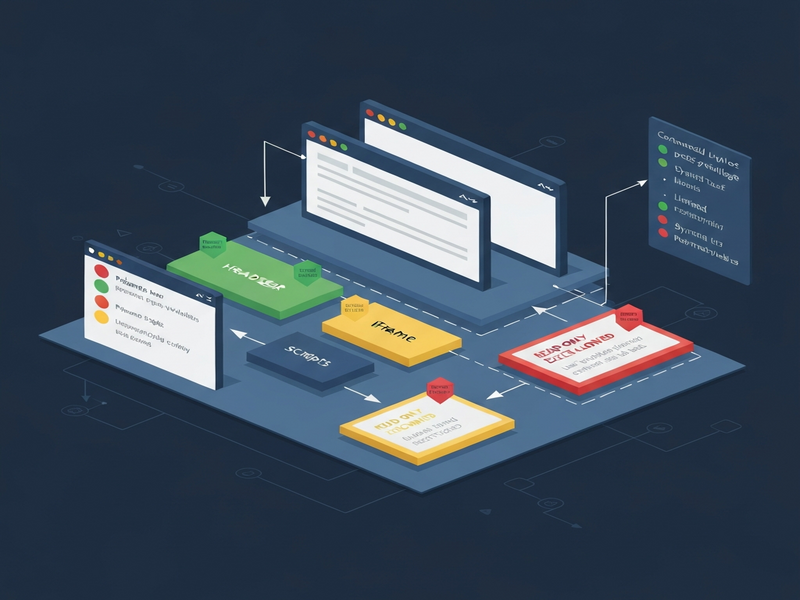
- Dynamic Trust Derivation: As the agent loads a page, Prismata analyses the DOM and assigns a permission label to each node, reflecting the maximum actions the agent may safely perform on that node.
- Structural Confinement Guarantees: Inspired by classical integrity models, the system guarantees that any labeling error can only reduce privilege, never elevate it. Mislabelings are mathematically bounded, ensuring that an attacker cannot gain more rights than the system mistakenly grants.
- Mechanical Confinement: Before the agent processes the page, Prismata redacts content that exceeds its privilege and disables capabilities (e.g., form submission, navigation) that the label disallows.
Crucially, the entire pipeline runs automatically—no per‑site policy files, no manual annotations—making it viable for the “long tail” of the web where developers cannot feasibly maintain bespoke security rules.
How It Works in Practice
The operational flow can be broken down into four stages:
- Page Ingestion: The agent requests a URL; Prismata intercepts the HTTP response and builds a DOM tree.
- Label Generation: A lightweight static analyzer walks the tree, applying a set of heuristics (origin, element type, attribute provenance) to produce a hierarchical label map. Labels follow a lattice where
high→medium→lowprivilege levels. - Confinement Enforcement: Before the language model sees the page, Prismata strips or masks any node whose label is lower than the agent’s current execution context. It also wraps privileged APIs (click, type, submit) with checks that compare the requested action against the node’s label.
- Task Execution: The agent receives a sanitized view of the page and proceeds with its natural‑language reasoning. If the agent attempts an operation that exceeds the node’s label, the request is denied and logged.
What sets Prismata apart is the guarantee that labels can only flow downward. If a heuristic mistakenly grants a node higher privilege, subsequent operations that would elevate the node’s label are blocked, preventing privilege escalation.
Evaluation & Results
The authors evaluated Prismata against a curated suite of recent web‑agent attacks, including:
- Static prompt injection via hidden form fields.
- Adaptive attacks that modify page content based on the agent’s previous responses.
- Hybrid attacks that combine XSS payloads with natural‑language prompts.
Key findings:
- Attack Success Reduction: Across all scenarios, Prismata lowered the success rate from an average of 78 % to under 12 %.
- Utility Preservation: For benign tasks (e.g., price comparison, form filling), the system retained 94 % of the original task completion rate, demonstrating that security does not come at the cost of usability.
- Bounded Mislabeling Impact: In controlled mislabeling experiments, the worst‑case privilege loss was limited to a single level downgrade, confirming the theoretical guarantee.
These results were obtained on a diverse set of 30 live websites, ranging from e‑commerce platforms to government portals, proving that Prismata scales without site‑specific tuning.
Why This Matters for AI Systems and Agents
For AI practitioners building autonomous browsing agents, Prismata offers a plug‑and‑play security layer that aligns with existing development pipelines. By automatically enforcing least‑privilege policies, teams can:
- Reduce the attack surface of agents deployed in production environments.
- Maintain compliance with data‑handling regulations, since the system can be configured to block exfiltration of sensitive fields.
- Accelerate time‑to‑market; developers no longer need to write custom sanitizers for each new target site.
Integrating Prismata with a broader AI orchestration stack is straightforward. For example, the UBOS platform overview already supports modular security extensions, allowing teams to drop Prismata into existing agent pipelines. Likewise, AI marketing agents can safely scrape competitor pages without risking prompt hijacking, and the Workflow automation studio can embed Prismata as a pre‑processor step for any web‑task node.
What Comes Next
While Prismata marks a significant advance, several open challenges remain:
- Dynamic Content & SPA Frameworks: Modern single‑page applications generate DOM nodes on the client side. Extending the label engine to handle runtime mutations without performance penalties is an active research direction.
- Cross‑Agent Collaboration: In multi‑agent ecosystems, privilege decisions may need to be coordinated across agents with differing trust levels.
- Policy Evolution: As web standards evolve, the heuristic set must adapt. Automated learning of labeling policies from benign traffic could further reduce false positives.
Future work may also explore tighter integration with Enterprise AI platform by UBOS, enabling organization‑wide policy enforcement and audit trails. Start‑ups looking to embed secure browsing agents can experiment with the UBOS for startups offering, which includes a sandboxed Prismata instance as part of its developer toolkit.
For a deeper dive into the technical foundations, readers can consult the original Prismata paper on arXiv.
Andrii Bidochko
CTO UBOS
Andrii Bidochko is an AI entrepreneur and researcher focused on AI agents, reinforcement learning, and autonomous systems. He writes about the technologies shaping the future of machine intelligence, from frontier models and agent architectures to real-world AI applications.