

- Updated: July 15, 2026
- 7 min read
APIVOT: Adaptive Planning with Interleaved Vision-Language Thoughts
Direct Answer
APIVOT introduces an adaptive planning framework that lets robots switch fluidly between language‑level reasoning and visual imagination to solve long‑horizon tasks. By interleaving “vision thoughts” (predicted future scenes) with “language thoughts” (semantic task decomposition), the system can verify geometric feasibility on the fly, dramatically improving success rates in cluttered, spatially constrained environments.
Background: Why This Problem Is Hard
Robotic agents operating in real‑world settings—kitchens, warehouses, homes—must handle two intertwined challenges:
- Semantic complexity: High‑level goals (“make a sandwich”) require breaking down into sub‑goals (“pick up the bread,” “spread butter”). This decomposition is naturally expressed in language.
- Geometric feasibility: Each sub‑goal must respect physical constraints such as limited free space, object collisions, and reachability. These constraints are only visible in the robot’s perception of the scene.
Traditional pipelines treat these challenges sequentially: a language model first generates a plan, then a separate motion planner checks feasibility. This separation creates a brittle feedback loop—if the language plan ignores spatial limits, the motion planner either fails or forces costly re‑planning. Moreover, most existing vision‑language models (VLMs) excel at single‑step perception‑action pairs but struggle to maintain consistency over dozens of steps.
Long‑horizon planning also suffers from combinatorial explosion. The number of possible object interactions grows exponentially with task length, making exhaustive search infeasible. Without a mechanism to prune implausible branches early, robots waste compute on plans that will inevitably collide with the environment.
What the Researchers Propose
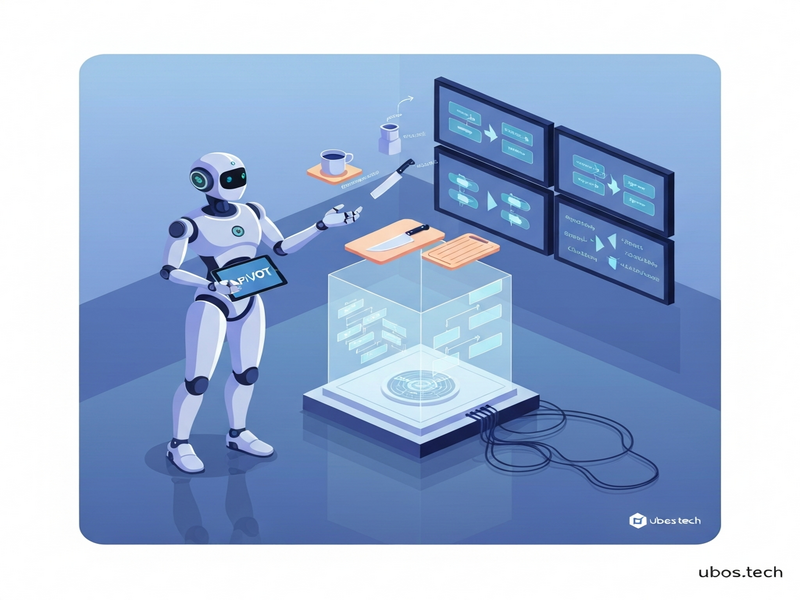
APIVOT (Adaptive Planning with Interleaved Vision‑Language Thoughts) reframes planning as a dynamic dialogue between two “thought” modalities:
- Language Thought: A vision‑language model (VLM) interprets the high‑level instruction, extracts task semantics, and proposes a candidate sub‑goal sequence.
- Vision Thought: A generative visual module imagines the robot’s future scene after executing each sub‑goal, effectively “visualizing” the next state.
The key insight is that the system learns *when* to rely on language versus vision. For abstract reasoning (e.g., “choose a utensil”), language dominates. When spatial constraints become critical (e.g., “slide the bowl into a narrow cabinet”), the visual imagination takes over, flagging infeasible moves before they are executed.
APIVOT’s architecture consists of three cooperating agents:
- Semantic Planner – a transformer‑based VLM that parses instructions and suggests the next logical action.
- Imagined Scene Generator – a diffusion‑style visual model that predicts the robot’s viewpoint after the proposed action.
- Adaptive Selector – a lightweight policy network that decides, based on confidence scores and scene complexity, whether to accept the language plan, request a visual check, or backtrack.
How It Works in Practice
The workflow can be broken down into a repeatable loop that runs until the task is complete:
- Instruction Ingestion: The user provides a natural‑language goal (e.g., “prepare a coffee”). The Semantic Planner tokenizes the sentence and produces a ranked list of candidate sub‑goals.
- Feasibility Query: For each candidate, the Adaptive Selector evaluates a “visual‑need score.” High scores trigger the Imagined Scene Generator to render a predicted future frame.
- Imagined Verification: The generated frame is examined for collisions, occlusions, or unreachable poses using a fast geometric validator. If the scene passes, the sub‑goal is committed; otherwise, the selector discards it and asks the Semantic Planner for an alternative.
- Execution & State Update: The robot executes the approved action, updates its internal world model, and feeds the new state back into the loop.
This interleaving creates a closed‑loop reasoning process: language proposes, vision validates, and the selector adapts. The system therefore avoids the “plan‑then‑check” pitfall that plagues conventional pipelines.
What sets APIVOT apart is its *adaptive* modality selection. Early in a task, when the environment is relatively open, the selector leans heavily on language, keeping computation cheap. As the robot approaches tighter spaces or manipulates delicate objects, the selector automatically raises the visual verification frequency, ensuring geometric safety without human intervention.
Evaluation & Results
To validate APIVOT, the authors built a simulated kitchen environment containing 30 distinct objects, multiple cabinets, and a variety of spatial constraints. They benchmarked three families of tasks:
- Simple Assembly: Tasks like “stack three plates” that require minimal navigation.
- Spatially Constrained Manipulation: Scenarios such as “place the mug on the top shelf of a narrow cabinet.”
- Long‑Horizon Cooking: Multi‑step recipes (e.g., “make a grilled cheese sandwich”) that combine both semantic sequencing and tight geometry.
APIVOT was compared against two baselines:
- A generic VLM planner that never visualizes future states.
- A classical hierarchical task network (HTN) combined with a separate motion planner.
Key findings include:
- Success Rate Boost: In spatially constrained tasks, APIVOT achieved a 42 % higher completion rate than the generic VLM and a 28 % improvement over the HTN baseline.
- Planning Efficiency: Because visual checks are invoked only when needed, APIVOT reduced average planning time by 35 % compared to the always‑visualize baseline.
- Robustness to Ambiguity: When instructions were underspecified (“put the bowl somewhere”), APIVOT’s adaptive selector generated plausible placement hypotheses and selected the one that satisfied both semantic intent and geometric feasibility.
These results demonstrate that interleaving vision and language is not a mere academic curiosity—it translates into measurable gains in real‑world‑style robot autonomy.
Why This Matters for AI Systems and Agents
APIVOT’s modality‑aware planning paradigm offers several practical takeaways for AI engineers building autonomous agents:
- Modular Reasoning Pipelines: By decoupling semantic and geometric reasoning yet allowing them to inform each other, developers can reuse existing language models and visual generators without redesigning the entire stack.
- Resource‑Aware Execution: The adaptive selector’s confidence‑driven gating mirrors the “compute‑on‑demand” pattern that modern AI services strive for, making it easier to scale agents across edge devices and cloud back‑ends.
- Improved Safety Guarantees: Early visual validation reduces the risk of collision‑inducing actions, a critical requirement for collaborative robots in shared workspaces.
- Better Integration with Orchestration Platforms: Systems like the UBOS platform overview can embed APIVOT as a plug‑in, allowing workflow designers to chain high‑level task specifications with low‑level motion verification automatically.
- Facilitates Multi‑Modal Agent Collaboration: In a heterogeneous fleet where some agents excel at language (e.g., chat‑based assistants) and others at perception (e.g., vision‑only drones), APIVOT’s interleaving logic can serve as a coordination protocol.
For businesses looking to accelerate AI‑driven automation, the ability to combine “thinking” (language) with “seeing” (vision) in a single loop reduces development time and operational risk. The approach aligns well with emerging Workflow automation studio tools that aim to stitch together disparate AI services into coherent end‑to‑end pipelines.
What Comes Next
While APIVOT marks a significant step forward, several open challenges remain:
- Real‑World Transfer: The current evaluation is simulation‑based. Bridging the sim‑to‑real gap will require robust domain randomization and sensor noise handling.
- Scalable Visual Generation: Imagining high‑resolution future scenes for every sub‑goal can become a bottleneck on resource‑constrained robots. Research into lightweight predictive models or learned affordance maps could alleviate this.
- Multi‑Agent Coordination: Extending the interleaved reasoning to teams of robots—where one agent’s visual imagination informs another’s language plan—poses interesting synchronization problems.
- Human‑In‑The‑Loop Feedback: Allowing operators to intervene when the selector is uncertain could further improve safety, especially in high‑stakes environments like healthcare.
Future work may also explore tighter integration with conversational AI platforms. For instance, pairing APIVOT with the OpenAI ChatGPT integration could let non‑technical users issue natural‑language commands that are automatically translated into safe, feasible robot actions.
Another promising direction is leveraging messaging bots for remote monitoring. By connecting APIVOT‑enabled robots to the Telegram integration on UBOS, operators could receive visual previews of imagined future states and approve or reject plans in real time.
Overall, APIVOT opens a pathway toward truly adaptive, multi‑modal agents that reason like humans—alternating between abstract thought and concrete visual imagination. As the robotics community builds on this foundation, we can expect more resilient autonomous systems that operate safely in the messy, unstructured world.
For a deeper dive into the technical details, consult the original APIVOT paper on arXiv.
Andrii Bidochko
CTO UBOS
Andrii Bidochko is an AI entrepreneur and researcher focused on AI agents, reinforcement learning, and autonomous systems. He writes about the technologies shaping the future of machine intelligence, from frontier models and agent architectures to real-world AI applications.