

- Updated: July 14, 2026
- 7 min read
When Implausible Tokens Get Reinforced: Tail-Aware Credit Calibration for LLM Reinforcement Learning
Direct Answer
The paper introduces Tail‑Aware Credit Calibration (TACO), a reinforcement‑learning (RL) technique that tempers the uniform credit assignment used by most critic‑free LLM trainers. By detecting tokens that sit in the low‑probability “tail” of a model’s distribution and scaling down the positive advantage they receive, TACO prevents implausible words from being reinforced while still allowing genuinely rare but useful patterns to thrive.
Background: Why This Problem Is Hard
Large language models (LLMs) have become the backbone of modern AI agents, from customer‑service chatbots to autonomous research assistants. To push these models beyond static next‑token prediction, practitioners often fine‑tune them with reinforcement learning from human feedback (RLHF) or other reward‑driven schemes. The most common approach—critic‑free RL such as REINFORCE‑based Proximal Policy Optimization (PPO) variants—assigns the same advantage value to every token in a generated trajectory. This “uniform credit” assumption simplifies gradient computation but hides a critical flaw.
In practice, LLMs generate a mixture of high‑probability, context‑appropriate tokens and low‑probability outliers that may be nonsensical, factually wrong, or even harmful. When the training loop treats all tokens equally, the rare outliers inherit the same positive reinforcement as the well‑behaved tokens. The phenomenon, which the authors label Positive‑Credit Contamination, leads to a feedback loop where implausible language is unintentionally encouraged, degrading reasoning quality and stability over long‑horizon tasks.
Existing mitigations—such as clipping gradients, applying entropy bonuses, or manually filtering low‑probability tokens—either bluntly discard useful rare patterns or require hand‑crafted heuristics that do not scale across domains. Consequently, developers of AI agents face a trade‑off between encouraging creative, low‑frequency language (e.g., novel code snippets) and suppressing harmful noise. This tension is especially acute in enterprise settings where consistency, factuality, and safety are non‑negotiable.
What the Researchers Propose
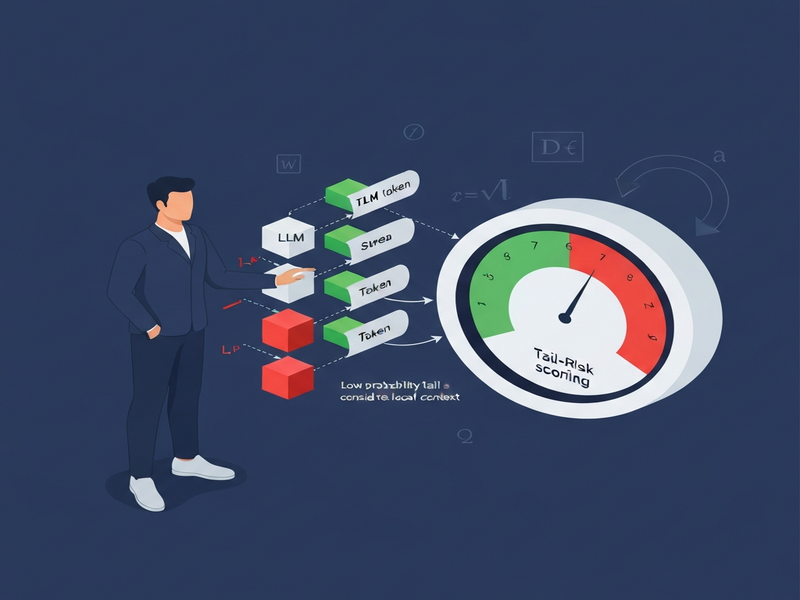
TACO reframes credit assignment as a risk‑aware calibration problem. Instead of broadcasting a single advantage to every token, the method first computes a tail‑risk score for each token based on two signals:
- Local probability: How unlikely the token is under the current model given its immediate context.
- Contextual surprise: Whether the token’s rarity stems from genuine uncertainty (e.g., a legitimate but uncommon phrase) or from a mismatch with the surrounding discourse.
These signals are fused into a scalar that reflects the token’s propensity to belong to the “unreliable tail.” TACO then uses this score to modulate the positive part of the advantage: high‑risk tokens receive a reduced positive boost, while low‑risk tokens keep the full advantage. Importantly, the method does not zero‑out gradients for tail tokens; it merely attenuates them, preserving the capacity for rare but valuable patterns to accumulate reinforcement over time.
The framework consists of three logical components:
- Risk Estimator: A lightweight module that ingests the token’s log‑probability and a contextual embedding to output the tail‑risk score.
- Credit Calibrator: A function that rescales the advantage based on the risk score, applying a smooth decay rather than a hard cutoff.
- RL Optimizer: The underlying policy‑gradient engine (e.g., PPO) that consumes the calibrated advantages to update the LLM.
How It Works in Practice
The TACO workflow can be visualized as a loop that runs during each RL training step:
- Generate a trajectory: The LLM produces a sequence of tokens conditioned on a prompt and any intermediate observations.
- Score each token: For every token, the Risk Estimator calculates a tail‑risk score using the token’s probability and a short‑range context window (e.g., the previous 5‑10 tokens).
- Compute raw advantage: The standard RL pipeline evaluates the reward signal (e.g., human preference model) and derives the advantage for each timestep.
- Calibrate credit: The Credit Calibrator multiplies the positive portion of the advantage by a factor f(risk) that smoothly declines as risk rises (e.g., a sigmoid or exponential decay).
- Update the policy: The RL Optimizer consumes the calibrated advantages to perform a gradient step, updating the LLM’s weights.
What distinguishes TACO from prior “filter‑and‑train” tricks is its granularity: the calibration happens at the token level, preserving the temporal structure of the trajectory. Moreover, because the risk score is derived from the model’s own confidence, the system adapts as the model improves—tokens that were once risky become less penalized, enabling a natural curriculum.
Evaluation & Results
The authors validated TACO on three distinct LLM families (a 7B, a 13B, and a 34B parameter model) across eight benchmark suites that stress reasoning, factuality, and long‑horizon planning. The key evaluation dimensions were:
- Reasoning accuracy on datasets such as GSM‑8K and MATH.
- Factual consistency measured by TruthfulQA and a custom fact‑verification suite.
- Stability over long horizons using multi‑turn dialogue and code‑generation tasks that require >50 steps.
Across the board, TACO outperformed the baseline GRPO‑style uniform credit assignment. Notable observations include:
- Average reasoning scores improved by 3–5 percentage points, with the largest gains on the 34B model where tail tokens are more prevalent.
- Factual error rates dropped by roughly 12 % relative to the baseline, indicating that implausible hallucinations were less likely to be reinforced.
- Training curves exhibited smoother convergence, and variance in reward signals decreased, confirming the authors’ claim of enhanced stability for long‑horizon RL.
Importantly, the experiments also demonstrated that TACO does not suppress genuinely rare but correct tokens. In a controlled “rare‑pattern” test, the method allowed low‑probability code snippets that solved a novel algorithmic problem to receive full credit after repeated successful trials.
Why This Matters for AI Systems and Agents
For practitioners building production‑grade AI agents, TACO offers a pragmatic lever to improve safety and reliability without sacrificing the creative edge of large language models. By curbing Positive‑Credit Contamination, developers can expect:
- Higher factual fidelity in customer‑facing chatbots, reducing the risk of misinformation.
- More stable fine‑tuning pipelines, meaning fewer costly re‑training cycles and smoother rollout of updates.
- Better long‑term planning for autonomous agents that must reason over many steps, such as workflow orchestrators or digital assistants.
These benefits translate directly into business value. For example, an enterprise deploying an Enterprise AI platform by UBOS can integrate TACO‑enhanced models to lower support ticket volume caused by hallucinated answers. Similarly, teams using the Workflow automation studio can trust that the underlying LLM will not amplify spurious token patterns when generating multi‑step automation scripts.
Beyond safety, TACO’s risk‑aware calibration aligns with emerging regulatory expectations around AI transparency and controllability. By providing a quantifiable “tail‑risk” metric, the method offers an audit trail that can be reported to compliance officers or used to trigger human‑in‑the‑loop interventions when risk exceeds a threshold.
What Comes Next
While TACO marks a significant step forward, several open challenges remain:
- Risk estimator generalization: The current design relies on short‑range context. Extending the estimator to capture longer‑range dependencies could further refine credit calibration for complex narratives.
- Multi‑modal extensions: Applying tail‑aware calibration to vision‑language or audio‑text models may require new risk signals (e.g., visual saliency).
- Integration with human feedback loops: Combining TACO with preference‑based reward models could yield a hybrid system that balances statistical risk with explicit human judgments.
Future research may also explore adaptive risk thresholds that evolve with the model’s competence, or meta‑learning approaches that let the model learn how to calibrate its own credit. From an application standpoint, developers could embed TACO into existing pipelines via the OpenAI ChatGPT integration or the ChatGPT and Telegram integration, enabling safer conversational agents on popular messaging platforms.
In the longer term, a robust tail‑aware credit system could become a standard component of any RL‑based LLM service, much like tokenizers and safety filters are today. As enterprises continue to scale AI‑driven products, the ability to fine‑tune models without inadvertently amplifying implausible outputs will be a decisive competitive advantage.
For readers who want to dive deeper, the full arXiv paper provides detailed algorithmic descriptions, ablation studies, and code links.
Andrii Bidochko
CTO UBOS
Andrii Bidochko is an AI entrepreneur and researcher focused on AI agents, reinforcement learning, and autonomous systems. He writes about the technologies shaping the future of machine intelligence, from frontier models and agent architectures to real-world AI applications.