

- Updated: July 13, 2026
- 7 min read
Architecture Generalization with MetaNCA
Direct Answer
MetaNCA introduces a meta‑learning framework that learns local update rules capable of self‑organizing the weights of arbitrary neural networks, eliminating the need for back‑propagation at inference time. By treating weight tensors as cells in a neural cellular automaton, the system can generate functional MLPs, CNNs, and ResNets on‑the‑fly, offering a new pathway to architecture‑agnostic model creation.
Background: Why This Problem Is Hard
Modern deep learning pipelines rely on two tightly coupled stages: architecture design and weight optimization. Designing an architecture that balances capacity, efficiency, and task‑specific inductive bias is already a combinatorial challenge, often addressed through costly trial‑and‑error or automated neural architecture search (NAS). Once an architecture is fixed, stochastic gradient descent (SGD) or its variants must be run for many epochs to converge to a useful set of parameters. This two‑step process suffers from several practical bottlenecks:
- Compute intensity: Training large models on high‑resolution data can consume thousands of GPU‑hours, limiting rapid experimentation.
- Rigidity of weight updates: Gradient‑based updates require global information (loss gradients) and cannot be performed locally on individual weights without full forward‑backward passes.
- Poor adaptability: Once deployed, a model’s weights are static; adapting to distribution shift or new tasks typically demands fine‑tuning, which again incurs gradient computation.
- Scalability of NAS: Searching over architectures and training each candidate from scratch is prohibitive for industry‑scale problems.
Biological neural tissue sidesteps many of these constraints. Neurons adjust synaptic strengths through local chemical signals, enabling lifelong learning without a centralized error signal. Neural Cellular Automata (NCA) have demonstrated that local, homogeneous rules can generate complex, stable patterns—suggesting a possible route to weight self‑organization. However, prior NCA work has been limited to image generation or simple morphogenesis tasks, lacking the ability to produce functional, high‑performing neural network weights for diverse architectures.
What the Researchers Propose
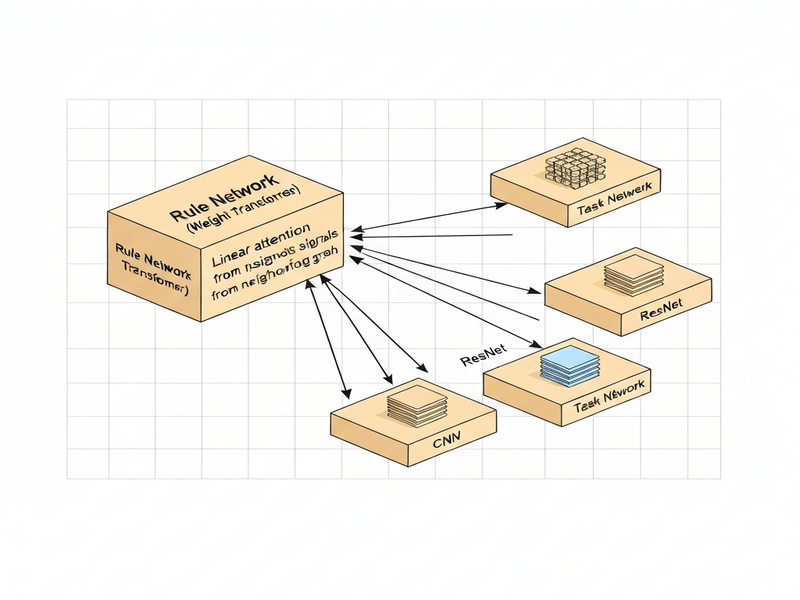
The authors present Meta Neural Cellular Automata (MetaNCA), a meta‑learning system that discovers a set of local transformation rules capable of iteratively updating the parameters of any target network. The framework consists of two cooperating agents:
- Task Network: The neural model whose architecture (e.g., MLP, CNN, ResNet) is defined by the user. Its weights are treated as a grid of cells that can exchange information with immediate neighbors.
- Rule Network (Weight Transformer): A lightweight neural module that reads a weight cell together with the hidden states of its neighboring cells, applies a learned linear‑attention operation, and emits an updated weight value. This rule network is trained once, across many tasks, to become a universal weight‑update engine.
During meta‑training, the rule network observes many pairs of (initial random weights, target performance) across a spectrum of architectures. It learns to “grow” high‑quality weights from random seeds solely through local interactions, mirroring how cellular automata evolve patterns over time. Once training completes, the rule network can be frozen and deployed to generate weights for unseen architectures without any gradient‑based optimization.
How It Works in Practice
The MetaNCA workflow can be broken down into three conceptual stages:
- Initialization: A task network is instantiated with a random weight tensor. Each weight element is considered a cell that holds both its scalar value and an associated hidden state vector.
- Local Update Loop: For a fixed number of iterations (often a few hundred), every cell queries the rule network. The rule network aggregates information from the cell’s immediate neighbors using a linear‑attention mechanism—essentially a weighted sum where attention scores are computed via simple dot products, keeping computation linear in the number of neighbors.
- Convergence: After the iterative process, the weight tensor stabilizes into a configuration that yields high accuracy on the downstream task. No back‑propagation is performed; the entire evolution is driven by the learned local rule.
The key differentiator is the Weight Transformer architecture inside the rule network. Unlike conventional transformers that attend over entire sequences, the Weight Transformer restricts attention to a cell’s spatially adjacent weights, preserving locality and dramatically reducing memory overhead. This design mirrors the physical constraints of biological synapses while still leveraging the expressive power of attention.
Because the rule network operates on the computation graph rather than raw data, it can be applied to any architecture whose weight tensors can be expressed as a graph of neighboring cells. This includes fully‑connected layers (where neighbors are defined along the matrix dimensions), convolutional kernels (neighbors are adjacent filter elements), and even residual connections (treated as additional adjacency edges).
Evaluation & Results
The authors validated MetaNCA on two benchmark image classification suites: MNIST (handwritten digits) and CIFAR‑100 (100‑class natural images). They trained the rule network on a diverse pool of architectures, ranging from shallow MLPs to deep ResNets with up to 2 million parameters. Evaluation focused on three axes:
- Performance parity: Generated weights achieved test accuracies within 1–2 % of models trained with conventional SGD, demonstrating that locally‑driven self‑organization can match gradient‑based optimization for standard vision tasks.
- Scalability: The system successfully produced functional weights for networks exceeding 2 M parameters, confirming that the linear‑attention mechanism scales without exploding memory or compute costs.
- Generalization to unseen architectures: When presented with novel topologies not encountered during meta‑training (e.g., a depth‑wise separable CNN), MetaNCA still converged to competitive performance, highlighting the rule network’s ability to extrapolate beyond its training distribution.
Crucially, the experiments showed that increasing architectural diversity during meta‑training—by exposing the rule network to a broader set of weight graphs—strengthened its generalization capability. This suggests a curriculum‑style approach where the rule network learns a more universal set of local dynamics.
Why This Matters for AI Systems and Agents
MetaNCA’s ability to synthesize high‑quality weights without back‑propagation opens several practical avenues for AI practitioners:
- Rapid prototyping: Engineers can spin up new model variants on the fly, bypassing the time‑consuming training loop. This accelerates experimentation cycles in research labs and product teams.
- Edge deployment: Devices with limited compute (e.g., IoT sensors) can receive a compact rule network and generate task‑specific weights locally, reducing the need to ship large pre‑trained checkpoints.
- Continual adaptation: Agents operating in non‑stationary environments can continuously re‑organize their weights in response to local signals, akin to biological plasticity, without incurring the overhead of gradient computation.
- Meta‑learning pipelines: MetaNCA can serve as a plug‑in component in broader meta‑learning frameworks, providing a weight‑initialization primitive that is architecture‑agnostic.
For organizations building AI‑driven workflows, integrating MetaNCA‑style self‑organization could simplify model management. For example, the UBOS platform overview already supports modular AI pipelines; a MetaNCA rule network could be added as a “weight generator” node, enabling dynamic model reconfiguration without redeploying containers.
Similarly, teams developing AI marketing agents could leverage MetaNCA to tailor agent policies to specific campaign constraints on the fly, improving personalization while keeping compute budgets low.
What Comes Next
While MetaNCA demonstrates impressive flexibility, several open challenges remain:
- Task diversity: Current experiments focus on image classification. Extending the framework to sequence modeling, reinforcement learning, or multimodal tasks will test the limits of local rule expressiveness.
- Stability guarantees: Cellular automata can exhibit chaotic dynamics. Formalizing convergence criteria for weight evolution would increase reliability for safety‑critical applications.
- Hardware acceleration: Implementing the linear‑attention updates on specialized accelerators (e.g., GPUs, TPUs, or edge ASICs) could further reduce latency, making on‑device generation practical.
- Hybrid training regimes: Combining a few gradient steps with MetaNCA updates might yield even higher performance, especially for tasks where fine‑grained loss information is essential.
Future research could also explore “meta‑meta” learning—training multiple rule networks that specialize in different domains and automatically select the best one based on a lightweight meta‑classifier. This would push the boundary toward truly universal weight generators.
From a product perspective, the Enterprise AI platform by UBOS could integrate a MetaNCA service layer, offering enterprises a managed API for on‑demand model generation. Such a service would align with the growing demand for AI solutions that adapt in real time to shifting business requirements.
References
MetaNCA paper (arXiv:2607.07743)
Andrii Bidochko
CTO UBOS
Andrii Bidochko is an AI entrepreneur and researcher focused on AI agents, reinforcement learning, and autonomous systems. He writes about the technologies shaping the future of machine intelligence, from frontier models and agent architectures to real-world AI applications.