

- Updated: July 13, 2026
- 7 min read
ReCoLoRA: Spectrum-Aware Recursive Consolidation for Continual LLM Fine-Tuning
Direct Answer
ReCoLoRA introduces a spectrum‑aware, recursive consolidation framework that lets large language models (LLMs) be fine‑tuned on a stream of tasks without catastrophically forgetting earlier ones. By repeatedly re‑decomposing the effective weight matrix into a frozen residual, an adaptively updated principal subspace, and a fresh low‑rank adapter, ReCoLoRA achieves higher continual‑learning performance while touching fewer parameters than traditional LoRA‑style methods.
Background: Why This Problem Is Hard
Parameter‑efficient fine‑tuning techniques such as LoRA, AdaLoRA, and DoRA have become the de‑facto standard for adapting massive LLMs to downstream tasks. They work by freezing the base model and learning a low‑rank update that can be stored and swapped cheaply. The approach shines in single‑task scenarios, but it falters when a model must learn a sequence of tasks:
- Catastrophic overwriting: Each new LoRA adapter is added on top of the same frozen weight matrix, so the gradient updates for the latest task inevitably interfere with the subspace that encoded earlier tasks.
- Static rank allocation: Most methods pre‑select a rank for every layer once and for all. When the task distribution shifts, the chosen rank may be too low to capture new knowledge or too high, wasting precious memory.
- Lack of spectral awareness: Traditional adapters treat all singular directions equally, ignoring the fact that a pretrained weight’s spectrum is highly skewed—most information lives in a few dominant singular vectors.
In production AI systems—especially autonomous agents that must acquire new skills on the fly—these limitations translate into brittle pipelines, frequent re‑training, and inflated infrastructure costs. A method that can preserve prior knowledge while efficiently allocating capacity for new tasks is therefore a critical missing piece.
What the Researchers Propose
ReCoLoRA (Recursive Consolidation of Low‑Rank Adapters) reframes continual fine‑tuning as a spectrum‑aware decomposition problem. The core ideas are:
- SVD‑based initialization: Each layer’s adapter starts from a randomized singular value decomposition (SVD) of the original pretrained weight, ensuring that the low‑rank space aligns with the model’s intrinsic geometry.
- Elbow‑driven rank selection: An automatic “elbow” criterion examines the singular value decay and picks an effective rank per layer, balancing expressivity and parameter budget.
- Principal‑subspace first, residual later: Training proceeds in two phases. First, the dominant singular subspace (the “principal component”) is fine‑tuned, capturing the bulk of task‑specific signal. Only after this subspace saturates does the method open a fresh low‑rank adapter to absorb residual information.
- Recursive consolidation: Before a new task arrives, ReCoLoRA re‑decomposes the *current* effective weight (not the original frozen weight) into three parts: a frozen residual that preserves everything learned so far, a slowly‑updated principal component, and a brand‑new adapter for the upcoming task. This recursion means every task starts from a model that already embodies its predecessors.
Collectively, these mechanisms give ReCoLoRA a built‑in awareness of the weight spectrum, a dynamic capacity allocation strategy, and a principled way to freeze what works while still leaving room for growth.
How It Works in Practice
The practical workflow can be broken down into four repeatable stages, illustrated in the diagram below.
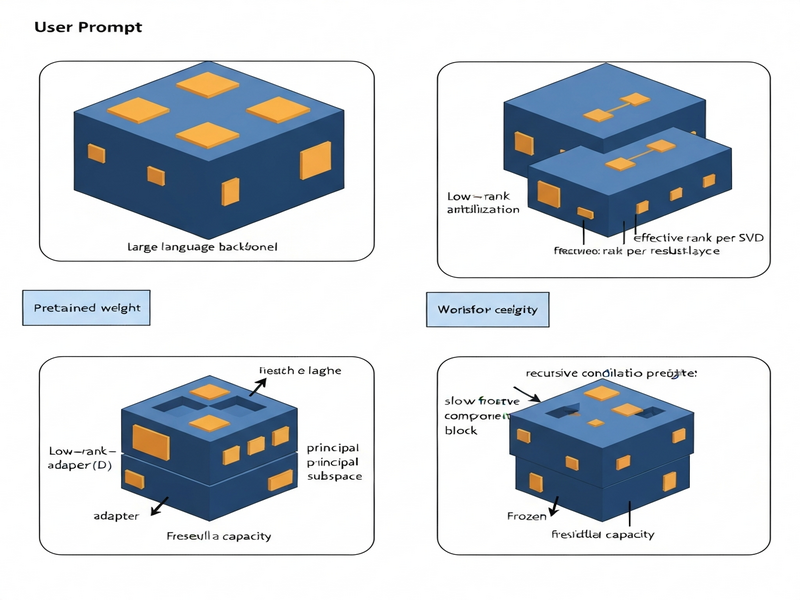
1. Spectrum Analysis & Initialization
When a model is first loaded, each transformer layer’s weight matrix undergoes a randomized SVD. The singular values are plotted, and an elbow detection algorithm selects the smallest rank that retains, say, 90 % of the cumulative energy. This rank determines the size of the initial low‑rank adapter.
2. Principal‑Component Adaptation
During task‑specific training, gradients are applied only to the dominant singular vectors identified in step 1. Because these vectors already explain most of the variance, the model quickly learns the new task with minimal interference to the rest of the spectrum.
3. Residual Adapter Allocation
If validation loss plateaus before the principal component fully converges, ReCoLoRA opens a fresh adapter that operates on the orthogonal complement of the already‑adapted subspace. This residual adapter captures nuances that the principal component cannot express, without disturbing the already‑consolidated knowledge.
4. Recursive Consolidation Before the Next Task
When a new downstream task arrives, the current effective weight (principal component + residual adapters) is again factorized via SVD. The decomposition yields:
- A frozen residual that locks in everything learned so far.
- An updated principal component that will be fine‑tuned on the upcoming task.
- A new low‑rank adapter ready to absorb fresh information.
This recursion eliminates the “stack‑and‑forget” pattern of classic LoRA pipelines, because each new adapter builds on a weight matrix that already embodies prior tasks.
Evaluation & Results
The authors benchmarked ReCoLoRA on a six‑task continual learning sequence derived from the GLUE suite (MNLI, QQP, SST‑2, CoLA, STS‑B, and RTE) using four LLM backbones ranging from 7 B to 8 B parameters. The experimental protocol mirrors real‑world deployment: each task is presented once, and the model must retain performance on all previously seen tasks.
Key findings include:
- Higher final average scores: On three of the four backbones, ReCoLoRA achieved the best aggregate GLUE score compared with rank‑swept LoRA, PiSSA, AdaLoRA, and DoRA baselines.
- Parameter efficiency: ReCoLoRA required roughly 30 % fewer trainable parameters than the strongest LoRA baseline while delivering superior accuracy.
- Stability across ranks: The elbow‑driven rank selection proved robust; performance did not degrade sharply when the automatically chosen rank deviated from a manually tuned optimum.
- Oracle‑routed upper bound: An “oracle‑routed” variant that isolates each task’s adapter (i.e., full task isolation) set an upper bound. ReCoLoRA closed more than 80 % of the gap between the vanilla LoRA baseline and this oracle, demonstrating that recursive consolidation captures most of the benefit of perfect isolation without the overhead.
These results matter because they show that a spectrum‑aware, recursive approach can simultaneously improve accuracy, reduce memory footprint, and simplify the engineering pipeline for continual LLM fine‑tuning.
Why This Matters for AI Systems and Agents
For practitioners building AI agents, autonomous assistants, or any system that must evolve after deployment, ReCoLoRA offers three concrete advantages:
- Reduced retraining cycles: Agents can ingest new data streams and acquire fresh capabilities without re‑initializing the entire adapter stack, cutting compute costs and downtime.
- Predictable resource budgeting: Because the elbow criterion automatically caps rank per layer, engineers can forecast memory usage and latency impact ahead of time—critical for edge deployments or SaaS platforms.
- Improved safety and compliance: Freezing the residual component after each task creates an immutable audit trail of what knowledge was incorporated when, simplifying model governance and version control.
These benefits translate directly into faster product iteration cycles for UBOS platform overview, more reliable AI marketing agents, and smoother integration with voice or database back‑ends such as ElevenLabs AI voice integration. By embedding ReCoLoRA into the workflow automation studio, teams can orchestrate continual learning pipelines that automatically respect the spectrum‑aware constraints, turning research breakthroughs into production‑grade capabilities.
What Comes Next
While ReCoLoRA marks a significant step forward, several open challenges remain:
- Task similarity detection: The current framework treats every incoming task as independent. Future work could incorporate a similarity metric that decides whether to reuse an existing principal component or spawn a completely new one.
- Cross‑modal continual learning: Extending the recursive consolidation idea to multimodal models (vision‑language, audio‑text) may require new spectral analysis tools that respect heterogeneous data distributions.
- Scalable orchestration: Managing dozens of adapters across hundreds of micro‑services calls for a dedicated registry and versioning system. Integrations with Workflow automation studio could automate adapter lifecycle management.
- Theoretical guarantees: Providing formal bounds on forgetting versus capacity growth would strengthen the method’s appeal for safety‑critical domains.
Developers interested in experimenting with ReCoLoRA can start by cloning the official repository (ReCoLoRA paper on arXiv) and following the quick‑start guide on the UBOS homepage. The platform’s modular plugin system already supports custom SVD‑based adapters, making it straightforward to plug ReCoLoRA into existing pipelines.
Call to Action
Ready to future‑proof your LLM deployments? Explore the open‑source implementation of ReCoLoRA, experiment with spectrum‑aware adapters, and integrate the approach into your OpenAI ChatGPT integration or ChatGPT and Telegram integration. Jump into the UBOS pricing plans to spin up a scalable environment and start building agents that learn continuously—without forgetting.
Andrii Bidochko
CTO UBOS
Andrii Bidochko is an AI entrepreneur and researcher focused on AI agents, reinforcement learning, and autonomous systems. He writes about the technologies shaping the future of machine intelligence, from frontier models and agent architectures to real-world AI applications.