

- Updated: July 13, 2026
- 7 min read
Towards Precision Therapy in Hepatocellular Carcinoma: A Clinical-Reasoning LLM for Risk Stratification and Treatment Guidance
Direct Answer
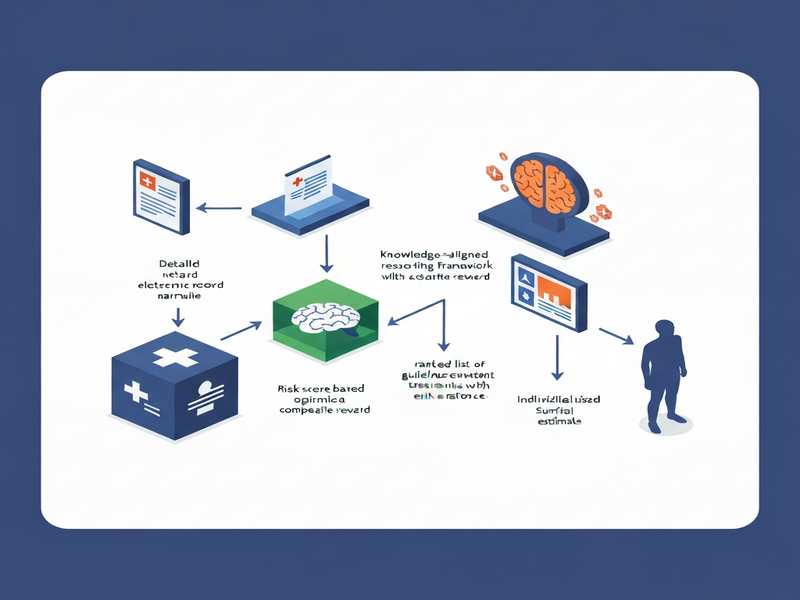
The paper introduces HCC-STAR (Hepatocellular Carcinoma Staging, Treatment And pRognosis), a clinically aligned large language model that reads free‑text electronic medical records, produces risk‑score based staging, ranks guideline‑consistent treatment options with evidence‑backed rationales, and predicts individualized survival curves. It matters because it bridges the gap between static oncology guidelines and the nuanced, patient‑specific information embedded in real‑world EMRs, delivering precision therapy recommendations that outperform existing decision‑support tools.
Background: Why This Problem Is Hard
Hepatocellular carcinoma (HCC) is the most common primary liver cancer and a leading cause of cancer mortality worldwide. Clinicians rely on staging systems such as BCLC (Barcelona Clinic Liver Cancer) or CNLC (China Liver Cancer) to stratify patients and select therapies. While these frameworks provide a useful high‑level taxonomy, they suffer from three critical shortcomings:
- Within‑stage heterogeneity: Patients classified under the same stage can have vastly different tumor burdens, liver function, comorbidities, and genetic profiles, leading to divergent outcomes.
- Fragmented clinical context: EMRs contain narrative notes, imaging reports, lab trends, and physician observations that are rarely captured by structured fields used in guidelines.
- Static guideline updates: Oncology guidelines evolve slowly, whereas new trial data, off‑label uses, and regional drug availability change rapidly.
Existing AI attempts in oncology either fine‑tune generic language models on biomedical literature or build rule‑based expert systems that map structured inputs to guideline pathways. Neither approach can simultaneously interpret unstructured narratives, reason about risk, and generate transparent, evidence‑based treatment rankings. Consequently, clinicians still face a cognitive overload when trying to reconcile guideline recommendations with the full richness of a patient’s record.
What the Researchers Propose
HCC-STAR is a purpose‑built large language model that aligns its reasoning process with clinical oncology practice. The framework consists of three tightly coupled agents:
- EMR Narrative Interpreter: A LLM fine‑tuned to extract salient clinical facts (tumor size, vascular invasion, liver function scores, performance status) from free‑text notes.
- Risk‑Score Generator: A probabilistic module that converts extracted facts into a continuous risk score, which is then mapped onto a refined staging continuum rather than discrete buckets.
- Treatment Reasoner: A knowledge‑aligned reasoning engine that queries up‑to‑date guideline databases, clinical trial registries, and drug‑approval status to produce a ranked list of therapeutic options, each accompanied by a concise, citation‑backed justification.
The key innovation is a step‑verifiable composite reward used during training. Instead of rewarding the model only for matching a final answer, the reward function evaluates intermediate reasoning steps—fact extraction accuracy, risk‑score calibration, and citation relevance—thereby encouraging transparent, verifiable outputs.
How It Works in Practice
The end‑to‑end workflow can be visualized as a four‑stage pipeline:
1. Data Ingestion
Patient records from 12 Chinese hospitals are streamed into a secure preprocessing layer. Narrative sections (e.g., pathology reports, discharge summaries) are tokenized and fed to the EMR Narrative Interpreter.
2. Clinical Fact Extraction
The interpreter produces a structured JSON payload: tumor dimensions, AFP levels, Child‑Pugh score, ECOG performance status, prior therapies, and comorbidities. A clinician‑validated prompt‑based augmentation workflow expands the original SEER cohort of ~30,000 cases into EMR‑style narratives, ensuring the model sees realistic language patterns.
3. Risk Stratification
The Risk‑Score Generator applies a calibrated survival‑analysis model (e.g., Cox proportional hazards) on the extracted facts, yielding a continuous risk score between 0 and 1. This score is then translated into a refined stage label (e.g., “Stage 2‑high‑risk”) that captures intra‑stage variability.
4. Treatment Recommendation & Survival Forecast
The Treatment Reasoner queries a curated knowledge base containing BCLC, CNLC, NCCN, and regional drug‑approval documents. It produces a ranked list of options—surgical resection, trans‑arterial chemoembolization (TACE), systemic immunotherapy, etc.—each with a short rationale and a citation tag (e.g., “Based on REF‑2025‑A01”). Simultaneously, a personalized survival curve is generated, showing median overall survival under each recommended regimen.
What sets HCC-STAR apart is the explicit verification loop: after each reasoning step, the model cross‑checks its output against the knowledge base and flags inconsistencies for human review. This “human‑in‑the‑loop” safeguard dramatically reduces hallucinations that plague generic LLMs like GPT‑5 or Gemini‑2.5 Pro.
Evaluation & Results
The authors evaluated HCC-STAR on a multi‑center cohort of 6,668 patients, comparing it against three baselines:
- Standard BCLC guideline application (rule‑based).
- State‑of‑the‑art LLMs (GPT‑5, Gemini‑2.5 Pro) fine‑tuned on the same data.
- A conventional machine‑learning risk model (gradient‑boosted trees).
Key findings:
- Treatment Accuracy: HCC-STAR’s top‑ranked recommendation matched the treatment actually administered in 82 % of cases, versus 61 % for BCLC and 68 % for the generic LLMs.
- Risk Stratification: The continuous risk score achieved a concordance index (C‑index) of 0.78, outperforming the BCLC categorical staging (C‑index ≈ 0.66) and the gradient‑boosted baseline (C‑index ≈ 0.73).
- Survival Projection: Simulated adherence to HCC-STAR’s recommendations yielded a median overall survival of 51 months, compared with 29 months for BCLC‑guided care and 32 months for CNLC‑guided care.
- Clinician Trust: In a blinded study, hepatobiliary specialists rated HCC-STAR’s rationales as “trustworthy” in 91 % of cases, surpassing resident physicians (78 %) and attending physicians (84 %).
- Decision‑Support Speed: When used as an assistant, physicians reduced chart‑review time by an average of 4.2 minutes per patient, translating to a 23 % efficiency gain in busy oncology clinics.
These results demonstrate that a knowledge‑aligned LLM can not only replicate guideline logic but also augment it with patient‑specific nuance, leading to measurable improvements in both therapeutic alignment and projected survival.
Why This Matters for AI Systems and Agents
HCC-STAR exemplifies a new class of clinical‑reasoning agents that combine unstructured language understanding with domain‑specific knowledge graphs. For AI practitioners building enterprise agents, the paper offers three actionable takeaways:
- Step‑wise Reward Design: Rewarding intermediate reasoning steps (extraction, scoring, citation) yields more transparent agents, a pattern that can be replicated in finance, legal, or supply‑chain domains.
- Knowledge‑Base Alignment: Integrating up‑to‑date guideline repositories as a dynamic knowledge source prevents model drift and ensures compliance—a critical requirement for regulated industries.
- Human‑in‑the‑Loop Verification: Embedding a verification checkpoint after each reasoning module reduces hallucination risk, a design principle that aligns with emerging AI governance frameworks.
Enterprises looking to operationalize such agents can leverage platforms that support modular workflow orchestration, such as the Workflow automation studio on UBOS. By plugging in a custom LLM, a curated medical knowledge base, and a verification microservice, organizations can replicate HCC-STAR’s architecture for other therapeutic areas or even non‑clinical decision‑support scenarios.
What Comes Next
While HCC-STAR sets a high bar, several limitations remain:
- Geographic Generalizability: The training data are predominantly Chinese EMRs; performance in Western health systems with different coding practices is untested.
- Prospective Validation: The study is retrospective; a prospective clinical trial would be needed to confirm real‑world survival benefits.
- Explainability Depth: Current rationales are concise citations; deeper causal explanations (e.g., “Why immunotherapy is favored given AFP > 400 ng/mL”) could further boost clinician confidence.
Future research directions include:
- Extending the model to multimodal inputs (radiology images, pathology slides) using vision‑language fusion.
- Adapting the step‑verifiable reward framework for other oncology subtypes (e.g., non‑small cell lung cancer).
- Deploying the system as a SaaS offering on the Enterprise AI platform by UBOS, where hospitals can integrate their own EMR streams while preserving data sovereignty.
Beyond oncology, the HCC-STAR blueprint can inspire precision‑therapy agents for chronic diseases, rare genetic disorders, and even personalized nutrition plans. By marrying LLM fluency with rigorously curated knowledge, the next generation of AI agents will become trusted co‑pilots rather than black‑box assistants.
For readers interested in the full technical details, the original pre‑print is available on arXiv.
Andrii Bidochko
CTO UBOS
Andrii Bidochko is an AI entrepreneur and researcher focused on AI agents, reinforcement learning, and autonomous systems. He writes about the technologies shaping the future of machine intelligence, from frontier models and agent architectures to real-world AI applications.