

- Updated: July 13, 2026
- 6 min read
AI-guided stimuli discovery and generation to optimize facial emotion perception studies in autism
Direct Answer
The paper introduces a model‑guided framework that uses population‑specific neural networks and generative adversarial networks (GANs) to discover and synthesize facial stimuli that amplify or diminish emotion‑perception differences between autistic and neurotypical adults. This matters because it transforms static, often noisy behavioral assays into dynamic, data‑driven tools that can pinpoint the exact visual conditions under which neurodivergent perception diverges.
Background: Why This Problem Is Hard
Facial emotion perception has long served as a benchmark for social cognition research, yet studies involving autistic participants produce highly variable results. The core difficulty stems from two intertwined issues:
- Stimulus sparsity: Traditional experiments rely on a fixed set of facial images that were originally curated for neurotypical populations. Only a tiny fraction of those images actually elicit divergent judgments, leaving most of the stimulus space uninformative.
- Group‑level averaging: Conventional analysis collapses responses across all images, masking the fact that differences may be concentrated on a few diagnostic faces. This averaging dilutes statistical power and obscures mechanistic insights.
Existing approaches attempt to mitigate these problems by increasing sample sizes or by manually selecting “emotionally ambiguous” faces. However, manual selection is subjective, time‑consuming, and still limited by the original image library. Moreover, scaling such curation to cover the high‑dimensional space of facial expressions is practically impossible.
What the Researchers Propose
The authors propose a two‑stage, AI‑driven pipeline that treats stimulus selection as an optimization problem rather than a static design choice. The framework consists of three key components:
- Population‑specific prediction models: Separate deep neural networks are trained on behavioral data from autistic and neurotypical participants to predict how each individual will label any given facial image.
- Discriminative image selector: Using the two models, the system scores every candidate image by the predicted magnitude of group separation and selects the top‑ranked faces for experimental use.
- Generative transformation module: A conditional GAN is conditioned on the diagnostic images and learns to morph them toward regions of the latent space that either increase or decrease the predicted group disagreement.
By iterating between prediction and generation, the pipeline can both discover novel, high‑impact stimuli and produce transformed versions that test the boundaries of perceptual convergence.
How It Works in Practice
The operational workflow can be broken down into four sequential steps:
1. Data Collection and Labeling
Researchers gather emotion‑judgment data from two cohorts—autistic adults and neurotypical controls—using a diverse set of facial photographs. Each participant rates the perceived emotion on a standardized scale.
2. Model Training
Two convolutional neural networks (CNNs) are independently trained on the labeled data. The autistic model learns the mapping from pixel patterns to the autistic group’s judgments; the neurotypical model does the same for the control group. Both models output a probability distribution over emotion categories for any input image.
3. Discriminative Selection
For every image in a large, unlabeled repository (including synthetic faces generated by existing GANs), the two models produce separate predictions. The system computes a “separation score”—typically the absolute difference between the two probability vectors. Images with the highest scores are flagged as diagnostic candidates.
4. Generative Refinement
A conditional GAN, pre‑trained on a broad facial dataset, receives the diagnostic images as conditioning inputs. The generator is guided by a loss function that penalizes predictions that reduce the separation score, effectively nudging the output toward faces that either amplify or suppress the predicted group disagreement.
The resulting pipeline is illustrated below:
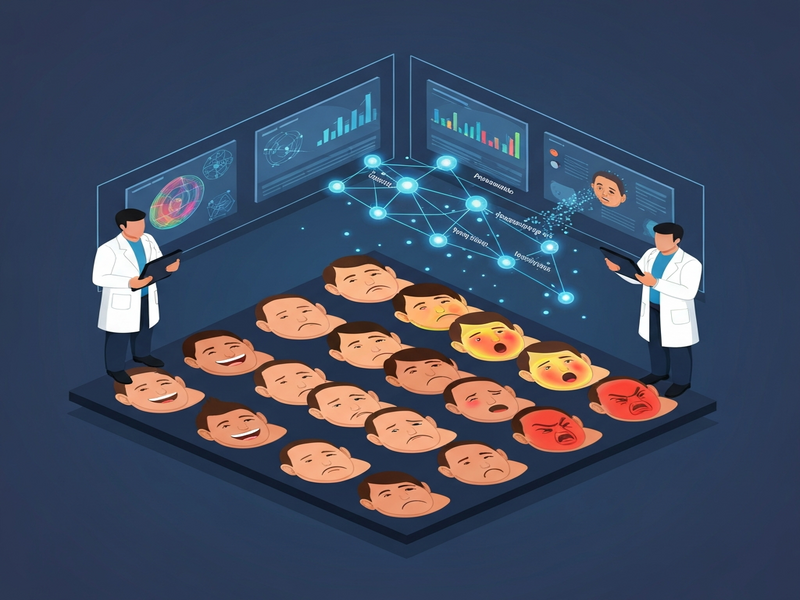
What distinguishes this approach from prior work is the closed‑loop use of predictive models to steer generative synthesis, turning stimulus creation into a data‑backed optimization rather than a manual art.
Evaluation & Results
The authors validated the framework in two independent experiments.
Experiment 1: Model‑Selected vs. Random Images
Using a fresh cohort of participants, the researchers presented two sets of images: (a) the top‑ranked diagnostic faces selected by the AI pipeline, and (b) a matched set of randomly chosen faces from the same source pool. Behavioral analysis revealed that the AI‑selected set produced a statistically larger mean difference in emotion ratings between autistic and neurotypical groups—approximately 1.8 × the effect size of the random set. This demonstrates that the selection mechanism successfully isolates the sparse subset of stimuli that drive group divergence.
Experiment 2: GAN‑Generated Transformations
In a phenotype‑matched validation, each diagnostic image was paired with its GAN‑transformed counterpart designed to reduce the predicted separation. When participants evaluated these pairs, the transformed faces consistently yielded smaller behavioral gaps, confirming that the generative module can steer perception toward convergence. Importantly, the effect was reversible: applying the opposite transformation (maximizing separation) restored the original disparity.
Collectively, the results prove three core claims:
- The predictive models capture meaningful, individual‑level perceptual patterns.
- Optimizing over a large image pool uncovers high‑impact stimuli that would be missed by random sampling.
- GAN‑based transformations can experimentally manipulate the degree of group disagreement, offering a controllable lever for behavioral phenotyping.
Why This Matters for AI Systems and Agents
Beyond academic curiosity, the framework offers concrete advantages for developers of AI‑driven assessment tools, therapeutic agents, and adaptive user interfaces:
- Precision testing: By focusing on the most diagnostic stimuli, AI‑enabled diagnostic platforms can reduce test length while increasing statistical power, leading to faster, more reliable screenings.
- Personalized interventions: Generative models can tailor visual content to an individual’s perceptual profile, enabling adaptive training regimes for social‑skill coaching applications.
- Simulation environments: Virtual agents that interact with humans can be equipped with the discriminative image selector to generate challenging social cues on demand, improving robustness testing of emotion‑recognition modules.
- Workflow automation: The entire pipeline can be orchestrated within an Workflow automation studio, allowing researchers to trigger data collection, model retraining, and stimulus generation with a single click.
In practice, an enterprise AI platform could embed this pipeline to continuously refine its assessment suite as new data arrives, ensuring that the system stays aligned with the evolving understanding of neurodivergent perception.
What Comes Next
While the study marks a significant step forward, several open challenges remain:
- Generalization across cultures: Facial expressions vary across ethnic groups; extending the model to multi‑ethnic datasets will test its cross‑cultural robustness.
- Multi‑modal integration: Combining facial cues with vocal tone, body language, and physiological signals could yield richer, multimodal diagnostic tools.
- Real‑time adaptation: Embedding the selection engine into interactive applications (e.g., VR training) requires low‑latency inference and on‑device model updates.
- Ethical safeguards: Automated generation of emotionally charged stimuli raises concerns about consent and potential distress; transparent governance frameworks are essential.
Future research may explore coupling the pipeline with a Enterprise AI platform by UBOS to scale data ingestion, model management, and compliance monitoring across large clinical networks. Additionally, integrating the system with AI marketing agents could automate outreach to study participants, ensuring diverse recruitment while respecting privacy.
For readers interested in the technical details, the full methodology, code, and data are available in the original arXiv paper.
Andrii Bidochko
CTO UBOS
Andrii Bidochko is an AI entrepreneur and researcher focused on AI agents, reinforcement learning, and autonomous systems. He writes about the technologies shaping the future of machine intelligence, from frontier models and agent architectures to real-world AI applications.