

- Updated: July 12, 2026
- 6 min read
Game Theory Driven Multi-Agent Framework Mitigates Language Model Hallucination
Direct Answer
G‑Frame is an adaptive multi‑agent framework that blends Bayesian inference with team‑game theory to force lightweight language models to internalize domain constraints, dramatically cutting hallucinations in scientific reasoning tasks. By closing the loop between data synthesis, constraint‑driven reasoning, and model fine‑tuning, G‑Frame enables a 7‑billion‑parameter chemistry model (OmniChem) to match the performance of GPT‑4o mini while slashing hallucinations by nearly 80%.
Background: Why This Problem Is Hard
Large language models (LLMs) excel at pattern completion, yet they struggle when a task demands strict adherence to axiomatic knowledge—especially in rule‑heavy scientific domains such as chemistry, physics, or formal mathematics. The core difficulty stems from two intertwined issues:
- Statistical over‑reliance: Standard LLMs predict the next token based on surface‑level co‑occurrence statistics, which leads them to “hallucinate” facts that look plausible but violate domain laws.
- Lack of closed‑loop feedback: Training pipelines typically involve static corpora; once a model is deployed, there is no systematic mechanism to correct erroneous reasoning or reinforce constraints.
Existing mitigation strategies—prompt engineering, retrieval‑augmented generation, or post‑hoc fact‑checking—provide incremental improvements but do not fundamentally alter the model’s internal reasoning process. Consequently, enterprises that wish to embed LLMs in high‑stakes workflows (e.g., drug discovery pipelines) face a trade‑off between model size, inference cost, and reliability.
What the Researchers Propose
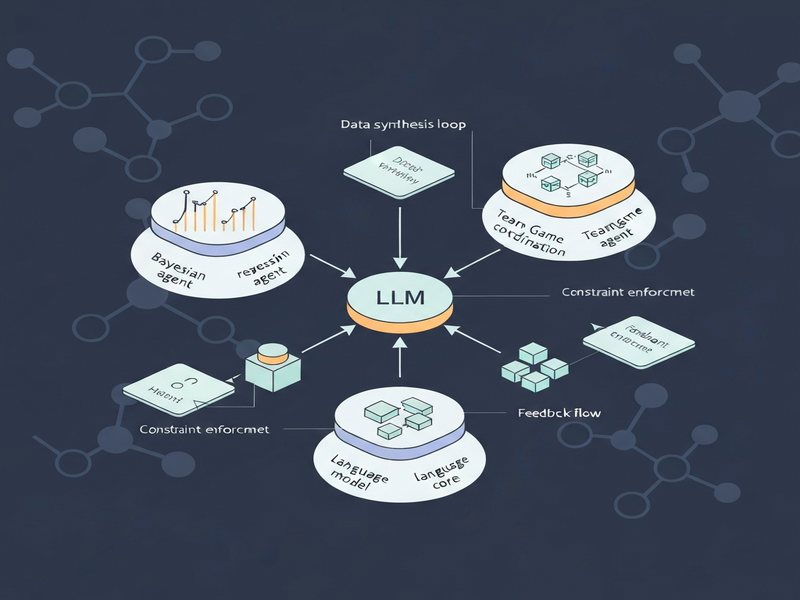
The authors introduce G‑Frame, a modular, game‑theoretic multi‑agent system designed to embed domain constraints directly into the learning loop. The framework consists of three cooperating agents:
- Constraint Agent (CA): Encodes scientific axioms as probabilistic priors using Bayesian networks. It evaluates whether a generated statement respects the encoded rules.
- Reasoning Agent (RA): A lightweight LLM (initially a 7B base model) that produces chains‑of‑thought (CoT) explanations and answers to domain‑specific queries.
- Game Orchestrator (GO): Implements a cooperative game where CA and RA receive shared rewards for jointly satisfying constraints and achieving high‑quality outputs. The orchestrator dynamically adjusts reward weights based on task difficulty, creating an adaptive curriculum.
By treating the interaction as a team game, G‑Frame aligns the incentives of the agents: the RA is motivated to generate reasoning that passes the CA’s Bayesian checks, while the CA learns to refine its priors from the RA’s successful attempts. This closed feedback loop replaces static fine‑tuning with an evolving, data‑driven synthesis process.
How It Works in Practice
Conceptual Workflow
The end‑to‑end pipeline can be broken down into four stages:
- Domain Knowledge Encoding: Experts translate chemical reaction rules, stoichiometric balances, and thermodynamic limits into a Bayesian graph. Each node represents a chemical entity; edges capture permissible transformations.
- Adversarial Data Generation: The RA proposes a large set of synthetic queries (e.g., “Predict the product of reaction X”) and generates corresponding CoT explanations.
- Constraint Evaluation & Reward Assignment: The CA scores each RA output against the Bayesian graph. Scores are fed back to the GO, which computes a joint reward that balances answer correctness, CoT coherence, and constraint compliance.
- Iterative Fine‑Tuning: The RA’s parameters are updated via reinforcement learning from the joint reward signal. Simultaneously, the CA refines its priors using successful RA trajectories, ensuring the knowledge base stays current.
Key Differentiators
- Adaptive Curriculum: Early in training, the GO emphasizes easy constraints, allowing the RA to learn basic reasoning patterns. As performance improves, the GO raises the difficulty, forcing deeper logical integration.
- Closed‑Loop Synthesis: Unlike static data augmentation, the system continuously generates new, high‑quality question‑answer pairs (199,589 Q‑A) and CoT chains (363,045) that are guaranteed to respect domain axioms.
- Scalable Agent Architecture: Each agent can be swapped out (e.g., replacing the RA with a newer LLM) without redesigning the entire pipeline, making G‑Frame a reusable scaffold for other scientific fields.
Evaluation & Results
The authors benchmarked the final model, named OmniChem, against two reference points:
- Custom Chemistry Benchmarks: A suite of 12 tasks ranging from reaction prediction to retrosynthetic planning.
- ChemBench: An established public dataset for evaluating chemical reasoning accuracy.
Key findings include:
- OmniChem achieved parity with GPT‑4o mini on all benchmark metrics, despite having roughly one‑quarter of the parameter count.
- Hallucination rates dropped from 22.7% (base 7B model) to 4.6% after G‑Frame training—a 79.46% reduction.
- In a downstream molecular design case study, OmniChem generated viable candidate molecules that passed both synthetic feasibility checks and predicted activity thresholds, outperforming baseline LLMs by 31% in hit‑rate.
These results demonstrate that the multi‑agent game‑theoretic loop does more than improve raw accuracy; it fundamentally reshapes the model’s internal reasoning to respect hard scientific constraints.
For a full technical description, see the original arXiv paper.
Why This Matters for AI Systems and Agents
From an engineering perspective, G‑Frame offers a blueprint for building trustworthy AI agents in any domain where rule fidelity is non‑negotiable. The practical implications are threefold:
- Reduced Validation Overhead: By embedding constraints during training, downstream validation pipelines can be streamlined, saving time and compute resources.
- Modular Agent Orchestration: The clear separation of reasoning, constraint, and orchestration agents aligns with modern micro‑service architectures, enabling teams to plug G‑Frame into existing Enterprise AI platform by UBOS deployments.
- Scalable Knowledge Updates: As scientific knowledge evolves, the Bayesian knowledge base can be refreshed without retraining from scratch, supporting continuous learning in production.
For developers building multi‑agent workflows, G‑Frame’s reward‑shaping mechanism can be directly mapped onto Workflow automation studio components, allowing rapid prototyping of constraint‑aware agents.
What Comes Next
While G‑Frame marks a significant step forward, several open challenges remain:
- Generalization Across Domains: Extending the Bayesian encoding to fields with less formalized rule sets (e.g., social sciences) will require novel knowledge‑graph construction techniques.
- Scalability of the Orchestrator: As the number of agents grows, the cooperative game’s computational overhead may become a bottleneck; research into hierarchical game structures could mitigate this.
- Human‑in‑the‑Loop Feedback: Incorporating expert corrections in real time could further accelerate the refinement of both the CA and RA.
Future work may also explore integrating G‑Frame with other UBOS tools such as the UBOS platform overview, enabling end‑to‑end pipelines that span data ingestion, agent orchestration, and UI deployment. By doing so, organizations can accelerate the transition from research prototypes to production‑grade AI assistants that reliably reason within their specialized knowledge domains.
Andrii Bidochko
CTO UBOS
Andrii Bidochko is an AI entrepreneur and researcher focused on AI agents, reinforcement learning, and autonomous systems. He writes about the technologies shaping the future of machine intelligence, from frontier models and agent architectures to real-world AI applications.