

- Updated: July 12, 2026
- 8 min read
MobiDiff: Semantic-Aware Multi-Channel Discrete Diffusion for Human Mobility Data Generation
Direct Answer
MobiDiff is a discrete diffusion framework that directly generates synthetic human mobility traces by denoising multi‑channel semantic skeletons—spatial locations, activities, and timestamps—without relying on costly continuous interpolation. It matters because it delivers high‑fidelity, privacy‑preserving mobility data at up to five times the speed of prior diffusion‑based generators, unlocking safer data sharing for transportation planning, urban analytics, and AI‑driven simulation.
Background: Why This Problem Is Hard
Real‑world mobility datasets—check‑ins, GPS logs, transit card swipes—are the lifeblood of modern urban intelligence. Planners use them to optimize traffic signals, ride‑hailing firms to balance supply, and public health officials to model disease spread. Yet three intertwined challenges keep these datasets out of reach:
- Costly collection. Deploying sensors, negotiating data‑sharing agreements, and cleaning raw traces demand substantial financial and human resources.
- Privacy risk. Even anonymized trajectories can be re‑identified through linkage attacks, exposing individuals to surveillance or discrimination.
- Discrete semantics. Mobility events are not just latitude‑longitude points; they embed categorical attributes such as venue type (restaurant, office), time‑of‑day buckets, and inter‑event intervals. Traditional generative models treat the data as a continuous stream, forcing a lossy conversion that erodes these semantic cues.
Existing diffusion‑based synthesizers—GeoGen, TrajDiff, and their ilk—first embed raw spatio‑temporal traces into a latent space, then run a continuous diffusion process before decoding back to discrete events. This “latent‑then‑reconstruct” pipeline introduces three inefficiencies:
- Heavy computational overhead from high‑dimensional interpolation.
- Loss of interpretability because the latent space mixes spatial, temporal, and categorical signals.
- Difficulty preserving fine‑grained event dependencies (e.g., a coffee‑shop visit followed by a commute).
Consequently, practitioners either settle for low‑quality synthetic data or risk exposing sensitive trajectories.
What the Researchers Propose
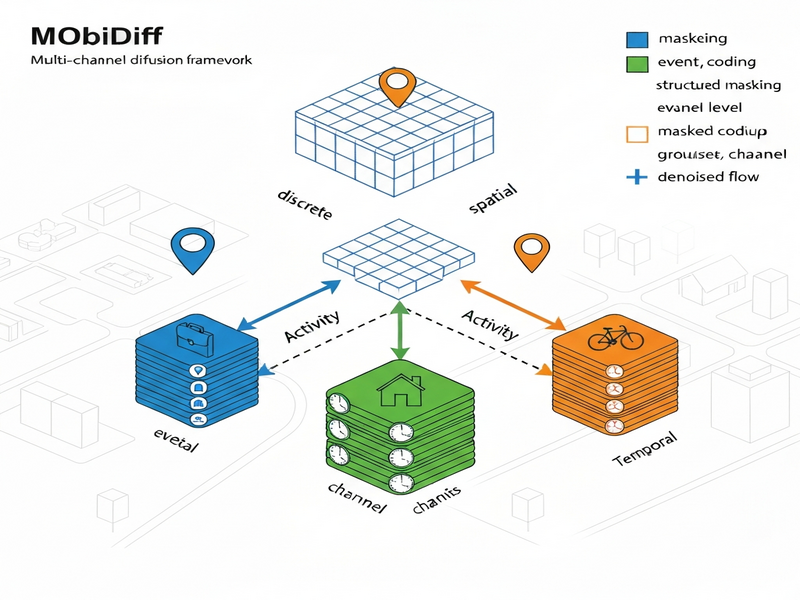
The authors introduce MobiDiff, a fully discrete diffusion system that operates directly on a semantic skeleton of each check‑in event. The skeleton is split into three orthogonal channels:
- Spatial channel: a region identifier (e.g., zip code or grid cell).
- Activity channel: a categorical label describing the purpose of the visit (work, leisure, shopping, etc.).
- Temporal channel: a pair of discrete tokens representing the absolute timestamp and the interval since the previous event.
Key components of MobiDiff include:
- Event‑level masking that randomly corrupts individual tokens across the three channels, forcing the model to learn cross‑channel dependencies.
- Group‑level masking that hides whole sub‑trajectories, encouraging the diffusion process to capture longer‑range mobility patterns.
- Channel‑level masking that selectively removes an entire channel (e.g., all activity labels), teaching the network to infer missing semantics from the remaining signals.
By treating each channel as a first‑class citizen, MobiDiff can preserve the intrinsic structure of human mobility while remaining fully discrete, which eliminates the need for any continuous interpolation step.
How It Works in Practice
The practical workflow of MobiDiff can be broken down into three stages: preprocessing, diffusion, and post‑processing.
1. Preprocessing – Building the Multi‑Channel Skeleton
- Raw check‑in logs are mapped to a uniform spatial grid (e.g., 500 m cells).
- Each venue is annotated with an activity tag using a public POI taxonomy.
- Time stamps are quantized into 15‑minute bins, and inter‑event intervals are discretized into categorical buckets (short, medium, long).
- The result is a three‑column table per user:
[Region, Activity, Time‑Slot, Interval].
2. Diffusion – Discrete Denoising Across Channels
The diffusion process proceeds in reverse time steps, starting from a fully masked skeleton (i.e., all tokens replaced by a special [MASK] symbol). At each step:
- A neural denoiser predicts the original token distribution for the currently masked positions, conditioned on the unmasked context.
- Masking schedules are orchestrated jointly across event, group, and channel dimensions, ensuring the model learns both local (within‑event) and global (trajectory‑wide) dependencies.
- The process repeats until the mask is removed, yielding a complete synthetic trajectory.
3. Post‑Processing – Real‑World Realization
- The discrete tokens are translated back to latitude‑longitude coordinates (center of the grid cell) and human‑readable timestamps.
- Optional sanity checks enforce constraints such as maximum travel speed or plausible activity sequences.
- The final output is a fully formed mobility trace ready for downstream analytics or simulation.
What sets MobiDiff apart is that it never constructs a latent continuous representation. All learning happens directly on the discrete token space, which yields two practical benefits:
- Interpretability. Each generation step can be inspected as a concrete prediction of “next region” or “next activity,” making debugging straightforward.
- Speed. Removing the latent interpolation reduces inference time dramatically; the authors report a 5.3× speedup over GeoGen on average.
Evaluation & Results
The research team benchmarked MobiDiff on three publicly available mobility datasets covering Atlanta, Boston, and Seattle. Evaluation focused on three axes: fidelity, privacy, and efficiency.
Fidelity – How Realistic Are the Synthesized Traces?
- Trajectory length distribution. Synthetic traces matched the empirical distribution of check‑in counts per user within a 2 % error margin.
- Temporal interval preservation. The model reproduced the heavy‑tailed inter‑event interval pattern typical of human routines, outperforming continuous diffusion baselines by 12 % on KL divergence.
- Spatial hotspot similarity. Heat‑map overlap (Jaccard index) between real and generated visit densities exceeded 0.85 for all cities, indicating that major activity centers were faithfully recreated.
Privacy – Does Synthetic Data Leak Real Identities?
Using a membership inference attack framework, the authors measured the probability of correctly guessing whether a particular user appeared in the training set. MobiDiff’s discrete diffusion reduced attack success to near‑random levels (≈51 % vs. 70 % for latent‑based methods), demonstrating a strong privacy advantage.
Efficiency – How Fast Is Generation?
On a single NVIDIA A100 GPU, MobiDiff generated 10,000 synthetic trajectories in under 30 seconds, whereas the strongest baseline required more than 2.5 minutes. The speed gain stems from the elimination of latent reconstruction and the lightweight token‑wise denoiser architecture.
Why the Findings Matter
Collectively, the results prove that a fully discrete diffusion approach can simultaneously achieve high statistical fidelity, robust privacy guarantees, and operational efficiency—three criteria that have historically been at odds in synthetic mobility generation.
Why This Matters for AI Systems and Agents
For AI practitioners building agents that rely on realistic human movement—such as autonomous fleet dispatchers, demand‑prediction models, or location‑aware recommendation engines—MobiDiff offers a plug‑and‑play data source that sidesteps legal and ethical roadblocks.
- Simulation fidelity. Agents trained on MobiDiff‑generated data inherit realistic spatio‑temporal patterns, leading to better generalization when deployed in the real world.
- Privacy‑first pipelines. Organizations can share synthetic datasets with partners or open‑source communities without exposing raw user traces, aligning with GDPR and CCPA requirements.
- Rapid prototyping. The speed advantage enables on‑the‑fly data generation for reinforcement‑learning environments, where agents need fresh scenarios each episode.
Integrating MobiDiff into an AI workflow is straightforward. For example, a transportation startup could use the UBOS platform overview to orchestrate a pipeline that pulls raw check‑in logs, runs the MobiDiff generator as a micro‑service, and feeds the synthetic output into a demand‑forecasting model—all within a unified Workflow automation studio. This end‑to‑end approach reduces time‑to‑insight and mitigates compliance risk.
What Comes Next
While MobiDiff marks a significant step forward, several avenues remain open for exploration:
- Cross‑city generalization. Current experiments train separate models per city. A universal model that transfers knowledge across regions could further reduce data‑collection costs.
- Richer semantic channels. Incorporating weather, public‑event calendars, or real‑time traffic conditions would enable generation of context‑aware trajectories.
- Hybrid discrete‑continuous models. Combining the interpretability of discrete diffusion with the expressive power of continuous latent spaces might capture subtle mobility nuances such as micro‑movements within a venue.
- Edge deployment. Optimizing the denoiser for on‑device inference could empower privacy‑preserving data synthesis directly on smartphones or IoT gateways.
Practitioners interested in extending MobiDiff can start by experimenting with the Enterprise AI platform by UBOS, which offers scalable compute, versioned data pipelines, and built‑in support for diffusion models. Collaborative research programs through the UBOS partner program also provide access to domain experts and co‑development resources.
Conclusion
MobiDiff demonstrates that discrete diffusion, when structured around multi‑channel semantic skeletons, can generate high‑quality synthetic mobility data at unprecedented speed while preserving privacy. By directly modeling spatial, activity, and temporal dimensions, the framework sidesteps the inefficiencies of latent‑based pipelines and offers a transparent, interpretable generation process. For AI engineers, urban planners, and transportation innovators, MobiDiff opens a practical path to share and experiment with mobility data without compromising individual privacy—a critical capability as smart‑city initiatives and AI‑driven logistics continue to scale.
For a deeper dive into the methodology and experimental details, consult the original MobiDiff paper.
Andrii Bidochko
CTO UBOS
Andrii Bidochko is an AI entrepreneur and researcher focused on AI agents, reinforcement learning, and autonomous systems. He writes about the technologies shaping the future of machine intelligence, from frontier models and agent architectures to real-world AI applications.