

- Updated: July 12, 2026
- 7 min read
Blind-Spots-Bench: Evaluating Blind Spots in Multimodal Models
Direct Answer
Blind‑Spots‑Bench is a newly released diagnostic benchmark that surfaces systematic blind spots in modern multimodal AI models by presenting tasks that are trivial for humans but consistently hard for machines. It matters because it reveals hidden failure modes that standard benchmarks miss, enabling developers to target concrete weaknesses before deploying models in real‑world products.
Background: Why This Problem Is Hard
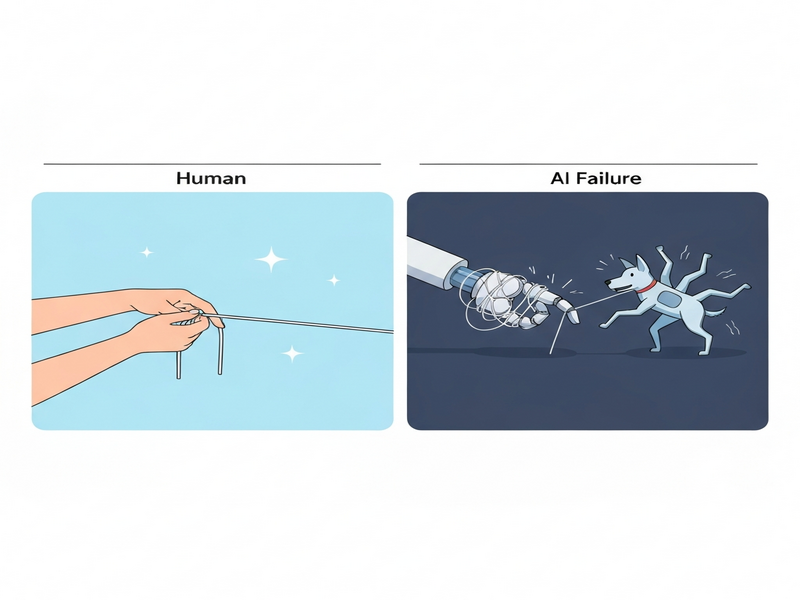
Multimodal models—systems that process text, images, audio, or video together—have surged ahead on public leaderboards such as VQAv2, COCO, and CLIPBench. Yet, practitioners repeatedly encounter “obvious” errors: a model that can caption a cat may fail to count objects, or an image generator may add extra limbs to a dog when asked to draw a five‑legged version. These failures expose two intertwined bottlenecks.
- Benchmark myopia. Most public datasets focus on narrow performance metrics (accuracy, F1, BLEU) and curated examples that avoid ambiguous or trick questions. Consequently, models are optimized for a limited slice of the problem space.
- Evaluation blind spots. Automated grading pipelines are tuned to well‑structured outputs (single‑label classification, caption generation). When a model produces an unconventional but semantically correct answer, the evaluator may incorrectly flag it as wrong, discouraging creative problem solving.
Because these blind spots remain invisible during development, they surface only after costly deployment—e.g., a customer‑support chatbot that misinterprets a simple “reset my password” request, or a visual inspection system that overlooks a subtle defect. The research community therefore needs a stress‑test that deliberately targets the “low‑hanging fruit” humans solve effortlessly.
What the Researchers Propose
The authors introduce Blind‑Spots‑Bench, a curated collection of 235 multimodal queries sourced directly from undergraduate AI course participants. Each query is annotated with a structured reference solution that captures the exact reasoning steps a human would take. The benchmark is organized around a taxonomy of six task families:
- String manipulation. Simple edits, concatenations, or pattern extractions.
- Logical reasoning. Short deductions that require a single inference step.
- Spatial imagination. Requests to draw or modify objects in ways that defy physical norms (e.g., a five‑legged dog).
- Numerical grounding. Counting, arithmetic, or unit conversion embedded in visual contexts.
- Commonsense grounding. Everyday facts that humans take for granted (e.g., “a banana is yellow”).
- Cross‑modal synthesis. Combining textual instructions with visual generation or editing.
Beyond the dataset, the paper contributes an automated grading pipeline that parses model outputs, aligns them with the reference solution, and assigns a binary correctness score. The pipeline is model‑agnostic, supporting open‑weight frameworks (e.g., LLaMA, Stable Diffusion) and closed‑source APIs (e.g., ChatGPT, Claude).
How It Works in Practice
The end‑to‑end workflow can be broken down into three logical components:
1. Query Ingestion
Raw student questions are first normalized (spell‑checking, tokenization) and stored in a lightweight JSONL repository. Each entry contains the original prompt, a human‑written reference solution, and metadata indicating the task family.
2. Model Invocation Layer
For each benchmark item, the system calls the target model via its API or local inference endpoint. The invocation layer abstracts away differences between language‑only, vision‑language, and pure image‑generation models, presenting a uniform prompt → response contract.
3. Automated Grader
The grader executes a series of deterministic checks:
- Structural validation. Ensures the response follows the expected format (e.g., a list of numbers, a short sentence).
- Semantic matching. Uses fuzzy string matching, regular expressions, or lightweight LLM verification to compare the model’s answer against the reference.
- Cross‑modal verification. For image‑generation tasks, the grader runs a secondary vision model to detect the presence or absence of the requested visual attribute (e.g., counting legs).
This pipeline runs in batch mode, producing a per‑task accuracy matrix that can be visualized across model families. What sets this approach apart is its ability to evaluate heterogeneous modalities with a single, reproducible scoring script.
Evaluation & Results
The authors evaluated a spectrum of 12 models, ranging from open‑weight LLaMA‑2‑13B to closed‑source frontier systems like GPT‑4‑Vision. The experiments were organized around two axes: model openness (open‑weight vs. closed‑source) and task family (the six categories described earlier).
Key Observations
- Closed‑source models lead by ~10 %. On average, proprietary APIs outperformed the best open‑weight baseline by roughly ten percentage points, even when both groups achieved similar scores on traditional benchmarks.
- No universal champion. Each model excelled in a subset of tasks—e.g., a vision‑language model dominated spatial imagination, while a pure language model shone on string manipulation.
- Persistent failure zones. All evaluated systems struggled with cross‑modal synthesis tasks that required generating an image from a nuanced textual constraint (e.g., “draw a dog with five legs”).
- Open‑weight gap narrows with instruction tuning. Models that received additional instruction‑following data reduced the performance gap to under 5 % on logical reasoning tasks.
These findings demonstrate that high scores on established leaderboards do not guarantee robustness against simple, human‑intuitive challenges. The benchmark therefore acts as a “stress test” that surfaces hidden weaknesses before they manifest in production.
Why This Matters for AI Systems and Agents
For engineers building AI‑powered agents, the implications are immediate:
- Risk mitigation. By running Blind‑Spots‑Bench during the model selection phase, teams can identify failure modes that could cause costly user‑experience bugs.
- Targeted fine‑tuning. The taxonomy pinpoints which capability (e.g., numerical grounding) needs additional data, enabling efficient, data‑centric improvement cycles.
- Orchestration strategies. Knowing that no single model dominates all tasks encourages a modular agent architecture where specialized models are invoked per‑task, a pattern supported by the Workflow automation studio.
- Product differentiation. Companies can advertise “blind‑spot‑tested” AI features, building trust with enterprise customers who demand rigorous validation.
In practice, a conversational AI platform could integrate the benchmark into its CI pipeline, automatically rejecting model updates that regress on any of the six task families. This aligns with the broader industry push toward “AI safety by design.”
What Comes Next
While Blind‑Spots‑Bench marks a significant step forward, several limitations remain:
- Scale of data. With only 235 items, the benchmark may not capture the full diversity of real‑world blind spots. Expanding the dataset through crowdsourcing or synthetic generation would improve coverage.
- Granular grading. The current binary correctness metric masks partial understanding (e.g., a model that counts three out of five legs). Future work could adopt graded scoring or confidence calibration.
- Domain specificity. The questions stem from an academic setting; industry‑specific blind spots (e.g., medical image interpretation) require tailored extensions.
Looking ahead, researchers can explore two promising directions:
- Adaptive benchmark generation. Leveraging LLMs to synthesize new blind‑spot queries on‑the‑fly, creating a dynamic evaluation loop that evolves with model capabilities.
- Integration with model‑ops platforms. Embedding the grading pipeline into continuous deployment tools, such as the UBOS platform overview, to enforce blind‑spot compliance as a service level objective.
For startups eager to adopt rigorous evaluation, the UBOS for startups program offers pre‑configured pipelines that include Blind‑Spots‑Bench as a built‑in test suite. Larger enterprises can leverage the Enterprise AI platform by UBOS to orchestrate multi‑model agents that automatically route tasks to the most capable subsystem, reducing the risk of blind‑spot failures.
Finally, developers interested in experimenting with open‑source tooling can explore the Openclaw (Clawdbot, MoltBot) suite, which provides a sandbox for building custom blind‑spot detectors and integrating them with existing model stacks.
For a deeper dive into the methodology and full dataset, consult the original Blind‑Spots‑Bench paper. The community is encouraged to contribute additional queries, share grading scripts, and co‑author follow‑up studies that push multimodal robustness toward production‑grade reliability.
Andrii Bidochko
CTO UBOS
Andrii Bidochko is an AI entrepreneur and researcher focused on AI agents, reinforcement learning, and autonomous systems. He writes about the technologies shaping the future of machine intelligence, from frontier models and agent architectures to real-world AI applications.