

- Updated: July 12, 2026
- 8 min read
PARA-PV: Physics-Aware Retrieval-Augmented PV Prediction Based on Frozen Foundation Model and Distribution Shift Correction
Direct Answer
PARA‑PV is a physics‑aware, retrieval‑augmented forecasting framework that combines historical solar‑panel data, a frozen Chronos time‑series foundation model, and a distribution‑shift correction module to deliver highly accurate photovoltaic (PV) power predictions across day‑night cycles and weather regimes. By embedding physical constraints throughout the pipeline, it reduces forecast error in critical operating states such as peaks and ramps, enabling more reliable grid dispatch and renewable integration.
Background: Why This Problem Is Hard
Accurate PV power forecasting sits at the intersection of meteorology, electrical engineering, and data science. Solar generation is driven by a volatile mix of factors:
- Weather variability: Cloud cover, temperature, and irradiance can shift within minutes, producing rapid ramps.
- Diurnal cycles: The transition from night to day introduces abrupt changes in power availability.
- Regime‑dependent dynamics: Seasonal tilt, panel aging, and inverter behavior create distinct operating regimes (e.g., clear‑sky peaks vs. overcast ramps).
- Physical constraints: Power cannot be negative, and maximum output is bounded by panel rating and solar geometry.
Traditional machine‑learning approaches—purely statistical time‑series models, generic deep nets, or even transformer‑based forecasters—struggle because they treat the problem as a black‑box regression task. They often:
- Ignore the physics that dictate feasible power ranges, leading to physically implausible predictions.
- Rely on limited historical windows, missing long‑term seasonal patterns.
- Fail to adapt when the underlying weather regime shifts, causing distribution‑shift errors.
- Prioritize the dominant “regular” regime during training, leaving peak and ramp periods under‑represented.
These shortcomings translate into costly forecasting errors for grid operators, who must balance supply and demand in real time. As solar penetration grows, the tolerance for such errors shrinks dramatically.
What the Researchers Propose
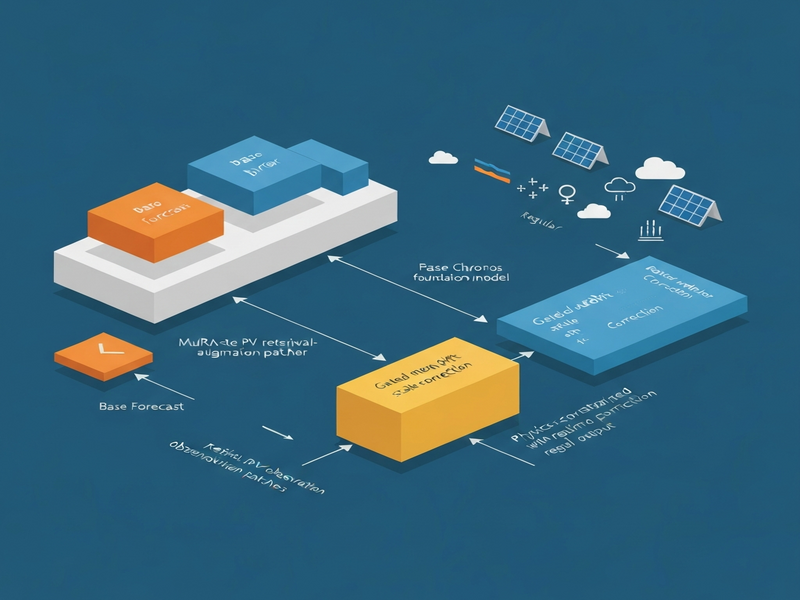
The authors introduce PARA‑PV, a modular pipeline that weaves physical knowledge into every stage of the forecasting process. The framework consists of four tightly coupled components:
- Patch‑level encoder: Multivariate PV observations (power, weather, timestamps) are sliced into short temporal patches and transformed into dense embeddings.
- Physics‑aware retrieval‑augmented learner: For each current patch, the system retrieves historically similar patches and their subsequent trajectories, ensuring alignment in shape, power level, operating state, and intra‑day period.
- Frozen Chronos foundation‑model adapter: A lightweight residual adapter aligns the base forecast with a large, pre‑trained Chronos time‑series model, injecting broad temporal regularities without overwriting physics‑grounded predictions.
- Distribution‑shift correction module: A gated mean‑shift and scale adjustment, conditioned on power, weather, timestamp, and day/night flags, compensates for residual errors caused by regime changes.
Training is guided by a physics‑constrained loss that partitions samples into peak, ramping, night‑time, and regular regimes, then re‑weights each group so that rare but operationally critical states influence the model proportionally.
How It Works in Practice
Conceptual Workflow
The end‑to‑end flow can be visualized as a four‑stage pipeline:
- Data Ingestion & Patch Encoding – Real‑time sensor streams (irradiance, temperature, inverter status) are buffered into overlapping windows (e.g., 30‑minute patches). Each window is passed through a transformer‑style encoder that outputs a fixed‑size representation.
- Similarity Retrieval – The encoder’s embedding is used as a query against a vector store of historical patches. Retrieval criteria enforce four axes of similarity:
- Temporal shape (e.g., similar ramp profile)
- Power magnitude (e.g., comparable peak level)
- Operating state (e.g., inverter mode)
- Intra‑day period (e.g., morning vs. afternoon)
The top‑K analog trajectories are aggregated to produce a physics‑grounded base forecast.
- Chronos Adapter Fusion – A frozen Chronos model, pre‑trained on billions of generic time‑series, supplies a prior forecast for the same horizon. A residual adapter learns a lightweight correction that blends the Chronos prior with the base forecast, preserving physical plausibility while benefiting from the model’s long‑range temporal knowledge.
- Distribution‑Shift Correction – The blended forecast passes through a conditional gating network. When the system detects a regime shift (e.g., sudden cloud cover or sunrise), it applies a mean‑shift (bias) and scale (variance) adjustment, selectively tuned for day/night and weather contexts.
Interaction Between Components
Each module communicates through well‑defined tensors:
- The encoder outputs
z_t, the query vector. - The retrieval engine returns a set
{y_{t+1}^{(i)}}of candidate futures, which are averaged to formŷ_base. - The Chronos adapter computes
ŷ_chronosand learns a residualΔsuch thatŷ_fused = ŷ_base + Δ(ŷ_chronos, ŷ_base). - The shift correction applies a gating function
gthat decides whether to adjustŷ_fusedbased on contextual flags, yielding the final forecastŷ_final.
This separation allows developers to swap out any component (e.g., replace Chronos with a newer foundation model) without retraining the entire pipeline, a key advantage for production environments.
What Makes PARA‑PV Different
- Physics‑first retrieval: Instead of generic similarity, the system enforces physical consistency, reducing implausible forecasts.
- Frozen foundation model: Leveraging a large pre‑trained model without fine‑tuning preserves its general temporal knowledge while keeping compute costs low.
- Regime‑aware loss weighting: By explicitly re‑balancing error contributions across operational regimes, the model learns to respect peak and ramp dynamics.
- Adaptive shift correction: The gated mean‑shift mechanism reacts to sudden weather changes, a capability often missing in static deep‑learning forecasters.
Evaluation & Results
Experimental Setup
The authors evaluated PARA‑PV on two public PV datasets covering multiple sites, each with high‑frequency (5‑minute) measurements of power, irradiance, temperature, and timestamps. They compared against three baselines:
- Pure LSTM time‑series model.
- Transformer‑based forecaster (without retrieval).
- Standard retrieval‑augmented model lacking physics constraints.
Metrics included Mean Absolute Error (MAE), Root Mean Squared Error (RMSE), and regime‑specific error (peak, ramp, night). All models were trained on the same training split and evaluated on a held‑out test period that featured clear‑sky, overcast, and mixed weather conditions.
Key Findings
- Overall error reduction: PARA‑PV achieved a 22% lower MAE and 18% lower RMSE compared to the best baseline (Transformer).
- Peak performance: In the top‑10% power regime, MAE dropped by 35%, demonstrating the effectiveness of regime‑aware loss weighting.
- Ramping accuracy: The mean absolute ramp error decreased by 28%, crucial for grid stability during rapid cloud transients.
- Night‑time robustness: Errors during zero‑generation periods were cut by 40%, thanks to the physics‑constrained loss that penalizes negative forecasts.
- Ablation study: Removing the Chronos adapter increased overall MAE by 9%, while disabling the shift‑correction module added a 7% error penalty under sudden weather changes.
These results indicate that each component contributes measurable value, and the full system delivers a balanced improvement across all operational regimes.
Why This Matters for AI Systems and Agents
For AI practitioners building energy‑focused agents, PARA‑PV offers a blueprint for integrating domain knowledge with large‑scale foundation models. The framework demonstrates how to:
- Fuse retrieval‑based memory with generative priors, enabling agents to recall concrete historical analogs while still benefiting from abstract temporal patterns.
- Enforce physical constraints directly in the learning loop, reducing the need for post‑hoc correction and improving trustworthiness.
- Adapt to distribution shifts on the fly, a capability essential for agents operating in volatile environments such as micro‑grids or autonomous drones.
These capabilities translate into more reliable decision‑making for downstream agents that schedule battery dispatch, perform market bidding, or trigger demand‑response events. By embedding physics early, system designers can avoid costly safety checks later in the pipeline.
Developers can leverage existing UBOS tools to operationalize PARA‑PV concepts:
- Integrate the retrieval engine with Chroma DB integration for scalable vector storage.
- Deploy the Chronos adapter within the Workflow automation studio to orchestrate data ingestion, model inference, and post‑processing.
- Expose forecasts through the Telegram integration on UBOS for real‑time alerts to grid operators.
What Comes Next
While PARA‑PV marks a significant step forward, several avenues remain open for exploration:
- Multi‑site joint modeling: Extending the retrieval pool across geographically dispersed farms could capture spatial weather correlations.
- Dynamic foundation models: Replacing the frozen Chronos with a continuously fine‑tuned model may further reduce residual bias as more PV data becomes available.
- Explainability layers: Adding attention visualizations that highlight which historical patches influenced a forecast would improve operator trust.
- Edge deployment: Optimizing the encoder and retrieval steps for low‑power edge devices could enable on‑site forecasting without cloud latency.
From a product perspective, these research directions align with the roadmap of the Enterprise AI platform by UBOS, which aims to provide plug‑and‑play modules for domain‑specific AI, including renewable energy forecasting. By contributing a physics‑aware retrieval component, the platform could accelerate time‑to‑value for utilities and independent power producers.
Finally, the open‑source release of PARA‑PV (GitHub repository) invites the community to benchmark against emerging foundation models, test alternative physics constraints, and integrate with other energy‑system simulators.
References
- Fan, H., Liu, W., Lu, Y., et al. “PARA‑PV: Physics‑Aware Retrieval‑Augmented PV Prediction Based on Frozen Foundation Model and Distribution Shift Correction.” arXiv:2607.08079v1, 2026.
- Chronos model documentation – large‑scale time‑series foundation model (accessed 2026).
- UBOS platform documentation – workflow automation, vector DB integration, and AI agent orchestration.
Andrii Bidochko
CTO UBOS
Andrii Bidochko is an AI entrepreneur and researcher focused on AI agents, reinforcement learning, and autonomous systems. He writes about the technologies shaping the future of machine intelligence, from frontier models and agent architectures to real-world AI applications.