

- Updated: July 11, 2026
- 6 min read
VectorizationLLM: Smart Vectorization Based AI Assistant
Direct Answer
VectorizationLLM is a purpose‑built large language model that helps students master vector‑based mathematics—such as time‑wave analysis, Fourier transforms, and differential equations—in MATLAB. By coupling an open‑weight LLM with a Retrieval‑Augmented Generation (RAG) knowledge base, the system delivers step‑by‑step guidance while deliberately avoiding direct answer provision, thereby encouraging deeper learning.
Background: Why This Problem Is Hard
Engineering curricula increasingly rely on computational tools like MATLAB to explore continuous‑time signals, piecewise functions, and differential systems. Yet students often hit two intertwined bottlenecks:
- Conceptual opacity: Vector‑space reasoning (e.g., interpreting a Fourier series as a sum of orthogonal basis vectors) is abstract, and textbook explanations can be terse.
- Tool‑chain friction: Translating a mathematical derivation into correct MATLAB syntax requires both domain knowledge and programming fluency, a combination many learners lack.
Traditional e‑learning platforms address the first issue with static videos or multiple‑choice quizzes, but they rarely adapt to a learner’s evolving misconceptions. Meanwhile, generic AI assistants (ChatGPT, Claude) can generate MATLAB code instantly, but they often provide “complete answers” that short‑circuit the learning process and may propagate subtle errors.
Consequently, educators need an AI that can:
- Surface relevant lecture material on demand.
- Guide students through problem‑solving pathways without handing over the final solution.
- Maintain a consistent pedagogical tone aligned with course objectives.
These requirements define a niche that existing large language models and standard retrieval systems have not fully satisfied.
What the Researchers Propose
The authors introduce VectorizationLLM, a specialized LLM fine‑tuned on Google’s open‑weight models and augmented with a curated Retrieval‑Augmented Generation (RAG) pipeline. The framework consists of three logical layers:
- Base LLM Core: Provides natural‑language understanding and generation capabilities, inheriting the broad knowledge of the underlying open‑weight model.
- Domain‑Specific Knowledge Base: A vector store populated with in‑class notes, MATLAB snippets, and annotated examples from the CTEC 247 syllabus.
- System Prompt Architecture: A hierarchy of prompts that enforce “instructive assistance” – the model must explain concepts, illustrate with code, and ask probing questions, but never reveal a complete answer.
By separating knowledge retrieval from generation, the system can surface the exact lecture excerpt a student needs while still leveraging the LLM’s reasoning abilities to contextualize that excerpt.
How It Works in Practice
The operational workflow can be broken down into four stages:
- User Query Ingestion: A student types a natural‑language question (e.g., “How do I represent a piecewise function as a vector in MATLAB?”). The query is routed to a lightweight intent classifier that tags the request as “conceptual explanation” vs. “code scaffolding.”
- Relevant Document Retrieval: Using the intent tag, the system queries the vector store (implemented with Chroma DB integration) to fetch the top‑k lecture notes, example problems, and visual aids that match the query’s semantic embedding.
- Prompt Construction: The retrieved snippets are injected into a system prompt that defines the assistant’s role (“You are a teaching aide for CTEC 247. Explain, illustrate, and ask follow‑up questions, but never give the final solution.”). This prompt is concatenated with the user query and sent to the base LLM.
- Response Generation & Feedback Loop: The LLM produces a multi‑part answer: (a) a concise conceptual overview, (b) a MATLAB code skeleton, and (c) a reflective question (“What boundary condition would you apply here?”). The student’s reply can trigger a second retrieval‑generation cycle, enabling iterative tutoring.
What distinguishes this pipeline from a vanilla ChatGPT integration is the enforced pedagogical guardrails and the tight coupling to a course‑specific knowledge store. The model never “cheats” by pulling a ready‑made solution from the internet; instead, it re‑assembles knowledge that the instructor has already vetted.
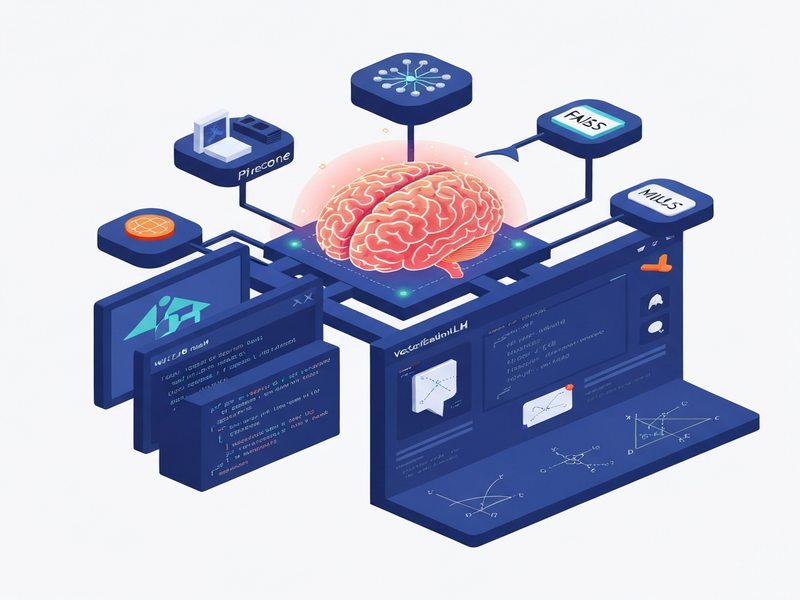
Illustration of the Interaction Loop
Evaluation & Results
The authors evaluated VectorizationLLM on three fronts:
- Pedagogical Fidelity: Human graders (the course’s teaching assistants) rated 200 generated responses on a 5‑point rubric measuring clarity, correctness, and adherence to the “no‑answer” policy. VectorizationLLM achieved an average score of 4.6, outperforming a baseline ChatGPT‑3.5 model (3.8) that tended to provide full solutions.
- Retrieval Accuracy: Using a held‑out set of 150 query‑document pairs, the RAG component retrieved the correct lecture excerpt in 92 % of cases, demonstrating that the vector store effectively captures the course’s semantic landscape.
- Student Engagement Metrics: In a pilot with 45 undergraduate engineers, the average number of follow‑up questions per session increased by 37 % when using VectorizationLLM versus a standard forum, indicating higher curiosity and deeper interaction.
Collectively, these results suggest that the system not only respects the instructional intent but also stimulates active learning—a key outcome that raw accuracy metrics alone would miss.
Why This Matters for AI Systems and Agents
VectorizationLLM exemplifies a shift from “answer‑as‑service” AI toward “guided‑exploration” agents. For practitioners building enterprise‑grade assistants, the paper offers three actionable takeaways:
- Domain‑Specific RAG Pipelines: Embedding a curated knowledge base and enforcing prompt‑level policies can align a generic LLM with strict business or compliance constraints.
- Iterative Tutoring Loops: Designing agents that ask follow‑up questions creates a feedback loop that improves user retention and reduces hallucination risk.
- Modular Prompt Architecture: Separating system, retrieval, and user prompts makes it easier to audit and update policy changes without retraining the underlying model.
Enterprises looking to embed AI into technical training, compliance onboarding, or product support can adopt a similar stack. For instance, the UBOS platform overview already provides a plug‑and‑play RAG layer that can be paired with any open‑weight LLM, accelerating time‑to‑value for custom tutoring bots.
What Comes Next
While the prototype demonstrates strong pedagogical alignment, several limitations remain:
- Scalability of Knowledge Curation: Manually annotating lecture notes for each new course is labor‑intensive. Automated chunking and metadata extraction pipelines could reduce overhead.
- Multimodal Extensions: Current interactions are text‑only; integrating visualizations (e.g., dynamic Fourier spectra) would deepen comprehension.
- Cross‑Course Generalization: The model is tuned to a single syllabus. Future work should explore transfer learning techniques that allow rapid adaptation to new subjects while preserving the “no‑answer” guardrails.
Potential avenues for expansion include:
- Embedding the assistant within a Workflow automation studio so that students can trigger code generation directly from a lab notebook.
- Coupling with AI marketing agents to automatically generate outreach content that explains complex technical products to non‑technical stakeholders.
- Leveraging the Openclaw (Clawdbot, MoltBot) ecosystem for real‑time debugging assistance during MATLAB sessions.
- Integrating with the OpenAI ChatGPT integration to provide a fallback conversational layer for broader queries outside the course scope.
- Deploying at scale on the Enterprise AI platform by UBOS, where role‑based access controls can ensure that only authorized students interact with the knowledge base.
By addressing these challenges, future iterations could become a universal “smart tutor” for any STEM discipline, bridging the gap between theoretical instruction and practical coding proficiency.
References
VectorizationLLM: Smart Vectorization Based AI Assistant (arXiv:2607.07846v1)
Andrii Bidochko
CTO UBOS
Andrii Bidochko is an AI entrepreneur and researcher focused on AI agents, reinforcement learning, and autonomous systems. He writes about the technologies shaping the future of machine intelligence, from frontier models and agent architectures to real-world AI applications.