

- Updated: July 11, 2026
- 6 min read
Cost-Effective Agent Harnesses for Abstract Reasoning and Generalization on ARC-AGI-1
Direct Answer
The paper introduces two lightweight, cost‑conscious agent frameworks—an Explorer‑Definer Pipeline and a Reflective Orchestrator—that enable a non‑fine‑tuned, open‑weight model (DeepSeek V3.2) to achieve state‑of‑the‑art performance on the ARC‑AGI‑1 benchmark while staying under a few dollars per task. This matters because it demonstrates that abstract reasoning can be unlocked through clever orchestration rather than brute‑force compute or task‑specific training.
Background: Why This Problem Is Hard
Abstract reasoning benchmarks such as ARC‑AGI‑1 require an AI system to infer hidden patterns, synthesize programs, and apply them to novel grid‑world puzzles. Historically, two dominant strategies have emerged:
- Heavy test‑time compute: Large frontier models are run through exhaustive sampling, evolutionary search, or long chain‑of‑thought prompts. The approach can reach high scores but incurs prohibitive latency and cost.
- Benchmark‑specific fine‑tuning: Researchers train small models on the ARC dataset itself, often designing bespoke architectures that embed domain knowledge. While efficient at inference, this method sacrifices generality and demands a curated training pipeline.
Both regimes clash with practical deployment constraints. Enterprises cannot afford to spin up dozens of GPU hours per query, and research teams lack the resources to curate task‑specific datasets for every new reasoning benchmark. The core difficulty, therefore, is to extract maximal reasoning ability from a fixed, off‑the‑shelf model without resorting to massive compute or bespoke training.
What the Researchers Propose
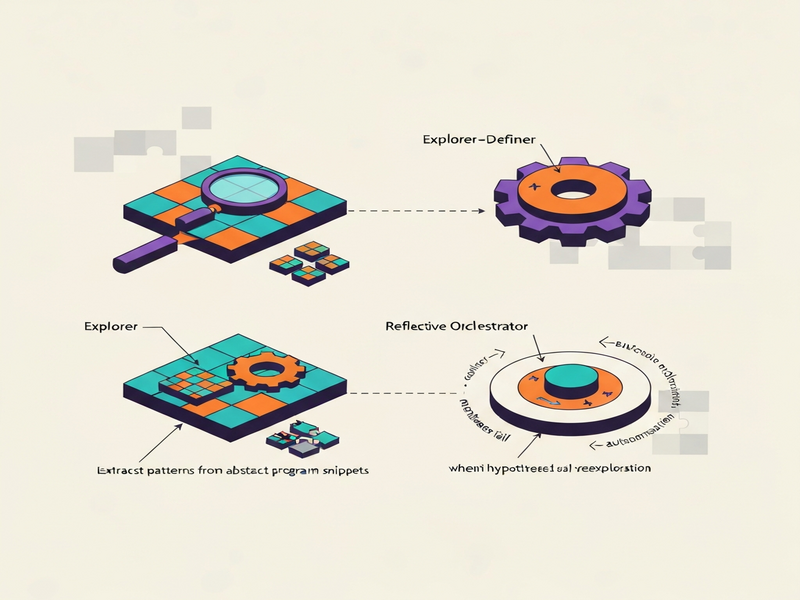
The authors present a two‑stage architectural philosophy that separates pattern discovery from executable transformation synthesis. The first stage, called the Explorer, scans input‑output pairs to hypothesize abstract rules. The second stage, the Definer, translates those rules into concrete program snippets that can be executed on the puzzle grid.
Building on this pipeline, the Reflective Orchestrator adds a meta‑controller that monitors hypothesis success, triggers autonomous re‑exploration when failures occur, and iteratively refines the candidate program space. In essence, the system treats reasoning as a loop of hypothesis generation, validation, and reflective adaptation.
How It Works in Practice
The workflow can be visualized as a linear chain with feedback:
- Input ingestion: The model receives a training pair (input grid, target grid) from the ARC‑AGI‑1 task.
- Explorer phase: Using a prompt that encourages “thinking out loud,” the model enumerates possible pattern descriptors (e.g., “rotate the red block clockwise”). This phase is deliberately lightweight—no sampling beyond a handful of candidates.
- Definer phase: Each descriptor is fed into a second prompt that asks the model to emit a short, domain‑specific program (pseudo‑code) that implements the rule.
- Validation step: The generated program is executed on the input grid. If the output matches the target, the hypothesis is marked successful.
- Reflective Orchestrator (optional): If none of the candidates succeed, the orchestrator adjusts the Explorer’s prompting strategy—e.g., by altering temperature, injecting new analogies, or expanding the search space—and repeats steps 2‑4.
- Final selection: The first successful program (or the top‑k ranked by training‑pair accuracy) is returned as the solution for the test instance.
This design diverges from prior “one‑shot” prompting approaches by explicitly decoupling the discovery of abstract concepts from their procedural encoding. The orchestrator’s reflective loop also ensures that the system is not stuck with a single, possibly incorrect hypothesis.
{{IMAGE}}
Evaluation & Results
To assess the frameworks, the authors evaluated on the public 400‑task ARC‑AGI‑1 suite, measuring pass@k (the probability that at least one of the top‑k generated programs solves a task) and the monetary cost per task.
- Explorer‑Definer Pipeline: Achieved
pass@2 = 57.5 %at an average cost of$0.25per task. - Reflective Orchestrator: Boosted performance to
pass@2 = 67.25 %while spending$0.62per task. - Both systems outperformed a strong one‑shot baseline by roughly 52 percentage points, without any ARC‑specific fine‑tuning.
Crucially, an unbiased analysis revealed that the bottleneck was generation rather than selection: the training‑pair accuracy metric captured about 95 % of the theoretical ceiling, indicating that better ranking would yield diminishing returns. The orchestrator’s adaptive re‑exploration confirmed this hypothesis, delivering a +9.81 pp lift in pass@1 while keeping selection quality constant.
Additional ablations showed that the “think tool” (the prompting scaffold that encourages the model to articulate reasoning) contributed a 5.75 pp gain, underscoring the importance of structured prompting in low‑compute regimes.
Why This Matters for AI Systems and Agents
For practitioners building AI‑driven products, the study offers a blueprint for extracting high‑level reasoning from off‑the‑shelf models without incurring the expense of massive inference fleets. The separation of discovery and execution aligns naturally with modular agent architectures, where a “reasoning” micro‑service can hand off concrete actions to a “execution” micro‑service.
Key practical takeaways include:
- Cost predictability: By capping the number of generated candidates and using a fixed‑price model, teams can budget AI usage per transaction—a critical factor for SaaS pricing.
- Scalable orchestration: The Reflective Orchestrator demonstrates how autonomous feedback loops can replace manual hyper‑parameter sweeps, enabling self‑optimizing pipelines.
- Transferability: Because the approach does not rely on ARC‑specific fine‑tuning, the same pipeline can be repurposed for other abstract reasoning domains (e.g., symbolic math, program synthesis).
- Integration potential: The modular nature of the pipeline makes it a natural fit for platforms that already support workflow automation, such as the Workflow automation studio on UBOS.
Enterprises looking to embed reasoning capabilities into chatbots, decision‑support tools, or autonomous agents can therefore adopt a “plug‑and‑play” orchestration layer rather than rebuilding large model stacks from scratch.
What Comes Next
While the results are promising, several limitations remain:
- Generation breadth: The current Explorer is limited to a handful of hypotheses per task. Expanding the hypothesis space—perhaps via retrieval‑augmented prompting—could push the ceiling higher.
- Domain generalization: The pipeline has been validated only on ARC‑AGI‑1. Applying it to other reasoning benchmarks will test its robustness.
- Model dependency: DeepSeek V3.2 was used as the base model; performance may vary with other open‑weight models, suggesting a need for systematic model‑agnostic studies.
Future research directions could explore:
- Integrating a Chroma DB integration to store and retrieve successful program snippets across tasks, enabling few‑shot transfer.
- Coupling the orchestrator with voice‑enabled agents via the ElevenLabs AI voice integration, opening up hands‑free reasoning assistants.
- Embedding the pipeline within a broader UBOS platform overview to provide a unified dashboard for cost monitoring, experiment tracking, and deployment.
By addressing these challenges, the community can move toward truly general, cost‑effective AI agents that reason abstractly without the need for bespoke training data.
For a deeper dive into the methodology and raw numbers, consult the original arXiv paper. To explore how UBOS can help you operationalize such agentic pipelines, visit the UBOS homepage and start building today.
Andrii Bidochko
CTO UBOS
Andrii Bidochko is an AI entrepreneur and researcher focused on AI agents, reinforcement learning, and autonomous systems. He writes about the technologies shaping the future of machine intelligence, from frontier models and agent architectures to real-world AI applications.