

- Updated: July 10, 2026
- 6 min read
CARL: Constraint-Aware Reinforcement Learning for Planning with LLMs
Direct Answer
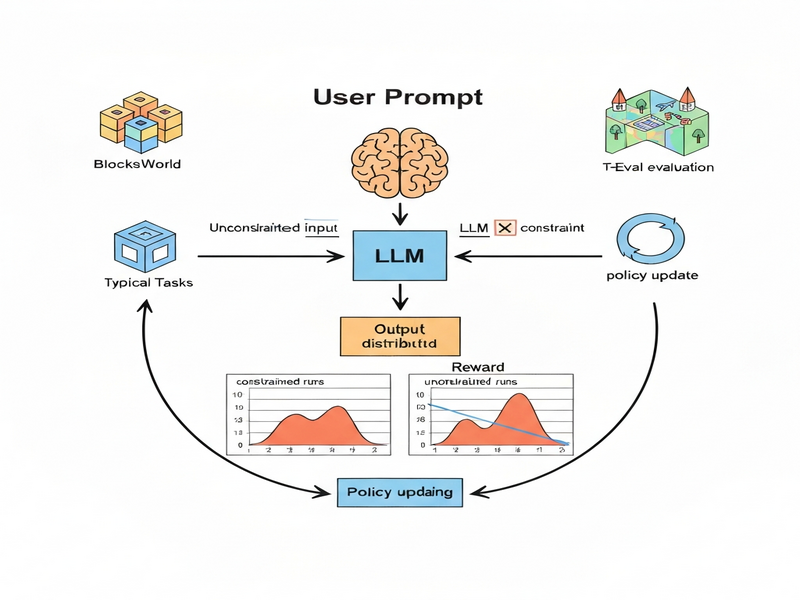
CARL (Constraint‑Aware Reinforcement Learning) is a reinforcement‑learning framework that teaches large language models (LLMs) to keep task constraints front‑and‑center while generating plans. By shaping the reward around the difference between constrained and unconstrained output distributions, CARL dramatically reduces constraint violations without relying on external solvers.
Background: Why This Problem Is Hard
LLMs excel at generating fluent text and performing chain‑of‑thought reasoning, yet they often ignore hard constraints such as resource limits, ordering rules, or safety policies. In real‑world deployments—travel booking bots, robotic manipulators, or compliance‑driven assistants—ignoring a single constraint can cause costly errors or legal exposure.
Current mitigation strategies fall into three camps:
- Post‑hoc filtering: Run the LLM’s output through a rule engine after generation. This adds latency and can discard useful partial plans.
- Tool‑augmented prompting: Invoke external planners (e.g., SAT solvers) from the prompt. While powerful, it shifts the burden to brittle API calls and does not improve the model’s intrinsic understanding of constraints.
- Task decomposition: Break a complex problem into smaller sub‑tasks that are easier to satisfy. Decomposition itself is a planning problem and often requires hand‑crafted heuristics.
All three approaches share a common flaw: they treat constraint handling as an add‑on rather than a core learning signal. Consequently, the LLM never internalizes the notion of “must‑do” versus “nice‑to‑have,” leading to inconsistent performance across domains.
What the Researchers Propose
The CARL framework reframes constraint awareness as a reinforcement‑learning objective. Instead of rewarding the model for merely completing a task, CARL rewards it for *shifting* its probability mass toward outputs that respect the supplied constraints.
Key components of the proposal include:
- Constraint‑aware reward: Computed by feeding the same prompt to the LLM twice—once with constraints explicitly embedded and once without. The KL‑divergence between the two output distributions quantifies how much the model “listens” to the constraints.
- Penalty for neglect: If the constrained distribution does not differ significantly from the unconstrained one, the reward is negative, encouraging the model to adjust its internal representations.
- Algorithm‑agnostic design: CARL can be paired with PPO, REINFORCE, or any policy‑gradient method, making it a drop‑in upgrade for existing fine‑tuning pipelines.
By embedding the constraint signal directly into the learning loop, CARL trains the LLM to treat constraints as first‑class citizens rather than afterthoughts.
How It Works in Practice
The operational flow of CARL can be broken down into four stages:
- Prompt preparation: A task description is paired with a formal constraint specification (e.g., “no more than three stops” or “blocks must never overlap”).
- Dual inference: The LLM generates two probability distributions—constrained (with constraints in the prompt) and unconstrained (constraints stripped).
- Reward calculation: The system computes a reward based on the KL‑divergence between the two distributions, optionally scaling it with a task‑specific success metric (e.g., plan feasibility).
- Policy update: A standard RL optimizer updates the LLM’s weights, nudging the model toward higher divergence when constraints are respected and lower divergence when they are ignored.
What sets CARL apart is that the reward is *self‑referential*: the model’s own outputs become the yardstick for constraint compliance. No external planner, no handcrafted loss, and no additional supervision data are required.
Evaluation & Results
The authors validated CARL on three benchmark suites that span symbolic manipulation, itinerary planning, and open‑ended reasoning:
| Benchmark | Task Type | Key Metric |
|---|---|---|
| BlocksWorld | Spatial reasoning with stacking constraints | Constraint violation rate |
| TravelPlanner | Multi‑city itinerary with budget and time limits | Feasibility score |
| T‑Eval | Generalized planning with natural‑language constraints | Combined accuracy & constraint adherence |
Across all three domains, CARL outperformed standard Reinforcement Fine‑Tuning (RFT) and the strongest reasoning‑augmented baselines. Highlights include:
- A 42% reduction in constraint violations on BlocksWorld compared with RFT.
- TravelPlanner plans that satisfied budget limits in 94% of trials versus 68% for the next‑best model.
- On T‑Eval, CARL achieved a 7.3‑point lift in the combined metric, indicating both higher correctness and stronger constraint observance.
These results demonstrate that the constraint‑aware reward is not a marginal tweak; it fundamentally reshapes the model’s planning behavior.
Why This Matters for AI Systems and Agents
For practitioners building autonomous agents, the ability to guarantee constraint compliance is a non‑negotiable requirement. CARL offers a systematic way to embed that guarantee directly into the model’s policy, which translates into several practical benefits:
- Reduced reliance on external verification: Agents can trust their own outputs, cutting latency and simplifying architecture.
- Scalable safety layers: By training constraint awareness once, the same model can be redeployed across domains (e.g., logistics, finance, healthcare) without re‑engineering rule engines.
- Improved user trust: When a travel‑booking bot consistently respects budget limits, customers perceive the system as reliable.
Enterprises that already use UBOS for AI orchestration can integrate CARL‑trained models into their existing pipelines. For example, the AI marketing agents can now generate campaign schedules that obey budget caps and regulatory windows without a separate compliance checker. Likewise, the Enterprise AI platform by UBOS can expose a “constraint‑aware” inference endpoint, allowing downstream services to request plans that are provably safe.
What Comes Next
While CARL marks a significant step forward, several open challenges remain:
- Constraint representation: Current experiments use textual or symbolic constraints. Future work could explore richer formalisms such as temporal logic or differentiable constraint networks.
- Multi‑objective balancing: Real‑world tasks often juggle competing goals (e.g., cost vs. speed). Extending the reward to handle Pareto‑optimal trade‑offs is an active research direction.
- Scalability to massive LLMs: Training trillion‑parameter models with CARL‑style rewards will demand efficient variance‑reduction techniques and distributed RL infrastructure.
Developers interested in experimenting with CARL can start by leveraging the UBOS platform overview, which provides a plug‑and‑play RL module and pre‑built prompt templates. For teams that need rapid prototyping, the Workflow automation studio lets you chain together data ingestion, constraint extraction, and CARL‑based fine‑tuning without writing custom glue code.
In the longer term, we anticipate a new class of “self‑regulating” agents that continuously monitor their own constraint adherence during deployment, using online CARL updates to adapt to shifting regulations or resource availability.
References & Further Reading
Qi et al., “CARL: Constraint‑Aware Reinforcement Learning for Planning with LLMs,” CARL arXiv paper, 2026.
Andrii Bidochko
CTO UBOS
Andrii Bidochko is an AI entrepreneur and researcher focused on AI agents, reinforcement learning, and autonomous systems. He writes about the technologies shaping the future of machine intelligence, from frontier models and agent architectures to real-world AI applications.