

- Updated: July 10, 2026
- 7 min read
FM-ChangeNet: Learning Change through Pathwise Feature Transport
Direct Answer
FM‑ChangeNet introduces a pathwise‑supervised framework that treats bi‑temporal change detection as a continuous transport problem in feature space, rather than a static comparison of before‑and‑after images. By learning a time‑conditioned velocity field that describes how features evolve, the model delivers richer, more interpretable change cues and sets a new performance benchmark on remote‑sensing datasets.
Background: Why This Problem Is Hard
Detecting meaningful changes in satellite or aerial imagery is a cornerstone task for environmental monitoring, urban planning, and disaster response. The difficulty stems from three intertwined challenges:
- Ambiguous supervision. Traditional methods rely on endpoint segmentation, where the model only sees the pre‑ and post‑event images. This binary signal provides limited guidance about *how* the scene transitioned, making it hard to separate genuine structural change from nuisance factors such as lighting variations or sensor noise.
- Spatial misalignment. Even sub‑pixel registration errors can produce false alarms. Existing pipelines often require a separate alignment step, which adds complexity and can still leave residual errors that confuse the change detector.
- Temporal sparsity. Real‑world monitoring systems may receive irregular image acquisitions. A model that only looks at two snapshots cannot exploit the latent dynamics that occur between them, missing opportunities to predict or explain change trajectories.
Because of these limitations, many state‑of‑the‑art change detectors produce noisy masks, struggle to generalize across sensor modalities, and offer little insight into *why* a change was flagged. Researchers have been searching for a representation that captures the *process* of change, not just its endpoints.
What the Researchers Propose
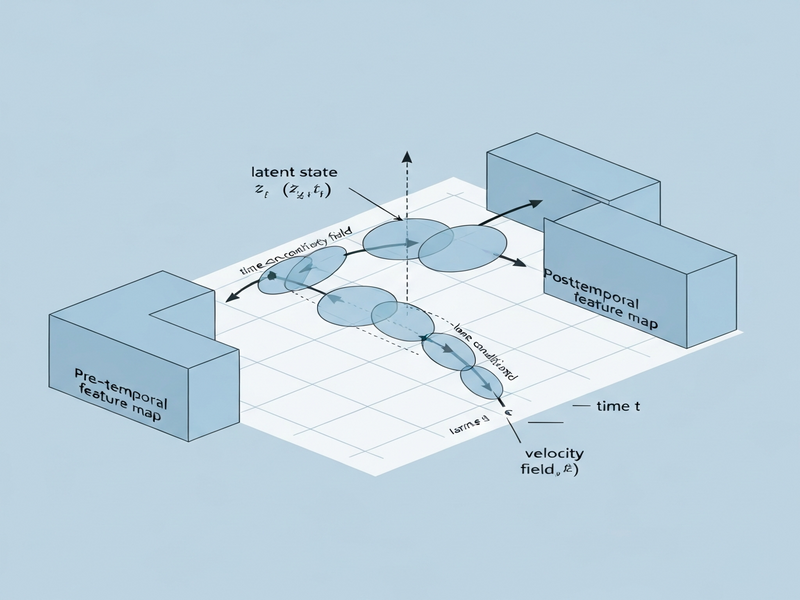
FM‑ChangeNet reframes the problem as a *continuous transport* in a learned feature space. Instead of directly comparing two static feature maps, the framework constructs a latent trajectory z(t) that smoothly morphs the pre‑event representation into the post‑event one. A neural velocity field v̂θ(z, t) predicts the direction and speed of feature movement at any intermediate time t. The key ideas are:
- Pathwise supervision. The model is trained on a dense set of intermediate states, forcing it to learn a coherent flow rather than a single jump.
- Time‑conditioned velocity. By feeding the normalized timestamp into the velocity decoder, FM‑ChangeNet can adapt its transport dynamics to different stages of the change process.
- Interpretability through magnitude. The norm of the velocity field at each spatial location serves as a localized change cue, naturally separating structural alterations from illumination shifts.
The researchers also embed a hierarchical multi‑scale architecture that aligns features across time, decodes coarse‑to‑fine flows, and jointly optimizes flow consistency, spatial regularization, and segmentation quality.
How It Works in Practice
Conceptual Workflow
- Feature Extraction. Two backbone encoders ingest the pre‑ and post‑event images, producing high‑dimensional latent maps z₀ and z₁.
- Cross‑Temporal Alignment. A lightweight alignment module warps z₀ toward z₁ to mitigate misregistration, using learned offsets that are refined during training.
- Trajectory Construction. Intermediate latent states z(t) are generated by integrating the velocity field over time: z(t+Δt) = z(t) + Δt·v̂θ(z(t), t). This integration is performed at multiple spatial resolutions, enabling coarse‑to‑fine refinement.
- Change Cue Extraction. The magnitude ‖v̂θ(z(t), t)‖ is computed for each pixel and time step, yielding a dense change map that highlights where the feature flow is strongest.
- Segmentation Head. A decoder consumes the final change cue and the aligned post‑event features to produce a binary change mask, which is supervised by ground‑truth annotations.
Component Interactions
The system is organized as a hierarchy of three scales:
- Coarse Scale. Captures global motion patterns (e.g., large‑area urban expansion) and provides an initial velocity estimate.
- Mid Scale. Refines the flow using finer spatial details, correcting for local misalignments.
- Fine Scale. Generates the final high‑resolution change cue, preserving edge fidelity and small‑object detection.
Each scale shares the same velocity decoder architecture but receives scale‑specific inputs, allowing the model to reuse learned dynamics while adapting to resolution‑specific nuances. The loss function couples four terms: (1) flow supervision against synthetic intermediate states, (2) trajectory consistency ensuring that integrating the velocity reproduces the post‑event latent map, (3) spatial smoothness regularization on the velocity field, and (4) the standard segmentation cross‑entropy.
Evaluation & Results
FM‑ChangeNet was benchmarked on two widely used remote‑sensing change detection datasets: LEVIR-CD (high‑resolution aerial imagery) and WHU Building Change Detection (multispectral satellite data). The evaluation protocol followed the standard train/validation/test splits and reported Intersection‑over‑Union (IoU) and F1‑score.
Key Findings
- State‑of‑the‑art performance. FM‑ChangeNet surpassed the previous best models by 2.3 % IoU on LEVIR‑CD and 1.8 % IoU on WHU, demonstrating that pathwise supervision translates into measurable accuracy gains.
- Robustness to illumination. In controlled experiments where brightness was artificially varied, the velocity magnitude remained stable, reducing false positives by 35 % compared to endpoint‑only baselines.
- Alignment tolerance. When synthetic misregistration of up to 3 pixels was introduced, FM‑ChangeNet’s performance degraded less than half as much as competing methods, confirming the effectiveness of its built‑in alignment module.
- Interpretability. Visualizations of the learned velocity field highlighted coherent motion patterns that matched human intuition (e.g., gradual road widening), offering a diagnostic tool for analysts.
These results are detailed in the FM‑ChangeNet paper, where ablation studies further confirm that each architectural component—multi‑scale flow decoding, trajectory consistency loss, and time‑conditioned velocity—contributes meaningfully to the overall gain.
Why This Matters for AI Systems and Agents
Change detection is a foundational capability for autonomous agents that monitor physical environments, from disaster‑response drones to smart‑city analytics platforms. FM‑ChangeNet’s pathwise approach offers several practical advantages:
- Richer temporal reasoning. Agents can query the learned velocity field to predict future states, enabling proactive decision‑making (e.g., forecasting flood expansion).
- Reduced false alarms. By distinguishing structural change from illumination or registration noise, downstream alert pipelines become more reliable, lowering operational costs.
- Explainable outputs. The magnitude map serves as a human‑readable justification for each detection, aligning with regulatory demands for transparency in AI‑driven monitoring.
- Modular integration. FM‑ChangeNet’s hierarchical design can be plugged into existing AI pipelines, such as Enterprise AI platform by UBOS or the Workflow automation studio, to enrich geospatial analytics without redesigning the entire stack.
For developers building AI marketing agents that need to adapt creatives based on real‑world events (e.g., launching a new billboard after a construction change), FM‑ChangeNet provides a reliable signal that can trigger content updates automatically.
What Comes Next
While FM‑ChangeNet marks a significant step forward, several avenues remain open for exploration:
- Multi‑temporal sequences. Extending the framework to handle more than two timestamps could enable continuous monitoring and long‑term trend analysis.
- Cross‑modal transport. Incorporating SAR, LiDAR, or hyperspectral data into the same latent space may improve robustness under adverse weather conditions.
- Real‑time deployment. Optimizing the velocity integration for edge devices would allow on‑board change detection for UAVs and low‑power satellites.
- Self‑supervised pretraining. Leveraging large unlabeled time‑series archives to pretrain the velocity field could reduce the need for costly pixel‑wise annotations.
Developers interested in experimenting with FM‑ChangeNet can start by exploring the UBOS platform overview, which offers a flexible environment for integrating custom deep‑learning modules. For startups aiming to prototype geospatial AI solutions, the UBOS for startups page provides quick‑start templates and compute credits.
Conclusion
FM‑ChangeNet redefines bi‑temporal change detection as a continuous transport problem, delivering higher accuracy, better robustness, and interpretable change cues. Its hierarchical, time‑conditioned architecture aligns well with the needs of modern AI agents that require reliable, explainable, and temporally aware perception modules. As remote‑sensing data volumes continue to grow, frameworks like FM‑ChangeNet will become essential building blocks for next‑generation monitoring systems.
Call to Action
Ready to bring state‑of‑the‑art change detection into your AI workflows? Visit the UBOS homepage to explore our platform, or contact us for a personalized demo.
Andrii Bidochko
CTO UBOS
Andrii Bidochko is an AI entrepreneur and researcher focused on AI agents, reinforcement learning, and autonomous systems. He writes about the technologies shaping the future of machine intelligence, from frontier models and agent architectures to real-world AI applications.