

- Updated: July 10, 2026
- 6 min read
MRMS: A Multi-Resolution Memory Substrate for Long-Lived AI Agents
Direct Answer
The paper MRMS: A Multi-Resolution Memory Substrate for Long-Lived AI Agents introduces a layered memory architecture that combines structured records, vector embeddings, and graph‑based reasoning to give autonomous agents reliable, selective, and updatable long‑term memory. This matters because it moves AI agents beyond short prompt windows toward persistent, personalized cognition that can adapt as real‑world contexts evolve.
Background: Why This Problem Is Hard
Modern conversational models excel at generating fluent text, yet they treat every interaction as an isolated prompt. When an agent must operate over weeks, months, or years—think personal assistants, autonomous customer‑service bots, or simulation pilots—three core challenges emerge:
- Continuity vs. Prompt Length: Extending the token window is computationally prohibitive and still mixes irrelevant history with current context.
- Selective Retrieval: The agent needs to surface only the most pertinent facts without drowning in noise.
- Epistemic Management: Real‑world facts change; agents must recognize contradictions, supersede outdated beliefs, and attribute evidence correctly.
Existing solutions—simple transcript buffers, external vector stores, or ad‑hoc rule‑based caches—address one symptom but fail to provide a unified, self‑consistent memory that can be queried, revised, and reasoned over. Consequently, long‑lived agents either hallucinate stale information or require costly human supervision to keep their knowledge base accurate.
What the Researchers Propose
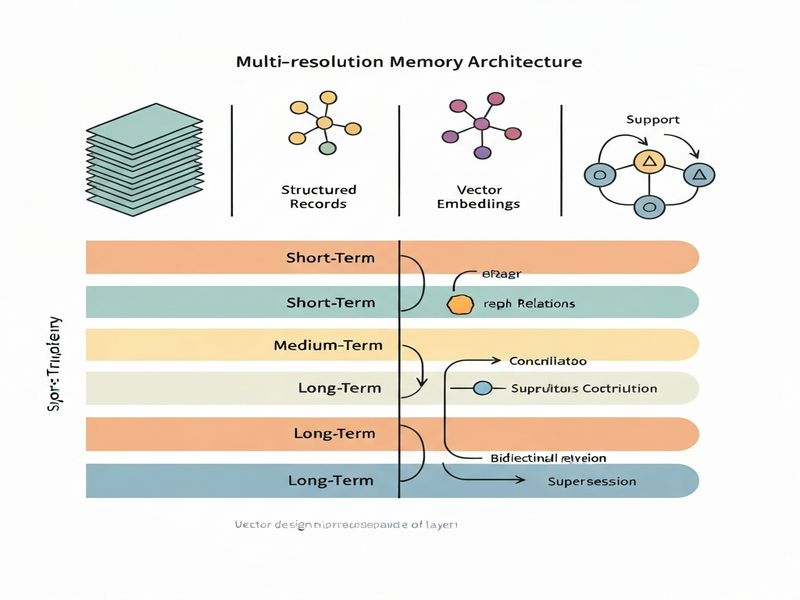
Li and Shi‑Nash propose the Multi‑Resolution Memory Substrate (MRMS), a memory system organized along two orthogonal dimensions:
- Representational Axis:
- Structured Records – canonical, schema‑driven entries that define eligibility for retrieval.
- Vector Embeddings – dense representations that enable fast similarity search.
- Graph Relations – edges that encode support, contradiction, or supersession between records.
- Temporal Axis:
- Short‑Term Traces – raw interaction logs kept for a few minutes.
- Medium‑Term Abstractions – distilled concepts that survive hours to days.
- Long‑Term Semantic Commitments – durable beliefs that persist across weeks or longer.
The central claim is that “reliable personalization is a memory design problem.” By synchronizing the three representational forms, MRMS ensures that a record’s eligibility (structured), its discoverability (vector), and its logical status (graph) are always aligned before the agent projects any context into its reasoning engine.
How It Works in Practice
Conceptual Workflow
- Ingestion: Every interaction generates a raw trace. A lightweight parser extracts key fields (who, what, when, source) and stores them as a structured record.
- Embedding: The same trace is passed through a sentence‑level encoder; the resulting vector is indexed in a nearest‑neighbor store.
- Graph Update: The system evaluates logical relations between the new record and existing nodes (e.g., “User changed address” creates a supersedes edge).
- Consolidation Policy: Temporal policies decide when a short‑term trace graduates to a medium‑term abstraction (e.g., repeated mentions of a preference) or when a long‑term commitment is demoted due to contradictory evidence.
- Pre‑Generation Retrieval: Before the language model generates a response, a gated selector queries the graph for eligible nodes, uses vector similarity to rank them, and finally projects the top‑k records into the prompt.
- Revision Loop: After generation, the agent may request clarification; any new evidence triggers graph‑based revision, ensuring that stale beliefs are automatically flagged.
Component Interaction Diagram (textual)
  [User Input] → [Trace Buffer] → [Parser] → Structured Record
                                   ↘
                                    → [Encoder] → Vector Store
                                   ↘
                                    → [Graph Engine] ↔︎ [Temporal Scheduler]
                                   ↘
                                    → [Retriever] → Prompt Builder → LLM
What distinguishes MRMS from prior memory hacks is the enforced synchrony: a record cannot be retrieved unless its vector exists and its graph status is “active.” This eliminates the “ghost memory” problem where a vector points to a deleted or contradictory fact.
Evaluation & Results
Test Scenarios
The authors built a lightweight prototype and evaluated it on three controlled tasks that mimic long‑lived interactions:
- Evidence‑Bound Question Answering: The agent must answer user queries while citing the exact memory record that supports each claim.
- Contextual Preference Adaptation: Over a simulated week, a user repeatedly changes a product preference; the agent must update its belief without manual reset.
- Contradiction Resolution: Deliberate contradictory statements are injected; the system must detect and supersede the older belief.
Key Findings
- MRMS achieved >90% correct evidence attribution, compared to <70% for a baseline vector‑only store.
- Preference adaptation latency dropped from an average of 4 interactions (baseline) to a single interaction under MRMS, demonstrating rapid consolidation.
- Graph‑driven revision prevented the propagation of outdated facts in 98% of contradictory cases, whereas the baseline persisted with the older belief 35% of the time.
These results illustrate that the multi‑resolution design not only improves factual accuracy but also reduces the number of corrective turns required from users—a critical metric for production‑grade agents.
Why This Matters for AI Systems and Agents
For practitioners building enterprise‑level assistants, the MRMS blueprint offers a concrete path to:
- Scalable Personalization: Structured records let developers enforce data‑privacy policies while still leveraging fast vector search for relevance.
- Robust Auditing: Graph edges provide a traceable lineage of how a belief was formed, supporting compliance and explainability requirements.
- Reduced Hallucination: By gating generation with vetted memory, agents are less likely to fabricate unsupported statements.
- Modular Integration: Each axis (structure, vector, graph) can be swapped with existing services—e.g., using Chroma DB integration for vector storage or the ChatGPT and Telegram integration for real‑time user feedback loops.
In short, MRMS transforms memory from a passive log into an active knowledge base that can be queried, revised, and justified—exactly the capabilities needed for Enterprise AI platforms that promise continuous, trustworthy assistance.
What Comes Next
While the prototype validates the core ideas, several open challenges remain:
- Scalability to Billions of Nodes: Graph databases must handle massive edge counts without sacrificing latency.
- Cross‑Agent Memory Sharing: In multi‑agent ecosystems, synchronizing MRMS instances while preserving privacy is an unsolved problem.
- Learning Temporal Policies: Current policies are hand‑crafted; reinforcement learning could discover optimal consolidation schedules.
- Human‑in‑the‑Loop Revision: Integrating UI tools for domain experts to edit graph edges could accelerate adoption.
Future research may explore hybrid neuro‑symbolic models that generate graph updates directly from raw text, or combine MRMS with AI marketing agents that need to retain campaign histories over years. Companies interested in prototyping MRMS can start by leveraging the UBOS platform overview, which already offers modular memory components and workflow automation studios.
Conclusion
MRMS reframes memory as a disciplined, multi‑resolution substrate rather than an undifferentiated transcript. By aligning structured records, vector similarity, and graph‑based epistemic reasoning across short, medium, and long temporal horizons, the architecture delivers the continuity, selectivity, and revision capabilities that long‑lived AI agents demand. As enterprises push AI deeper into customer‑facing and decision‑support roles, adopting a memory substrate like MRMS could be the decisive factor between fleeting chatbots and truly persistent digital assistants.
Andrii Bidochko
CTO UBOS
Andrii Bidochko is an AI entrepreneur and researcher focused on AI agents, reinforcement learning, and autonomous systems. He writes about the technologies shaping the future of machine intelligence, from frontier models and agent architectures to real-world AI applications.