

- Updated: July 10, 2026
- 6 min read
LLM-as-a-Tutor: Policy-Aware Prompt Adaptation for Non-Verifiable RL
Direct Answer
The paper introduces LLM-as-a-Tutor, a framework that lets a single large language model both judge and adapt training prompts for non‑verifiable reinforcement learning (RL), ensuring that prompt difficulty grows in step with the policy’s capabilities. This matters because it eliminates the reward‑signal collapse that occurs when static prompts become too easy for an improving policy, thereby delivering a self‑calibrating learning signal without external curricula.
Background: Why This Problem Is Hard
Non‑verifiable instruction‑following RL relies on LLM judges that score policy rollouts against handcrafted rubrics. The rubrics can be updated as the policy evolves, but the underlying prompts—often drawn from fixed corpora—remain static. As the policy improves, these prompts stop differentiating between good and mediocre rollouts, causing the judge’s reward signal to flatten. Without a discriminative signal, policy gradients lose direction, and training stalls.
Real‑world deployments amplify the issue. Enterprises that embed LLM‑driven agents in customer‑service or workflow automation need continual skill upgrades. If the training data does not keep pace, agents become over‑fitted to trivial tasks and fail to generalize to more complex, business‑critical instructions. Existing pipelines therefore face a bottleneck: they can adapt the evaluation metric, but they cannot adapt the difficulty of the questions themselves.
What the Researchers Propose
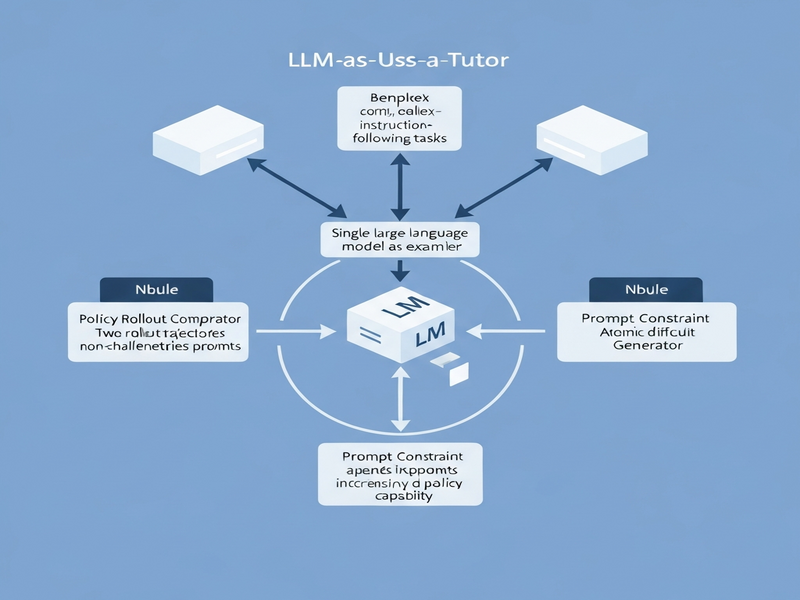
The authors propose a two‑role LLM that acts as both examiner and generator. First, the model pairwise‑compares policy rollouts to spot prompts that no longer create a performance gap. Second, it appends atomic constraints—simple, additive conditions—to those prompts, making them incrementally harder. Because the constraints are only added (never removed), difficulty monotonically increases alongside the policy’s skill level. This “append‑only” design removes the need for an external difficulty schedule and keeps the training signal self‑calibrating.
Key components:
- Examiner LLM: Evaluates two rollouts on the same prompt and decides which is better, effectively acting as a binary judge.
- Prompt Tutor LLM: Generates constraint tokens (e.g., “use at most three steps”, “avoid passive voice”) that are concatenated to the original prompt.
- Policy Learner: The RL agent that receives the adapted prompt, produces a rollout, and is rewarded based on the examiner’s judgment.
How It Works in Practice
The workflow proceeds in three iterative phases:
- Rollout Generation: The policy receives a prompt (potentially already adapted) and generates an answer.
- Examination: The Examiner LLM receives two rollouts for the same prompt and outputs a binary preference, which serves as the reward signal.
- Prompt Adaptation: If the Examiner finds the two rollouts indistinguishable, the Prompt Tutor LLM appends a new constraint to the prompt. The updated prompt is then fed back into the next training iteration.
This loop continues until the Examiner can reliably distinguish between rollouts, indicating that the prompt is sufficiently challenging. Because constraints are only added, the difficulty curve is guaranteed to be non‑decreasing, aligning naturally with the policy’s learning trajectory.
What sets this approach apart is the elimination of a separate “curriculum generator.” Traditional curriculum‑learning methods require a hand‑crafted schedule or a separate model that rewrites entire prompts. LLM-as-a‑Tutor instead leverages the same model for both evaluation and incremental prompt augmentation, reducing system complexity and inference overhead.
Evaluation & Results
The authors benchmarked the framework on three demanding instruction‑following suites:
- Complex Code Generation: Tasks that require multi‑step reasoning and precise API usage.
- Procedural Writing: Long‑form instructions where coherence and ordering matter.
- Dynamic Planning: Scenarios that involve conditional actions and resource constraints.
Across all benchmarks, LLM-as-a‑Tutor consistently outperformed two baselines:
- Policy‑unaware static prompts – where prompts never change.
- Rubric‑only adaptation – where only the reward rubric evolves, but prompts stay fixed.
Key findings include:
- Average reward improvement of 12‑18% over static‑prompt baselines.
- Faster convergence: policies reached target performance 30% sooner when prompts adapted.
- Robustness to prompt distribution shift: the append‑only constraints prevented catastrophic forgetting when new task domains were introduced.
These results demonstrate that prompt adaptation is a missing axis of policy awareness, and that a single LLM can reliably serve both as a judge and a tutor without external supervision.
Why This Matters for AI Systems and Agents
For practitioners building enterprise‑grade agents, the ability to keep training signals informative is crucial. LLM-as-a‑Tutor offers a plug‑and‑play module that can be layered onto existing RL pipelines, delivering:
- Continuous Skill Scaling: Agents automatically face harder instructions as they improve, mirroring human tutoring.
- Reduced Engineering Overhead: No need to maintain separate curriculum generators or manually curate difficulty schedules.
- Better Generalization: By constantly stretching the policy’s limits, agents learn more robust strategies that transfer across domains.
These advantages translate directly into business outcomes. For example, an ChatGPT and Telegram integration could use LLM-as-a‑Tutor to keep its conversational policies sharp, ensuring that automated support agents remain effective as product features evolve. Similarly, the Enterprise AI platform by UBOS can embed this framework to provide self‑improving assistants for sales, HR, or compliance tasks, reducing the need for frequent human‑in‑the‑loop re‑training.
What Comes Next
While the study validates the concept, several open challenges remain:
- Constraint Diversity: Current constraints are atomic and additive; future work could explore hierarchical or semantic constraints that reshape prompt intent more dramatically.
- Multi‑Model Tutors: Leveraging ensembles of LLMs might improve examination reliability, especially for ambiguous tasks.
- Cross‑Domain Transfer: Investigating how constraints learned in one domain affect performance in another could unlock universal tutoring curricula.
Potential applications extend beyond RL. Any system that relies on LLM‑generated content—such as Chroma DB integration for semantic search or ElevenLabs AI voice integration for audio assistants—could benefit from a tutor that incrementally raises task difficulty, ensuring continuous improvement without manual dataset curation.
Developers interested in experimenting with the framework can start by integrating the tutor logic into the Workflow automation studio, where prompt adaptation can be visualized and tuned in real time.
Conclusion
LLM-as-a‑Tutor reframes the role of large language models from passive evaluators to active educators, closing the feedback loop that has long hampered non‑verifiable RL. By appending difficulty‑raising constraints in an automated, monotonic fashion, the framework delivers a self‑calibrating training signal that scales with policy competence. The empirical gains across diverse benchmarks underscore its practical relevance, and the modular design makes it ready for integration into commercial AI platforms.
As enterprises continue to embed LLM‑driven agents in mission‑critical workflows, tools that ensure those agents keep learning—without constant human oversight—will become a strategic differentiator.
Call to Action
Ready to experiment with self‑adapting prompts? Explore the UBOS platform overview for a sandbox environment, or dive straight into the UBOS templates for quick start. For startups seeking a lightweight solution, see UBOS for startups. Larger organizations can evaluate the Enterprise AI platform by UBOS to scale tutoring across teams.
References
LLM-as-a-Tutor: Policy-Aware Prompt Adaptation for Non-Verifiable RL (arXiv)
Andrii Bidochko
CTO UBOS
Andrii Bidochko is an AI entrepreneur and researcher focused on AI agents, reinforcement learning, and autonomous systems. He writes about the technologies shaping the future of machine intelligence, from frontier models and agent architectures to real-world AI applications.