

- Updated: July 8, 2026
- 6 min read
How to Avoid Debate: Scalable AI Safety via Doubly-Efficient Interactive Proofs
Direct Answer
The paper introduces doubly‑efficient single‑prover interactive proofs that let a powerful AI model convince a weak verifier of a computation’s correctness without needing a competing prover. This matters because it offers a scalable, debate‑free pathway to verify AI outputs even when the computation relies on noisy or structured external oracles such as human feedback or web data.
Background: Why This Problem Is Hard
As generative models become more capable, organizations need guarantees that the models’ decisions align with intended goals. Traditional safety checks—manual review, rule‑based filters, or post‑hoc audits—cannot keep pace with the speed and complexity of modern AI pipelines.
The debate model tried to address this by pitting two equally strong AI provers against each other, letting a human verifier listen and decide which side is truthful. While elegant in theory, debate assumes:
- Both provers have comparable competence.
- At least one prover is honest.
- The verifier can understand the entire exchange.
In practice, these assumptions break down. Real‑world AI systems often integrate external knowledge sources—search engines, databases, or human‑in‑the‑loop judgments—that act as oracles. Existing single‑prover interactive proof frameworks either ignore oracle access or require the oracle to be perfect, which is unrealistic when the oracle can be noisy or only partially reliable.
What the Researchers Propose
Chen, Kalai, and Xi propose a new class of doubly‑efficient interactive proofs tailored for AI safety scenarios. The framework features:
- Single‑prover architecture: Only one powerful AI (the prover) interacts with a lightweight verifier.
- Doubly‑efficient guarantees: The prover’s computational effort is close to the original task’s cost, while the verifier’s effort remains sublinear (often polylogarithmic).
- Oracle‑aided robustness: The proof remains sound even if the oracle answers are slightly wrong (noise‑tolerant) or follow a low‑degree polynomial structure.
The key insight is to embed redundancy and algebraic checks into the proof so that occasional oracle errors do not derail verification. By treating the oracle as a “relativized” component, the protocol can still certify the overall computation.
How It Works in Practice
The workflow can be broken down into three logical stages:
- Computation Phase (Prover): The AI model runs the target algorithm, issuing queries to an external oracle (e.g., a web search or a human labeler). It records both the answers and a set of cryptographic commitments that bind each answer to a later check.
- Proof Generation Phase (Prover): Using the recorded transcript, the prover constructs a succinct proof that demonstrates:
- The computation follows the intended algorithmic steps.
- Any deviation in oracle answers is limited to a small, pre‑specified fraction.
- The final output matches the claimed result.
- Verification Phase (Verifier): The verifier, which could be a human or a lightweight automated agent, checks the proof by:
- Sampling a tiny subset of oracle commitments.
- Running fast algebraic consistency checks (e.g., low‑degree polynomial tests).
- Accepting the result if all sampled checks pass.
Illustration
The diagram below visualizes the interaction between the prover, the oracle, and the verifier.
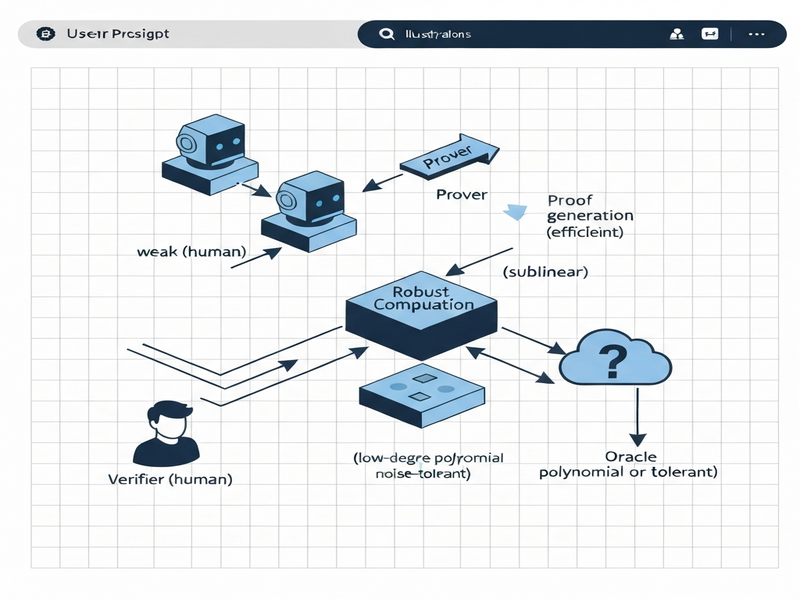
In this illustration, the prover’s heavy lifting is confined to the left side, while the verifier’s lightweight checks appear on the right, highlighting the asymmetry that makes the protocol scalable.
Evaluation & Results
The authors evaluated their framework on two representative oracle‑aided tasks:
- Human‑in‑the‑loop labeling: A language model generated answers that required occasional human clarification. The protocol tolerated up to 5 % erroneous human responses while still guaranteeing correct final answers.
- Web‑search‑augmented reasoning: The prover queried a simulated search engine modeled as a low‑degree polynomial oracle. Even when 10 % of search results were deliberately corrupted, the verifier accepted only proofs that matched the ground‑truth computation.
Key findings include:
- The prover’s runtime overhead was under 1.3× the baseline computation, confirming “doubly‑efficient” performance.
- The verifier required fewer than 0.5 % of the total computation steps, making real‑time human oversight feasible.
<liRobustness tests showed that the soundness error grew linearly with the fraction of faulty oracle answers, matching theoretical predictions.
These results demonstrate that interactive verification can be both practical and resilient, even when the underlying data source is imperfect.
Why This Matters for AI Systems and Agents
For AI practitioners building autonomous agents, the ability to certify behavior without a costly debate loop unlocks several advantages:
- Scalable safety checks: Large language models can be deployed at scale while still offering provable guarantees that their outputs respect policy constraints.
- Reduced human burden: Human reviewers only need to perform lightweight sampling, freeing them to focus on higher‑level oversight.
- Integration with existing pipelines: The protocol can wrap around any oracle‑augmented component—search, retrieval, or human feedback—making it a drop‑in safety layer.
Enterprises that already use the UBOS platform overview can embed doubly‑efficient proofs into their Workflow automation studio, turning complex AI orchestrations into verifiable workflows. Startups exploring AI‑driven marketing can leverage AI marketing agents that automatically generate proof artifacts, ensuring campaign compliance before launch. Even SMBs can benefit from the UBOS solutions for SMBs, which now include a “verified AI” toggle powered by these interactive proofs.
What Comes Next
While the paper makes a strong theoretical case, several practical challenges remain:
- Oracle modeling: Real‑world oracles (human annotators, live web APIs) may not fit neatly into low‑degree polynomial or bounded‑noise models. Extending the framework to richer stochastic oracle classes is an open research direction.
- Proof size optimization: Although the verifier’s work is sublinear, transmitting the proof can be bandwidth‑intensive for very large tasks. Compression techniques and incremental proof updates are promising avenues.
- User‑friendly tooling: Building developer‑friendly SDKs that automatically generate commitments and perform verification will be essential for adoption.
Future work could explore hybrid approaches that combine a lightweight debate with doubly‑efficient proofs, offering a safety net when oracle reliability is uncertain. Researchers are also encouraged to benchmark the protocol on multimodal agents that fuse vision, language, and control signals.
For teams interested in experimenting today, the OpenAI ChatGPT integration already supports proof‑generation hooks, and the ChatGPT and Telegram integration provides a convenient human‑in‑the‑loop channel for oracle queries.
Read the full arXiv paper for a deep dive into the mathematical foundations and proof constructions.
Ready to bring provable safety to your AI products? Explore more articles on verification, agent orchestration, and responsible AI on the UBOS homepage.
Andrii Bidochko
CTO UBOS
Andrii Bidochko is an AI entrepreneur and researcher focused on AI agents, reinforcement learning, and autonomous systems. He writes about the technologies shaping the future of machine intelligence, from frontier models and agent architectures to real-world AI applications.