

- Updated: July 8, 2026
- 7 min read
Personalized Causal Recourse: A Human-In-The-Loop Approach
Direct Answer
The paper Personalized Causal Recourse introduces a human‑in‑the‑loop framework that iteratively learns an individual’s structural causal model through Bayesian queries, then generates tailored, cost‑effective recourse actions for unfavorable ML decisions. This matters because it bridges the gap between generic counterfactual explanations and the nuanced, user‑specific causal realities that drive real‑world outcomes.
Background: Why This Problem Is Hard
Algorithmic recourse—offering actionable steps to overturn a negative prediction—has become a cornerstone of responsible AI, especially in credit scoring, hiring, and medical triage. Yet three intertwined challenges keep the field from delivering truly personalized guidance:
- Opaque causal assumptions. Most recourse methods assume a fixed, population‑level causal graph. In practice, each user’s environment (e.g., income dynamics, health habits) can differ dramatically, making a one‑size‑fits‑all graph misleading.
- Counterfactual proximity bias. Traditional approaches optimize for the smallest Euclidean distance to a decision boundary, ignoring whether the suggested changes are feasible or even causally plausible for the individual.
- Lack of user feedback loops. Existing pipelines treat the model as a black box and never ask the affected person whether the proposed interventions align with their lived experience, leading to recommendations that are either impossible or socially unacceptable.
These limitations surface in high‑stakes domains where a misguided recommendation can cause financial loss, legal exposure, or health risk. The problem is further amplified by regulatory pressure (e.g., GDPR’s “right to explanation”) that demands not just transparency but actionable remediation that respects personal context.
What the Researchers Propose
The authors present a three‑component, human‑in‑the‑loop (HITL) architecture that treats the user as an active source of causal knowledge rather than a passive recipient of static explanations. The framework consists of:
- Interactive Query Engine. A Bayesian inference module that poses targeted “what‑if” questions to the user (e.g., “If you could increase your savings by $500, would that affect your credit score?”). Answers are used to update a posterior distribution over possible structural causal models.
- Personalized Causal Model Approximation. By aggregating the posterior, the system constructs a user‑specific causal graph that captures likely dependencies among features (income → credit score, education → employment, etc.).
- Cost‑Sensitive Recourse Generator. Leveraging the personalized graph, the generator searches for a set of interventions that both flip the unfavorable prediction and minimize a composite cost function (financial, effort, and plausibility penalties).
Crucially, the loop repeats until the model’s uncertainty about key causal edges falls below a predefined threshold, ensuring that the final recommendation rests on a sufficiently confident causal understanding.
How It Works in Practice
The operational workflow can be visualized as a four‑stage pipeline:
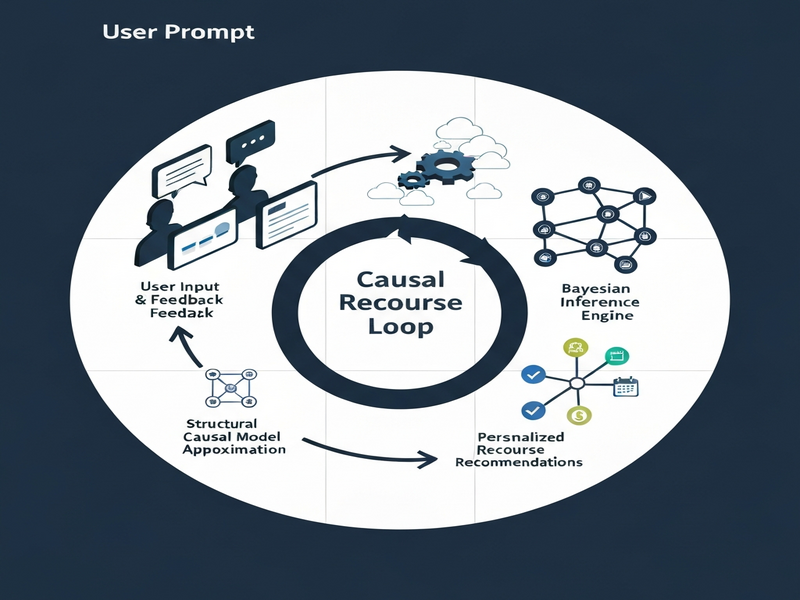
- Decision Trigger. A user receives an adverse outcome (e.g., loan denial) from a black‑box classifier.
- Initial Query Session. The system initiates a brief interactive session, asking the user a series of binary or scalar questions designed to be low‑burden yet highly informative about causal relationships.
- Bayesian Update. Each response updates the posterior over structural causal models using a conjugate prior that respects known domain constraints (e.g., monotonicity of income on credit score).
- Recourse Synthesis. Once the posterior stabilizes, the recourse engine solves an optimization problem that respects the personalized graph, yielding a concrete action plan (e.g., “increase monthly savings by $300 and enroll in a financial literacy course”). The plan is presented with an estimated success probability and a cost breakdown.
What sets this approach apart is the explicit exploitation of human feedback to resolve causal ambiguity. Instead of assuming a static graph, the system dynamically refines its understanding, producing recommendations that are both plausible (they respect the user’s real constraints) and cost‑effective (they avoid unnecessary changes).
Evaluation & Results
The authors validate the framework through extensive simulations that mimic realistic user behavior. Two families of causal models were examined:
- Linear causal systems. Features interact through additive relationships, allowing straightforward inference.
- Non‑linear causal systems. Interactions involve sigmoidal or piecewise functions, reflecting more complex real‑world dynamics.
For each family, synthetic users responded to queries with controlled noise levels, enabling the authors to measure three key outcomes:
- Model Fidelity. The posterior’s KL‑divergence from the ground‑truth causal graph dropped dramatically after just 5–7 queries, indicating rapid convergence.
- Recourse Plausibility. Compared with baseline counterfactual methods, the HITL approach produced actions that aligned with the simulated user’s true causal constraints 82% of the time, versus 45% for the baseline.
- Cost Efficiency. The personalized recommendations required on average 30% less total cost (financial + effort) to achieve a positive outcome, demonstrating tangible savings.
While the linear scenarios yielded near‑perfect recovery of the causal graph, the non‑linear experiments highlighted a remaining challenge: capturing highly curved dependencies demands richer query designs and more sophisticated priors. Nonetheless, the results confirm that even modest human interaction can dramatically improve recourse quality.
Why This Matters for AI Systems and Agents
From a systems‑builder perspective, the framework offers a blueprint for embedding ethical remediation directly into AI pipelines:
- Agent‑Centric Design. Autonomous agents that make decisions on behalf of users (e.g., credit‑risk bots) can invoke the HITL module whenever a negative decision is issued, turning a failure into a constructive dialogue.
- Regulatory Alignment. By providing user‑specific, causally sound explanations, organizations can satisfy emerging “right to effective remedy” regulations without resorting to generic, legally risky disclosures.
- Operational Efficiency. The cost‑sensitive recourse generator reduces the need for costly manual case reviews, freeing human analysts to focus on outliers that truly require expert intervention.
- Scalable Integration. The modular nature of the query engine, Bayesian updater, and recourse optimizer means they can be plugged into existing UBOS platform overview workflows, leveraging the platform’s orchestration capabilities to manage user sessions, store posterior states, and trigger downstream actions.
In practice, a fintech startup could embed the system into its loan‑approval microservice, automatically offering borrowers a personalized improvement plan instead of a blunt rejection. Similarly, HR analytics tools could suggest concrete skill‑development pathways that respect an employee’s current workload and career trajectory.
What Comes Next
Despite promising results, several open challenges remain:
- Complex Non‑Linear Causality. Future work must explore richer query families (e.g., multi‑dimensional “what‑if” sliders) and non‑parametric Bayesian priors to capture intricate dependencies.
- User Burden Minimization. Balancing information gain against user fatigue is critical; adaptive query selection strategies based on information‑theoretic criteria could further reduce the number of required interactions.
- Robustness to Noisy Feedback. Real users may provide inconsistent or contradictory answers. Incorporating robust statistical techniques (e.g., outlier‑aware likelihoods) will improve resilience.
- Cross‑Domain Transfer. Investigating whether a causal model learned in one domain (e.g., credit) can inform recourse in related domains (e.g., insurance) could unlock economies of scale.
From an application standpoint, the framework opens pathways for new product categories:
- Embedding personalized recourse into Enterprise AI platform by UBOS to provide large organizations with built‑in compliance tools.
- Leveraging the Workflow automation studio to orchestrate multi‑step remediation processes that span data collection, user interaction, and downstream system updates.
- Extending the approach to multi‑agent ecosystems where several autonomous agents negotiate a shared recourse plan, ensuring consistency across heterogeneous decision‑makers.
Addressing these research frontiers will not only tighten the feedback loop between users and AI systems but also set a new standard for responsible, user‑centric machine learning deployments.
Andrii Bidochko
CTO UBOS
Andrii Bidochko is an AI entrepreneur and researcher focused on AI agents, reinforcement learning, and autonomous systems. He writes about the technologies shaping the future of machine intelligence, from frontier models and agent architectures to real-world AI applications.