

- Updated: July 8, 2026
- 6 min read
Evaluating Generative Agents with Actions Grounded in Socially Distributed Task Environments using Incognita
Direct Answer
The paper introduces Incognita, a modular framework that separates social communication from grounded execution, enabling rigorous evaluation of generative agents operating in environments where critical knowledge is split across isolated roles. It matters because it surfaces the hidden steps—knowledge elicitation, source selection, and premature‑completion bias—that current benchmarks overlook, giving developers a clearer picture of where agent reliability still falls short.
Background: Why This Problem Is Hard
Real‑world AI assistants rarely act in a vacuum. In retail, customer support, or collaborative planning, the information needed to complete a task is often scattered among multiple stakeholders—think of a sales rep, inventory manager, and shipping clerk each holding a piece of the puzzle. Existing benchmarks either focus on pure language interaction (e.g., dialogue‑only simulations) or on isolated tool use (e.g., code execution), but they rarely combine both dimensions.
Key challenges include:
- Knowledge partitioning: Agents must discover who knows what before they can act.
- Action grounding: Even after gathering the right facts, the agent must issue a concrete operation that changes the environment state.
- Evaluation fidelity: Measuring success requires tracking both the conversational path and the final world state, which most single‑modal tests ignore.
Because of these gaps, developers have limited insight into failure modes such as “the agent thinks it has finished” or “the agent asks the wrong person for a key detail.” Incognita aims to fill that blind spot.
What the Researchers Propose
Incognita is built on the premise that social interaction (asking questions, routing messages) and grounded execution (writing to a database, moving inventory) should be treated as distinct yet coordinated subsystems. The framework introduces four logical layers:
- Message Router: Directs each outgoing utterance either to a human user or to a specialized “entity” (e.g., a product‑catalog specialist).
- Specialist Mediators: Domain‑specific agents that validate whether a requested operation is permissible and translate high‑level intents into concrete commands.
- Deterministic Sub‑Environment: A sandbox that executes accepted commands against a canonical state, guaranteeing reproducible outcomes.
- Offline Evaluator: Scores the final state against inherited reward functions, while also logging intermediate metrics such as hidden‑knowledge extraction.
By decoupling these layers, Incognita can plug any generative language model into the same social‑task pipeline, making performance comparisons fair and transparent.
How It Works in Practice
Conceptual Workflow
The agent’s reasoning loop follows a three‑step cycle:
- Explore: The agent sends a message to the router asking for clarification or requesting a specific entity’s input.
- Mediate: The chosen specialist checks the request against its knowledge base, possibly rejecting it or returning a structured payload (e.g., a product ID).
- Exploit: If the payload is admissible, the deterministic sub‑environment applies the operation (e.g., “add item to cart”) and updates the world state.
This loop repeats until the evaluator determines that the task’s goal state has been reached—or until the agent prematurely declares completion.
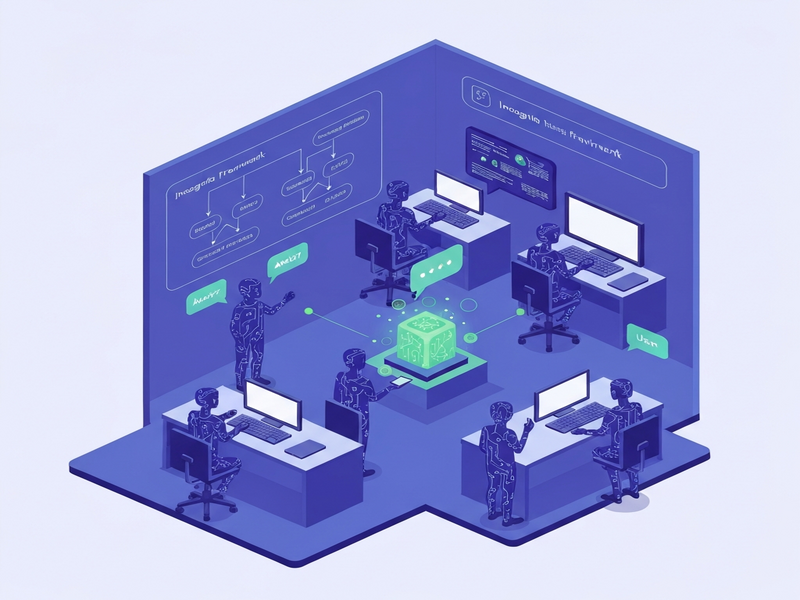
Component Interaction Diagram
What Sets Incognita Apart
- Role‑Isolated Knowledge: Unlike monolithic environments, each specialist holds exclusive data, forcing the agent to perform genuine information‑seeking.
- Deterministic Grounding: The sub‑environment guarantees that the same command always yields the same state change, eliminating stochastic noise in evaluation.
- Offline Scoring: Rewards are computed after the episode, allowing researchers to retroactively apply multiple metrics (e.g., hidden‑knowledge count, premature‑finalization rate).
Evaluation & Results
Task Suite: Incognita‑Retail
To demonstrate the framework, the authors transformed the public tau‑bench retail benchmark into a multi‑entity scenario called Incognita‑Retail. The environment retained the original end‑state reward (successful purchase) but distributed knowledge across three specialist roles:
- Customer Service Agent – knows customer preferences.
- Inventory Manager – knows stock levels.
- Payment Processor – validates payment methods.
Experimental Design
Three generative agent models (baseline, mid‑tier, and state‑of‑the‑art) were run on 18 distinct tasks, each repeated 30 times for a total of 540 trials. Metrics captured:
- Overall success rate (final state matches goal).
- Premature finalization (agent stops before achieving the goal).
- Number of hidden‑knowledge queries issued.
- Frequency of grounded write attempts.
Key Findings
| Metric | Baseline | Mid‑Tier | State‑of‑the‑Art |
|---|---|---|---|
| Success Rate | 0 % | 8.9 % | 17.2 % |
| Premature Completion | 100 % | 87 % | 58 % |
| Hidden‑Knowledge Queries | Few | Moderate | Many |
| Grounded Writes Attempted | Rare | Occasional | Frequent |
Even the strongest model succeeded on fewer than one‑fifth of the tasks, highlighting a substantial reliability gap. However, the upward trend in success correlates with more aggressive knowledge‑seeking and higher willingness to issue grounded actions, suggesting a clear path for improvement.
Why This Matters for AI Systems and Agents
Incognita surfaces failure modes that are invisible in traditional language‑only benchmarks. For practitioners building enterprise‑grade agents, the framework offers:
- Actionable diagnostics: By logging each knowledge‑request and write attempt, developers can pinpoint whether an agent is “talking” enough before it “does.”
- Cross‑role orchestration insights: The specialist‑mediator pattern mirrors real‑world micro‑service architectures, making the evaluation directly translatable to production pipelines.
- Risk mitigation: Premature finalization is a safety concern; Incognita quantifies it, enabling early‑stage mitigation strategies such as confidence‑threshold gating.
These capabilities align with the needs of UBOS platform overview, where AI agents must coordinate across chat, voice, and database layers while preserving business‑critical state integrity.
What Comes Next
While Incognita marks a significant step forward, several limitations remain:
- Scalability of specialists: Current experiments use three handcrafted roles; real enterprises may involve dozens of services.
- Dynamic knowledge updates: The framework assumes static role knowledge during an episode, whereas production systems often see inventory or policy changes in real time.
- Human‑in‑the‑loop evaluation: Offline scoring is useful for research, but integrating live user feedback would close the loop for continuous improvement.
Future research directions could explore:
- Automated generation of specialist agents from existing APIs, reducing manual engineering effort.
- Adaptive routing policies that learn which entity to query based on past success rates.
- Hybrid reward models that blend deterministic state checks with human satisfaction signals.
Practically, organizations can start experimenting with Incognita‑style pipelines by leveraging existing integrations such as the ChatGPT and Telegram integration or the Chroma DB integration to simulate specialist knowledge bases.
For a deeper dive into the original research, see the arXiv paper. The authors also discuss how Incognita could be extended to domains beyond retail, such as healthcare triage or multi‑agent negotiation.
Call to Action
Ready to prototype socially aware agents that can both converse and act reliably? Explore the About UBOS page to learn how our platform supports modular agent orchestration, or visit the UBOS blog for tutorials on building end‑to‑end workflows with the tools highlighted above. Accelerate your AI product roadmap by adopting evaluation practices that reflect real‑world complexity today.
Andrii Bidochko
CTO UBOS
Andrii Bidochko is an AI entrepreneur and researcher focused on AI agents, reinforcement learning, and autonomous systems. He writes about the technologies shaping the future of machine intelligence, from frontier models and agent architectures to real-world AI applications.