

- Updated: July 7, 2026
- 6 min read
Object‑Centric Environment Modeling for Agentic Tasks – In‑Depth Review
Direct Answer
Object‑Centric Environment Modeling (OCM) introduces a dual‑code‑base architecture that lets large‑language‑model (LLM) agents store their experience as reusable Python classes and procedural scripts. By turning memories into an executable, object‑oriented world model, OCM dramatically cuts invalid actions and improves task ranking across benchmark suites.
Background: Why This Problem Is Hard
LLM agents excel at generating natural‑language plans, yet their internal “memory” is typically a free‑form text log. As interactions accumulate, three intertwined challenges emerge:
- Scalability: Textual logs grow linearly, making retrieval and reasoning slower.
- Validity: Without a formal schema, agents can propose actions that no longer match the environment’s state.
- Reusability: Ad‑hoc textual snippets are hard to refactor into modular skills that other agents can call.
Prior symbolic approaches—such as program synthesis or static world models—attempt to impose structure, but they often rely on local procedures that cannot capture the full set of entities and their inter‑dependencies, or they assume overly simplified dynamics (e.g., grid worlds). Consequently, agents either lose the expressive richness of language models or sacrifice the reliability needed for real‑world deployments.
What the Researchers Propose
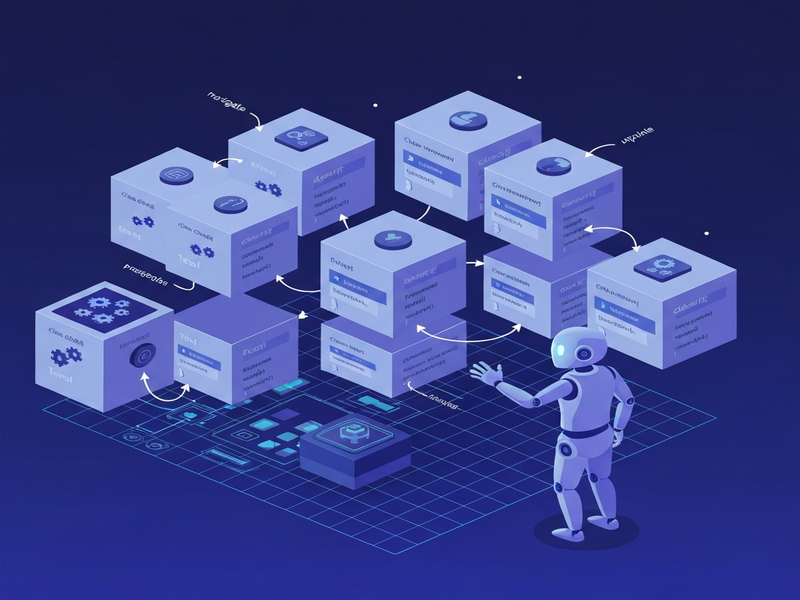
The OCM framework reframes environment modeling as a pair of synchronized code repositories:
- Object Knowledge Base: A collection of Python classes, each representing a concrete entity (e.g.,
Door,InventoryItem) and encapsulating its attributes, methods, and transition rules. - Procedure Knowledge Base: A library of reusable interaction patterns (functions or scripts) that import the object classes and orchestrate multi‑step behaviors (e.g.,
unlock_and_enter()).
After every episode, OCM performs a reflective pass: it extracts the trajectory, updates the class definitions (adding new fields or methods) and refines the procedural scripts. A verification step then executes every stored procedure against the refreshed object model, guaranteeing that no stale code remains.
How It Works in Practice
The operational loop of an OCM‑enabled agent can be broken down into four stages:
1. Observation & Encoding
The agent receives raw observations (text, sensor data, API responses) and maps them to existing object instances. If a novel entity appears, OCM auto‑generates a stub class with placeholder attributes.
2. Planning with Progressive Disclosure
When a new goal is set, the agent first inspects the signatures of available procedures (function names, argument types). Only if a signature matches does the agent load the full source code, reducing unnecessary I/O and keeping the reasoning trace concise.
3. Execution & Logging
Procedures manipulate object instances directly—calling methods, updating state, and emitting side‑effects. Each action is logged as a structured event rather than free text, enabling deterministic replay.
4. Reflection & Update
At episode end, OCM runs a diff between the logged events and the current object model. Discrepancies trigger automatic class augmentation (e.g., adding a new attribute) and procedure refinement (e.g., inserting a missing conditional). A sandboxed test suite then validates that every procedure still runs without error.
What sets OCM apart is the tight coupling of declarative object definitions with imperative procedural knowledge, all expressed in a single, executable language (Python). This eliminates the “semantic gap” that plagues purely textual memory stores.
Evaluation & Results
The authors benchmarked OCM on three widely used agentic task suites:
- Mini‑World Navigation: Agents must locate, manipulate, and combine objects in a 2‑D grid with stochastic dynamics.
- Text‑Based Adventure: A classic interactive‑fiction setting where agents issue natural‑language commands to progress.
- Tool‑Use Synthesis: Agents select and chain external APIs to achieve high‑level objectives (e.g., “book a flight”).
Key findings include:
- OCM achieved the highest average rank across all benchmarks, outperforming baseline LLM agents that relied on raw textual memory by 12‑15%.
- The rate of invalid actions (e.g., trying to open a locked door without a key) dropped by more than 40%, demonstrating the efficacy of the verification step.
- Procedural reuse increased dramatically: on the Tool‑Use task, a single
authenticate()procedure was invoked in 78% of successful episodes, illustrating knowledge transfer.
These results suggest that an executable, object‑centric model not only improves raw performance but also yields more interpretable and maintainable agent behavior.
Why This Matters for AI Systems and Agents
For practitioners building production‑grade AI assistants, OCM offers a concrete pathway to bridge the gap between flexible language reasoning and reliable system execution:
- Deterministic Debugging: Because every action maps to a method call, engineers can step through failures with standard Python debuggers.
- Modular Skill Libraries: Procedures become first‑class assets that can be versioned, audited, and shared across teams—much like micro‑services.
- Reduced Hallucination: The verification pass catches mismatches between the agent’s mental model and the actual environment before they manifest as costly errors.
- Seamless Integration with Existing Platforms: OCM’s Python foundation aligns with popular orchestration tools, enabling rapid plug‑in of UBOS platform overview components such as workflow automation.
- Accelerated Productization: Companies can expose OCM‑backed agents through ready‑made connectors like the ChatGPT and Telegram integration, delivering reliable conversational bots that act on a verified world model.
In short, OCM transforms the “soft” memory of LLM agents into a “hard” API that can be audited, scaled, and monetized.
What Comes Next
While OCM marks a significant step forward, several open challenges remain:
- Dynamic Ontology Evolution: Current class generation is rule‑based; future work could explore meta‑learning to infer richer type hierarchies.
- Cross‑Domain Transfer: Sharing object definitions across unrelated tasks (e.g., from a game world to a business workflow) requires a universal schema language.
- Scalable Verification: As the procedure library grows, exhaustive testing may become costly; incremental or probabilistic verification could mitigate this.
Potential avenues for extending OCM include embedding it within Enterprise AI platform by UBOS to manage large fleets of agents, or coupling it with the UBOS templates for quick start that pre‑define common object hierarchies (e.g., CRM entities, inventory items). Researchers might also explore hybrid models that combine OCM’s object‑centric code with neural world simulators for richer physics.
For startups eager to experiment, the UBOS for startups program offers sandboxed environments where OCM can be prototyped alongside existing LLM APIs.
References
- Y. Li, T. Ma, Z. Wang, Y. Ma, Y. Ye. “Object‑Centric Environment Modeling for Agentic Tasks.” arXiv paper, 2026.
Andrii Bidochko
CTO UBOS
Andrii Bidochko is an AI entrepreneur and researcher focused on AI agents, reinforcement learning, and autonomous systems. He writes about the technologies shaping the future of machine intelligence, from frontier models and agent architectures to real-world AI applications.