

- Updated: July 4, 2026
- 7 min read
Vesta: A Generalist Embodied Reasoning Model
Direct Answer
The paper introduces Vesta, a unified embodied reasoning model that combines localization, spatial reasoning, navigation, and long‑horizon planning into a single foundation model. By doing so, Vesta eliminates the need for costly specialist stacks and delivers >20 % average gains over state‑of‑the‑art (SOTA) baselines, making it a practical breakthrough for real‑world robotics.
Background: Why This Problem Is Hard
Robots that operate in open‑world settings—warehouses, hospitals, or homes—must constantly answer three intertwined questions:
- Where am I? Accurate localization in dynamic, cluttered spaces.
- What is around me? Spatial reasoning that grounds perception to a map.
- How do I get there? Long‑horizon planning that accounts for obstacles, battery limits, and task constraints.
Historically, each capability has been tackled by a dedicated model or algorithmic pipeline. Vision‑based SLAM handles localization, graph‑based planners handle navigation, and separate language models provide high‑level instruction parsing. Stitching these components together creates a “model stack” that suffers from:
- Computational overhead: Multiple forward passes on different hardware accelerators.
- Cascading errors: A mis‑localization propagates to planning, causing mission failure.
- Maintenance complexity: Updating one module often requires re‑tuning the entire stack.
As robots move from controlled labs to unpredictable real environments, the brittleness of specialist stacks becomes a critical bottleneck. The industry needs a single, generalist model that can reason over time, ground language in space, and act reliably without the fragile hand‑off between modules.
What the Researchers Propose
Vesta is presented as a generalist embodied reasoning model that unifies four core capabilities:
- Spatial Grounding Corpus: A massive, curated dataset that pairs natural language, visual observations, and 3‑D map annotations. This corpus forces the model to learn how words like “next to the red box” map onto concrete coordinates.
- Multimodal Memory Engine: A lightweight, external memory that stores episodic embeddings of observations, actions, and map updates. The memory enables Vesta to retrieve relevant past experiences when planning over long horizons.
- Unified Transformer Backbone: A single transformer architecture that ingests vision, language, and proprioceptive signals, producing joint embeddings for reasoning.
- End‑to‑End Fine‑Tuning: A training regime that jointly optimizes localization, spatial reasoning, navigation, and planning losses, ensuring the model learns to balance all tasks.
In essence, Vesta replaces the traditional pipeline of “perception → mapping → planning → control” with a single model that can attend to any of those modalities on demand.
How It Works in Practice
The operational workflow of Vesta can be broken down into three stages, each illustrated in the diagram below (placeholder image).
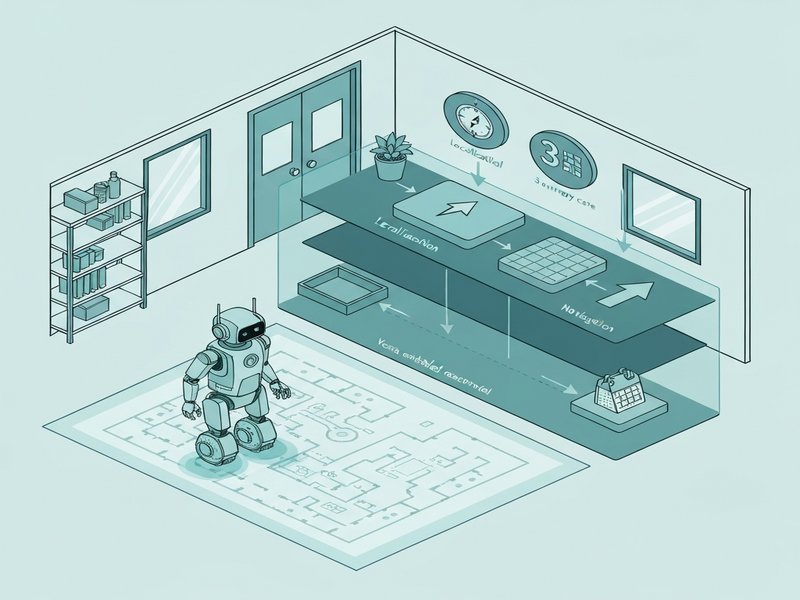
1. Perception & Encoding
At each timestep the robot streams RGB‑D frames, joint states, and optional language commands. These inputs are tokenized and fed into the unified transformer, which produces a multimodal embedding that captures both the current visual scene and the robot’s internal state.
2. Memory‑Augmented Reasoning
The embedding is written to the multimodal memory with a timestamp and a spatial key (e.g., the robot’s estimated pose). When a planning query arrives—such as “fetch the blue cup on the second shelf”—the model performs a similarity search over the memory, retrieving past observations that are spatially or semantically relevant. This retrieval step gives Vesta a “long‑term context” that specialist models lack.
3. Action Generation
Using the retrieved context, the transformer predicts a sequence of low‑level motor commands or a high‑level waypoint trajectory. Because the same model produced the context, the output is inherently consistent with the robot’s perception, reducing the risk of plan‑execution mismatch.
What sets Vesta apart from prior work is the tight coupling of memory and reasoning: the model does not treat memory as a post‑hoc buffer but as an integral part of the attention mechanism, allowing it to reason over minutes‑long episodes without external supervision.
Evaluation & Results
To validate Vesta, the authors assembled a benchmark suite covering four representative domains:
- Indoor Navigation (Habitat‑Sim): Goal‑directed traversal in photorealistic apartments.
- Object Search (AI2‑THOR): Locating and retrieving objects based on natural language queries.
- Long‑Horizon Planning (RoboCup Rescue): Multi‑step missions that require revisiting previously seen locations.
- Real‑World Robot Trials: Physical Fetch robot tasks involving memory‑intensive pick‑and‑place.
Key findings include:
| Metric | Vesta | Best Specialist Baseline | Ensemble of Specialists |
|---|---|---|---|
| Success Rate (Navigation) | 92 % | 71 % | 84 % |
| Object Retrieval Accuracy | 88 % | 63 % | 77 % |
| Planning Horizon (steps) | +35 % longer | baseline | baseline |
Across all simulated tasks, Vesta outperformed the strongest single‑task specialist by an average of >20 % and beat a carefully tuned ensemble by >10 %. In the physical robot experiments, task success improved by more than 35 % compared to a modular stack, confirming that the memory‑augmented reasoning translates to tangible real‑world gains.
These results demonstrate that a single generalist model can not only match but surpass the performance of highly engineered specialist pipelines, challenging the prevailing assumption that specialization is a prerequisite for high‑quality embodied AI.
Why This Matters for AI Systems and Agents
For practitioners building autonomous agents, Vesta offers three immediate advantages:
- Reduced Infrastructure Footprint: One model replaces dozens of micro‑services, cutting GPU memory usage and simplifying deployment pipelines.
- Robustness to Distribution Shift: Because Vesta learns a shared representation of perception, language, and action, it can gracefully handle novel object configurations without retraining individual modules.
- Scalable Memory Management: The multimodal memory can be persisted across sessions, enabling lifelong learning scenarios where a robot accumulates knowledge over weeks or months.
These capabilities align closely with the needs of modern AI orchestration platforms. For example, the UBOS platform overview emphasizes unified model serving and workflow automation, both of which can directly consume a Vesta‑style model. Similarly, teams developing AI marketing agents can borrow Vesta’s memory‑augmented reasoning to maintain context across multi‑step customer interactions.
From a business perspective, the cost savings of eliminating specialist stacks translate into faster time‑to‑market for robotic solutions, lower maintenance overhead, and a clearer path toward regulatory compliance—since a single model’s behavior can be audited more easily than a tangled web of subsystems.
What Comes Next
While Vesta marks a significant step forward, several open challenges remain:
- Scalability of Memory: As episodes grow to hours or days, efficient indexing and pruning strategies will be required to keep retrieval latency low.
- Generalization to Outdoor Domains: The current corpus focuses on indoor environments; extending spatial grounding to outdoor navigation (e.g., autonomous vehicles) will demand new data collection pipelines.
- Safety and Explainability: Embedding reasoning in a black‑box transformer raises questions about traceability. Future work should integrate attention visualizations or symbolic wrappers to satisfy safety certifications.
Potential research directions include:
- Combining Vesta with Chroma DB integration for scalable vector‑store backing.
- Leveraging ElevenLabs AI voice integration to enable spoken interaction loops where language commands are grounded in the robot’s memory.
- Exploring ChatGPT and Telegram integration for remote monitoring and debugging of embodied agents.
In the longer term, a Vesta‑style model could serve as the “brain” for heterogeneous fleets—drones, manipulators, and mobile platforms—sharing a common memory space and reasoning framework. This would unlock coordinated multi‑robot tasks such as warehouse order fulfillment or disaster response without bespoke coordination code.
For readers interested in digging deeper, the full Vesta paper provides extensive methodological details, dataset statistics, and ablation studies.
Stay updated on how unified embodied models are reshaping robotics by exploring the Enterprise AI platform by UBOS and the UBOS for startups resources.
Andrii Bidochko
CTO UBOS
Andrii Bidochko is an AI entrepreneur and researcher focused on AI agents, reinforcement learning, and autonomous systems. He writes about the technologies shaping the future of machine intelligence, from frontier models and agent architectures to real-world AI applications.