

- Updated: July 3, 2026
- 6 min read
FOCA: Future-Oriented Conditioning for Data-Efficient Vision-Language-Action Adaptation
Direct Answer
FOCA (Future‑Oriented Conditioning) is a new framework that lets vision‑language‑action (VLA) models learn robotic tasks from only a handful of demonstrations. By predicting where a task will go next in a latent space, FOCA dramatically improves data‑efficiency, achieving near‑perfect success on benchmarks with as few as 20 examples.
Background: Why This Problem Is Hard
Robotic control systems that combine visual perception, natural‑language instructions, and motor actions—known as VLA models—have shown impressive generality when trained on massive multimodal datasets. However, real‑world deployment rarely offers such luxury. Engineers often have to teach a robot a new behavior using a few human‑provided demos, a scenario called few‑shot imitation learning. In this regime, two fundamental challenges emerge:
- Sparse supervision: Each demonstration provides only a short trajectory, leaving the model to infer long‑range dependencies from limited data.
- Distribution shift: Pre‑trained VLA models are biased toward the data distribution they saw during large‑scale training. When a new task deviates from that distribution, the model’s internal representations become misaligned, causing rapid performance degradation.
State‑of‑the‑art adaptation techniques—such as fine‑tuning on the few demos or adding auxiliary losses—have mitigated these issues only marginally. Empirical stress tests on leading VLA architectures reveal a steep drop in success rate once the number of demos falls below 30, exposing a critical weakness for any commercial or research robot that must adapt on the fly.
What the Researchers Propose
The FOCA framework tackles the few‑shot bottleneck by shifting the adaptation focus from “what should I do now?” to “where will the task lead me next?”. In concrete terms, FOCA introduces two complementary mechanisms:
- Future‑oriented latent prediction: The model learns to embed the expected future interaction—both the visual observation and the corresponding action—into a shared latent space. This prediction is conditioned on the current language instruction and visual context.
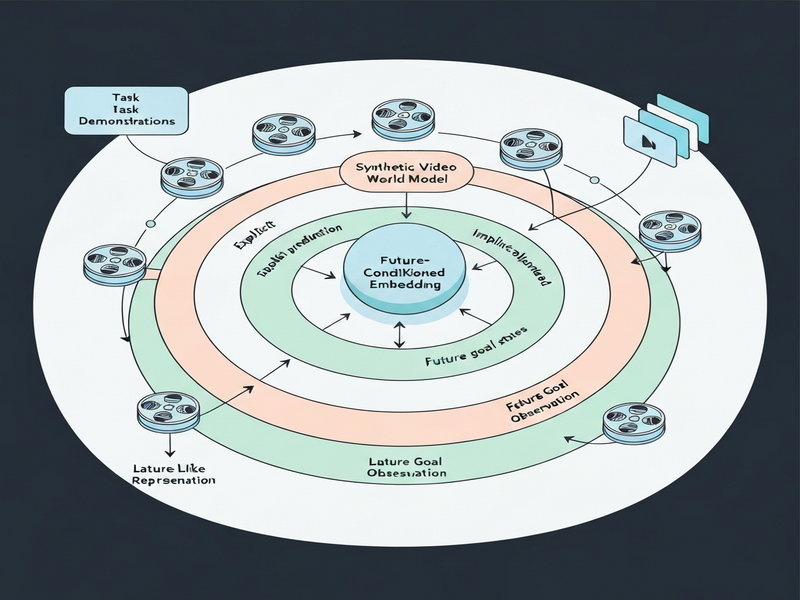
- Goal‑aligned latent alignment: Simultaneously, FOCA aligns the predicted future embedding with embeddings derived from synthetic goal observations generated by a video world model. The alignment operates without requiring explicit pixel‑level reconstruction, keeping computation tractable.
Together, these components create a “future‑conditioned value‑like” representation that can be updated with a handful of real demos while still benefiting from massive amounts of synthetic video data.
How It Works in Practice
The FOCA pipeline can be broken down into four logical stages, each of which can be implemented as a separate neural module:
1. Multimodal Encoder
A pre‑trained VLA encoder ingests the current RGB frame, the natural‑language command, and the robot’s proprioceptive state, producing a joint embedding Eₜ.
2. Future Interaction Predictor
Given Eₜ, a lightweight transformer predicts a future interaction embedding Fₜ₊₁. This embedding encodes the anticipated observation‑action pair at the next decision step, effectively answering “what will I see and do next if I follow the instruction?”
3. Synthetic Goal Generator
A video world model—trained on large‑scale robot‑centric video corpora—produces a synthetic goal frame that represents the desired end‑state of the task. The same encoder processes this frame to obtain a goal embedding G.
4. Alignment & Adaptation Module
The core of FOCA aligns Fₜ₊₁ with G using a contrastive loss. Because the alignment operates purely in latent space, the system can co‑train on millions of synthetic videos without ever rendering pixels. During few‑shot adaptation, a small set of real demonstrations provides ground‑truth (observation, action) pairs that fine‑tune the predictor and alignment weights.
The result is a model that can infer long‑horizon plans from a single step of latent prediction, dramatically reducing the amount of real data needed to achieve competent behavior.
Evaluation & Results
To validate FOCA, the authors conducted three tiers of experiments, each designed to stress a different aspect of data efficiency:
LIBERO Benchmark (Simulated Manipulation)
LIBERO comprises 100+ diverse manipulation tasks with high‑dimensional state spaces. FOCA achieved a 95.7% success rate using only 20 human demonstrations per task, surpassing the previous best by more than 12 percentage points. Notably, performance remained stable when the demo count dropped to 10, highlighting robustness to extreme data scarcity.
RoboCasa (Household Simulation)
RoboCasa evaluates long‑horizon tasks such as “set the table” or “load the dishwasher.” FOCA improved success rates by 7–12% across all tasks compared to fine‑tuning baselines, even when the robot had to reason about occluded objects and multi‑step subgoals.
Real‑World Robot Trials
On a physical Franka Emika Panda arm, the authors tested pick‑and‑place, drawer opening, and tool‑use scenarios. FOCA delivered up to a 26% absolute gain in success over the strongest prior adaptation method, confirming that the latent‑only alignment transfers effectively from simulation to reality.
Across all settings, the key takeaway is that FOCA’s future‑oriented conditioning enables long‑horizon reasoning without the need for pixel‑level prediction, thereby preserving computational budget while dramatically cutting the number of required demonstrations.
Why This Matters for AI Systems and Agents
From a systems‑engineering perspective, FOCA reshapes how we think about robot learning pipelines:
- Reduced data collection costs: Companies can now roll out new robotic services with a handful of on‑site demos instead of labor‑intensive data‑gathering campaigns.
- Scalable simulation‑to‑real transfer: Because the alignment loss works on latent embeddings, synthetic video data from world models can be leveraged at massive scale, accelerating the “simulation‑first” development paradigm.
- Modular integration: FOCA’s components—encoder, predictor, and alignment module—are interchangeable, allowing existing VLA stacks to be upgraded without a full retraining.
- Improved safety and predictability: By explicitly modeling future interaction embeddings, the system can flag trajectories that diverge from the learned goal space, offering a built‑in sanity check for autonomous agents.
Enterprises looking to embed intelligent robotics into their workflows can therefore achieve faster time‑to‑value and lower operational risk. For teams building AI‑driven automation platforms, FOCA provides a concrete recipe for marrying large‑scale pretraining with low‑shot task specialization.
Explore how the Enterprise AI platform by UBOS can incorporate future‑oriented conditioning to accelerate your robot‑centric AI initiatives.
What Comes Next
While FOCA marks a significant leap, several open challenges remain:
- Generalization to unseen domains: Current experiments focus on tabletop manipulation and household environments. Extending the approach to outdoor navigation or aerial robotics will require richer world models.
- Multi‑agent coordination: Future‑oriented conditioning for collaborative tasks (e.g., hand‑overs) is an unexplored frontier.
- Real‑time constraints: Although latent alignment is lightweight, integrating FOCA into latency‑critical control loops demands further optimization.
- Explainability: Interpreting the latent future embeddings in human‑readable terms could improve trust and debugging.
Future research may combine FOCA with reinforcement‑learning critics, hierarchical planners, or diffusion‑based video generators to broaden its applicability. Moreover, the framework’s modular nature invites integration with workflow‑automation tools that orchestrate data pipelines, simulation environments, and deployment stacks.
Developers interested in building end‑to‑end pipelines around FOCA can start with the Workflow automation studio, which offers pre‑built connectors for video world models, data versioning, and model serving.
References
For a complete technical description, see the original FOCA paper on arXiv.
Andrii Bidochko
CTO UBOS
Andrii Bidochko is an AI entrepreneur and researcher focused on AI agents, reinforcement learning, and autonomous systems. He writes about the technologies shaping the future of machine intelligence, from frontier models and agent architectures to real-world AI applications.