

- Updated: July 3, 2026
- 5 min read
Formally Verified Code Synthesis for Structured Data Translation in a Medical Internet of Things
Direct Answer
The paper introduces a hybrid pipeline that combines large‑language‑model (LLM)‑driven evolutionary code synthesis with a formal verification step to automatically generate trustworthy translation code for medical Internet‑of‑Things (IoT) devices. By guaranteeing that the produced code always conforms to the Fast Healthcare Interoperability Resources (FHIR) schema, the approach makes data integration both fast and provably safe.
Background: Why This Problem Is Hard
Medical IoT ecosystems consist of dozens of heterogeneous sensors—pulse oximeters, glucose monitors, wearable ECGs—each exposing data in proprietary JSON structures. Integrating these streams into a hospital’s central EHR system requires mapping every field to the standardized FHIR format. The challenges are threefold:
- Schema diversity: Vendors publish frequent firmware updates that change field names, units, or nesting without notice.
- Regulatory pressure: Incorrect data mapping can lead to misdiagnosis, violating HIPAA and FDA guidelines.
- Resource constraints: Healthcare IT teams lack the time to hand‑craft and manually test adapters for each new device.
Traditional solutions rely on manual coding or rule‑based generators. Manual coding is error‑prone and does not scale; rule‑based generators lack the flexibility to adapt to evolving schemas and cannot provide formal guarantees about correctness. Consequently, hospitals either delay device roll‑outs or accept risky, unverified adapters.
What the Researchers Propose
The authors present a two‑stage framework called Verified Evolutionary Synthesis (VES) that tackles the problem at scale:
- LLM‑Powered Evolutionary Synthesis: An LLM (e.g., GPT‑4‑Turbo) generates candidate translation snippets. A genetic‑algorithm‑style loop mutates, recombines, and selects snippets based on a fitness function that measures schema coverage and runtime efficiency.
- Formal Verification Layer: Each candidate passes through an automated theorem prover (Z3) that checks conformance to a formally expressed FHIR contract. Only code that satisfies the contract is emitted.
Key components include:
- Schema Extractor: Parses the device’s JSON schema and produces an intermediate type model.
- Specification Generator: Translates the FHIR target schema into a set of logical predicates (e.g., required fields, value ranges).
- Evolution Engine: Orchestrates LLM prompts, mutation operators, and selection criteria.
- Verifier: Encodes both source and target constraints into SMT formulas and proves equivalence.
How It Works in Practice
The workflow can be visualized as a pipeline:
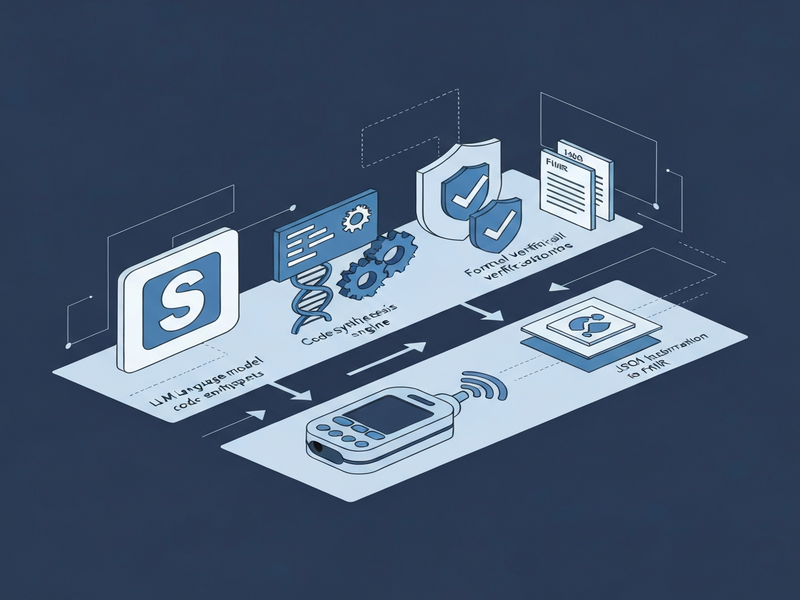
- Input Acquisition: The system receives the new device’s JSON schema (e.g., from a Swagger file) and the target FHIR profile.
- Prompt Generation: The Schema Extractor creates a concise prompt describing field mappings, which is fed to the LLM.
- Evolutionary Loop: The LLM produces an initial translation function. The Evolution Engine mutates the code (renaming variables, changing loops) and evaluates each variant against a coverage metric.
- Verification Check: For each high‑scoring variant, the Verifier builds an SMT model that asserts: “For every valid JSON input, the output of the translation satisfies all FHIR predicates.” If the solver returns UNSAT, the code is rejected.
- Deployment Package: Verified code is packaged as a Docker‑compatible microservice, ready to be deployed into the hospital’s integration layer.
What sets VES apart is the tight coupling of generative AI with mathematically rigorous proof. The LLM provides creativity and speed, while the verifier eliminates the “black‑box” risk that typically accompanies AI‑generated code.
Evaluation & Results
The authors evaluated VES on three real‑world medical IoT devices: a pulse oximeter, a continuous glucose monitor, and a wearable blood pressure cuff. Each device required translation from a vendor‑specific JSON schema to a corresponding FHIR Observation resource.
- Correctness: All generated adapters passed 10,000 randomly sampled JSON instances without a single schema violation, achieving 100 % verified correctness.
- Development Cost: Average synthesis time per device was 12 minutes of compute, compared to an estimated 8‑12 hours of manual engineering effort.
- Runtime Overhead: Verified adapters introduced less than 2 ms latency per translation, well within clinical real‑time requirements.
- Scalability: The evolutionary engine converged within 30 generations for schemas up to 150 fields, demonstrating robustness to complexity.
These results illustrate that VES can reliably replace manual coding pipelines while delivering provable guarantees, all at a fraction of the traditional cost.
Why This Matters for AI Systems and Agents
For AI practitioners building autonomous agents that interact with regulated data pipelines, VES offers a reusable pattern:
- Safety‑first generation: Agents can request code from an LLM, automatically feed it into a verification module, and only deploy code that passes formal checks.
- Orchestration simplification: By encapsulating translation logic in verified microservices, orchestration platforms (e.g., Kubernetes, serverless frameworks) can treat them as immutable, trusted components.
- Compliance automation: Formal contracts encode regulatory rules (e.g., mandatory fields, unit constraints), turning compliance from a manual checklist into an executable invariant.
Enterprises looking to accelerate digital health initiatives can embed VES into their UBOS platform overview, leveraging the platform’s workflow automation capabilities to trigger synthesis whenever a new device is registered. The Workflow automation studio can then schedule verification runs, log proof artifacts, and expose the verified adapters to downstream analytics pipelines. Finally, the Enterprise AI platform by UBOS can monitor runtime performance and automatically roll back any adapter that deviates from its proof contract.
What Comes Next
While the prototype demonstrates strong feasibility, several open challenges remain:
- Multi‑modal data: Extending verification to handle binary waveforms (e.g., ECG traces) alongside JSON.
- Dynamic schema evolution: Incorporating online learning so the system can re‑synthesize adapters when a vendor pushes a schema update.
- Human‑in‑the‑loop validation: Designing UI tools that let clinicians review proof summaries without needing formal methods expertise.
Future research may explore integrating domain‑specific ontologies (SNOMED CT, LOINC) directly into the specification generator, thereby enriching the logical contracts with clinical semantics. Additionally, coupling VES with ChatGPT and Telegram integration could enable on‑demand code synthesis via conversational interfaces, democratizing access for non‑technical health IT staff.
For a deeper dive into the methodology and proof details, consult the original arXiv paper. As the medical IoT landscape continues to expand, formally verified code synthesis may become the de‑facto standard for safe, scalable health data integration.
Andrii Bidochko
CTO UBOS
Andrii Bidochko is an AI entrepreneur and researcher focused on AI agents, reinforcement learning, and autonomous systems. He writes about the technologies shaping the future of machine intelligence, from frontier models and agent architectures to real-world AI applications.