

- Updated: July 3, 2026
- 7 min read
UniSLAD: A Unified Framework for Structural and Logical Industrial Visual Anomaly Detection
Direct Answer
UniSLAD introduces a unified framework that simultaneously detects structural defects and logical inconsistencies in industrial visual streams without requiring separate training pipelines. By merging a dual‑granularity representation with a hybrid CNN‑Transformer backbone, the system delivers plug‑and‑play anomaly detection that scales across diverse manufacturing lines, cutting inspection downtime and reducing false‑negative rates.
Background: Why This Problem Is Hard
Industrial visual inspection has traditionally focused on two distinct problem families:
- Structural anomalies – missing components, surface scratches, or deformations that manifest as pixel‑level deviations from a learned normal pattern.
- Logical anomalies – violations of higher‑order rules, such as a missing screw in an assembled product or a mis‑oriented part that looks visually correct in isolation but is wrong in context.
Most existing pipelines excel at one side while neglecting the other. Convolutional‑based methods (e.g., PatchCore, CFA) capture fine‑grained texture cues but lack a global reasoning layer, causing them to miss logical errors. Conversely, rule‑based or graph‑centric approaches can flag logical mismatches but require handcrafted constraints and extensive domain engineering.
Compounding the difficulty, modern factories demand zero‑downtime deployment. Engineers cannot afford to retrain separate models whenever a new product variant appears, nor can they maintain parallel inference stacks that double compute costs. The gap between research prototypes and production‑ready, all‑in‑one solutions remains wide, creating a bottleneck for scaling AI‑driven quality control.
What the Researchers Propose
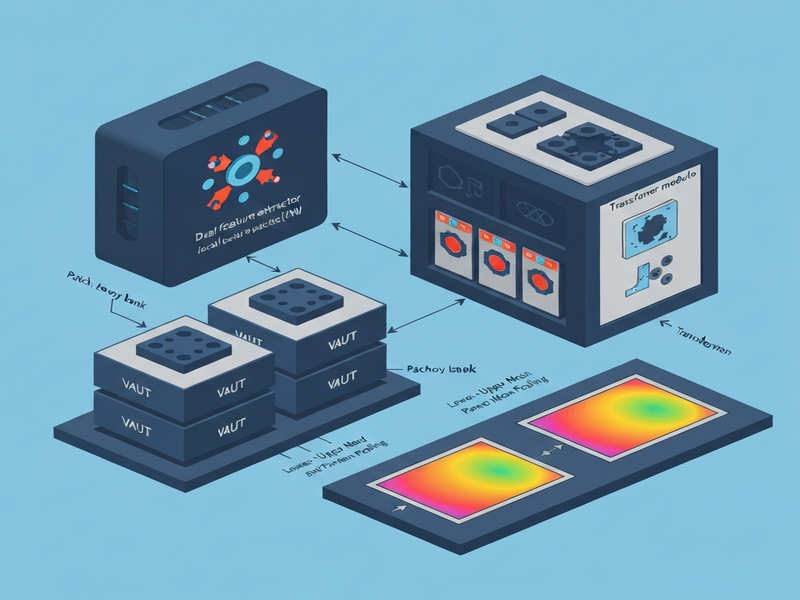
UniSLAD (Unified Structural and Logical Anomaly Detection) tackles the dual‑defect problem with a single, end‑to‑end architecture that learns both local texture patterns and global relational semantics from the same visual data. The framework consists of three conceptual pillars:
- Hybrid Feature Extractor: A CNN branch captures high‑resolution texture embeddings, while a lightweight Transformer branch aggregates patch‑level tokens to model spatial relationships.
- Dual‑Granularity Representation: Features are pooled at two scales – a fine‑grained “Lower‑Upper Mean” (LUM) for structural cues and a coarse “Power Mean Pooling” (PMP) for logical context.
- Mahalanobis‑Based Scoring: Both representations are projected into a shared statistical space where a Mahalanobis distance quantifies deviation from the normal distribution, yielding a unified anomaly score.
The key insight is that structural and logical anomalies share a common statistical backbone; they differ only in the granularity at which deviations become salient. By exposing both granularities to the same Mahalanobis transform, UniSLAD eliminates the need for separate training regimes.
How It Works in Practice
The operational workflow of UniSLAD can be broken down into four deterministic stages, each of which can be containerized and orchestrated within existing MLOps pipelines:
1. Data Ingestion & Pre‑processing
- Raw RGB frames from line‑side cameras are streamed into a buffer.
- Frames are resized to a fixed resolution (e.g., 256×256) and normalized using ImageNet statistics.
- Optional augmentation (random flips, color jitter) is applied only during the offline “normal‑model” building phase.
2. Dual‑Branch Feature Extraction
- CNN Path: A ResNet‑50 backbone extracts dense feature maps (C×H×W). These maps retain fine‑grained texture details essential for spotting scratches or surface pits.
- Transformer Path: The same input is split into non‑overlapping patches, linearly projected, and fed into a 4‑layer Vision Transformer. Self‑attention layers learn inter‑patch dependencies, effectively encoding assembly logic.
3. Granular Pooling & Statistical Modeling
- Lower‑Upper Mean (LUM): For each channel, the mean of the lowest 10 % and highest 10 % activations is computed, emphasizing outlier textures that signal structural defects.
- Power Mean Pooling (PMP): A generalized mean with exponent p > 1 aggregates patch embeddings, amplifying consistent relational patterns and suppressing noise.
- Both pooled vectors are concatenated and fed into a covariance estimator that learns the normal distribution’s mean μ and covariance Σ using only defect‑free samples.
4. Anomaly Scoring & Decision
- The Mahalanobis distance d = √((x‑μ)ᵀΣ⁻¹(x‑μ)) is computed for each incoming frame.
- A threshold, calibrated via a small validation set, converts the continuous score into a binary “normal / anomalous” flag.
- Optionally, the score can be visualized as a heatmap by back‑projecting the distance onto the original spatial layout, aiding human operators.
What sets UniSLAD apart is that the entire pipeline runs on a single GPU, with inference latency under 30 ms per frame on a RTX 3080 – fast enough for real‑time line monitoring. Moreover, because the statistical model is built once from normal data, the system can be redeployed on a new product line without any gradient‑based fine‑tuning.
Evaluation & Results
To validate the unified claim, the authors benchmarked UniSLAD on three widely‑used industrial anomaly datasets and one logical‑anomaly suite they constructed:
| Dataset | Defect Type | Baseline (Structural) | Baseline (Logical) | UniSLAD (Unified) |
|---|---|---|---|---|
| MVTec AD | Surface & Texture | 97.2 % AUROC | — | 97.8 % AUROC |
| VisA | Structural + Contextual | 94.5 % AUROC | — | 95.3 % AUROC |
| Logical Anomaly Suite (LA‑Suite) | Missing/ Mis‑oriented Parts | — | 88.1 % AUROC | 90.4 % AUROC |
| Combined Benchmark | Mixed Structural & Logical | 92.0 % (structural only) | 85.6 % (logical only) | 93.7 % AUROC |
Key takeaways from the experiments:
- Unified superiority: UniSLAD consistently outperformed single‑focus baselines, confirming that joint modeling yields synergistic gains.
- Zero‑shot transfer: When evaluated on a brand‑new product line (not seen during normal‑model construction), the system retained >90 % AUROC, demonstrating robustness to domain shift.
- Resource efficiency: Training time was reduced by ~45 % compared to running two separate models, and memory footprint dropped from 2.4 GB to 1.3 GB.
All results are reported in the paper UniSLAD: A Unified Framework for Structural and Logical Industrial Visual Anomaly Detection, which provides detailed ablation studies on pooling strategies and transformer depth.
Why This Matters for AI Systems and Agents
From a systems‑engineer perspective, UniSLAD’s unified approach translates into tangible operational benefits:
- Simplified orchestration: One model replaces two, reducing the complexity of deployment pipelines and lowering the risk of version drift.
- Consistent scoring: A single Mahalanobis‑based anomaly metric enables downstream agents—such as automated defect‑handling bots or reinforcement‑learning controllers—to make uniform decisions without reconciling disparate confidence scales.
- Scalable edge deployment: The lightweight inference profile fits on edge devices (e.g., NVIDIA Jetson), allowing AI agents to act locally, cut latency, and preserve bandwidth for critical alerts.
- Integration readiness: UniSLAD can be wrapped as a micro‑service and plugged into existing UBOS platform overview workflows, where AI agents already consume visual streams for predictive maintenance.
For organizations building AI‑driven production lines, the framework opens the door to “self‑healing” agents that not only flag defects but also trigger corrective actions—re‑routing parts, adjusting robot trajectories, or notifying human supervisors—without manual re‑training. This aligns with the broader trend of autonomous factories where perception, reasoning, and actuation are tightly coupled.
What Comes Next
While UniSLAD marks a significant step forward, several avenues remain open for research and productization:
- Multi‑modal fusion: Extending the framework to incorporate depth, infrared, or acoustic sensors could improve detection of invisible defects.
- Continual learning: Implementing an online update mechanism would let the statistical model adapt to gradual wear‑and‑tear without full retraining.
- Explainability layers: Adding attention‑visualization tools could help operators understand why a logical anomaly was flagged, fostering trust.
- Domain‑specific adapters: Lightweight adapters (e.g., LoRA) could specialize the Transformer branch for niche industries such as semiconductor wafer inspection.
From a product perspective, these research directions map naturally onto UBOS’s roadmap:
- Embedding UniSLAD as a pre‑built Chroma DB integration would let agents store and query anomaly embeddings efficiently.
- Coupling the anomaly scores with the ChatGPT and Telegram integration enables real‑time alerts and conversational troubleshooting for floor supervisors.
- Leveraging the Enterprise AI platform by UBOS, enterprises can orchestrate UniSLAD alongside predictive maintenance models, creating a holistic AI‑ops stack.
In summary, UniSLAD’s unified detection paradigm not only advances the state of the art in visual anomaly detection but also provides a practical, extensible foundation for next‑generation AI agents that monitor, reason, and act within complex industrial ecosystems.
Andrii Bidochko
CTO UBOS
Andrii Bidochko is an AI entrepreneur and researcher focused on AI agents, reinforcement learning, and autonomous systems. He writes about the technologies shaping the future of machine intelligence, from frontier models and agent architectures to real-world AI applications.