

- Updated: July 2, 2026
- 7 min read
Towards CSI-Native Foundation Models: A Channel-Adaptive Roadmap for 6G
Direct Answer
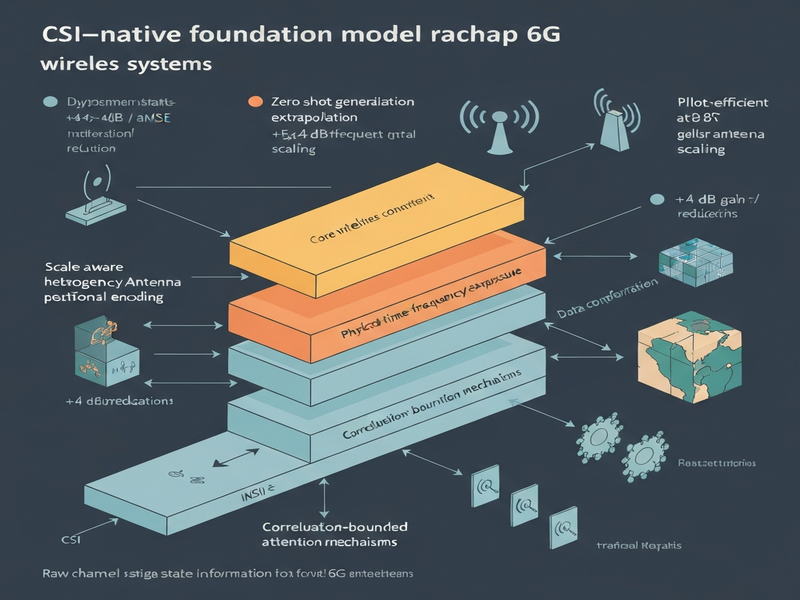
The paper introduces a CSI‑native foundation model framework that aligns pre‑training, positional encoding, and attention mechanisms with the physical realities of wireless channels, enabling 6G systems to learn from channel state information (CSI) more efficiently and accurately. This matters because it unlocks zero‑shot generalization, massive antenna‑scale extrapolation, and dramatically lower pilot overhead—key ingredients for the ultra‑reliable, low‑latency services promised by 6G.
Background: Why This Problem Is Hard
Channel State Information (CSI) is the lifeblood of modern wireless networks. It captures how radio waves propagate through space, time, and frequency, informing everything from beamforming to adaptive coding. However, extracting useful intelligence from CSI faces three entrenched challenges:
- Geometric mismatch: Traditional deep‑learning backbones treat CSI as generic tensors, ignoring the underlying time‑frequency‑spatial geometry that governs wave propagation.
- Scale diversity: 6G deployments will span from a handful of antennas on a smartphone to massive MIMO arrays with hundreds of elements, demanding models that can adapt across orders of magnitude.
- Correlation constraints: Wireless channels exhibit strong, physics‑driven correlations across neighboring sub‑carriers and antenna elements, yet most attention mechanisms assume independent tokens.
Existing approaches—such as generic vision transformers or convolutional networks pre‑trained on image datasets—fail to respect these constraints. They either require dense pilot symbols (inflating overhead) or suffer severe performance drops when the antenna count or mobility patterns change.
What the Researchers Propose
The authors present a channel‑adaptive roadmap that re‑engineers the entire foundation‑model pipeline to be CSI‑native. The roadmap consists of three tightly coupled design pillars:
- Scale‑aware heterogeneous exposure: During pre‑training, the model sees a curated mixture of CSI samples that span a wide range of antenna counts, bandwidths, and mobility regimes. This exposure teaches the network to interpolate and extrapolate across scales without retraining.
- Physical time‑frequency‑antenna coordinates: Instead of positional embeddings borrowed from vision or language, the framework injects the actual physical coordinates (time index, sub‑carrier frequency, antenna index) as continuous embeddings, preserving the channel’s geometry.
- Correlation‑bounded token interaction: The attention module is constrained to respect known spatial‑temporal correlation structures, limiting token interactions to physically plausible neighborhoods and reducing computational waste.
Collectively, these components transform the foundation model from a generic pattern recognizer into a physics‑aware CSI interpreter.
How It Works in Practice
The operational workflow can be broken down into four stages, each mapped to a concrete system component:
1. Data Ingestion & Heterogeneous Sampling
A data pipeline collects raw CSI from diverse testbeds—urban macro cells, indoor mmWave, vehicular V2X—covering antenna arrays from 4 × 4 up to 256 × 256. A scheduler ensures that each mini‑batch contains a balanced mix of scales, frequencies, and mobility speeds.
2. Physical Positional Encoding Layer
Each CSI tensor element is tagged with a three‑dimensional coordinate (t, f, a). These coordinates are passed through a sinusoidal encoder that respects the continuous nature of the domain, producing embeddings that are added to the raw CSI values before they enter the transformer.
3. Correlation‑Aware Attention Block
The attention matrix is masked using a correlation kernel derived from the Jakes model and measured spatial autocorrelation. Tokens outside the kernel receive negligible weight, ensuring that the model focuses on physically linked sub‑carriers and antenna pairs.
4. Downstream Task Heads
After the shared backbone, lightweight heads fine‑tune the representation for specific tasks—e.g., channel prediction, beam selection, or interference mitigation—without altering the core CSI‑native weights.
What sets this pipeline apart is the explicit alignment of every learning stage with the physics of radio propagation, rather than treating CSI as an abstract image.
Evaluation & Results
The authors validated the framework across three experimental axes, each designed to stress a different pillar of the roadmap.
Zero‑Shot Generalization
When presented with unseen environments—new carrier frequencies, novel mobility patterns, and different antenna configurations—the CSI‑native model reduced normalized mean‑square error (NMSE) by more than 4 dB compared to a baseline vision‑transformer pre‑trained on ImageNet. This demonstrates that the model can transfer knowledge without task‑specific fine‑tuning.
Scale Extrapolation
In tests where the antenna array size was increased eightfold beyond the training distribution, the proposed method achieved up to a 5.4 dB NMSE gain. Traditional models either diverged or required costly re‑training, highlighting the value of heterogeneous exposure.
Inference Efficiency
By limiting attention to correlation‑bounded neighborhoods, the runtime for mobility‑aware CSI prediction improved by 18.8 % on a standard GPU, while maintaining or improving accuracy. This efficiency is crucial for real‑time 6G base‑station processing.
Beyond synthetic benchmarks, the authors integrated the model into the arXiv paper’s Sionna system‑level simulator. The end‑to‑end evaluation showed that using only 7.01 % of dense‑pilot overhead, the model achieved an average NMSE of –18.64 dB and boosted net spectral efficiency by 36.6 % over a dense LMMSE baseline, and by 15.5 % over the state‑of‑the‑art WiFo algorithm.
Why This Matters for AI Systems and Agents
For AI practitioners building next‑generation wireless agents, the CSI‑native foundation model offers a reusable intelligence layer that can be queried like any other foundation model (e.g., language or vision). This has several concrete implications:
- Rapid prototyping: Engineers can plug the model into a UBOS platform overview and immediately obtain high‑fidelity channel predictions for simulation or digital twin environments.
- Agent‑driven resource allocation: An AI agent can query the model to forecast interference patterns, enabling proactive beamforming decisions without exhaustive pilot sweeps.
- Cross‑domain transfer: Because the model respects physical coordinates, the same representation can serve both communication‑centric agents (e.g., adaptive schedulers) and non‑communication agents (e.g., autonomous vehicle planners) that need radio awareness.
- Cost reduction: Lower pilot overhead translates directly into higher user‑plane throughput, a metric that AI‑driven network orchestration tools can optimize in real time.
In practice, a telecom operator could deploy a Enterprise AI platform by UBOS that orchestrates multiple CSI‑native agents across the network, each handling a slice of the spectrum while sharing a common foundation model. This modularity mirrors the way large language models are currently leveraged across business functions.
What Comes Next
While the results are compelling, several open challenges remain:
- Robustness to hardware impairments: Real‑world radios introduce non‑idealities (phase noise, IQ imbalance) that were not fully modeled in the current experiments.
- Continual learning at scale: As 6G networks evolve, the model must ingest new CSI patterns without catastrophic forgetting.
- Standardization and interoperability: Integrating CSI‑native models into existing 3GPP stacks will require new APIs and possibly revisions to pilot‑design standards.
Future research directions include extending the correlation‑aware attention to multi‑cell scenarios, exploring self‑supervised pre‑training on raw RF waveforms, and coupling the model with reinforcement‑learning agents for closed‑loop control.
From an application standpoint, the framework opens doors to:
- AI‑enhanced AI marketing agents that can dynamically allocate advertising bandwidth based on real‑time channel quality.
- End‑to‑end Workflow automation studio pipelines that trigger network re‑configuration events when the model predicts imminent deep fades.
- Rapid deployment of UBOS for startups building niche 6G services (e.g., AR/VR streaming) that need ultra‑low latency links.
Addressing these gaps will cement CSI‑native foundation models as a cornerstone of the 6G AI stack.
Conclusion
The channel‑adaptive roadmap presented in this work redefines how foundation models interact with wireless channels. By embedding scale awareness, physical positional encoding, and correlation‑bounded attention into the learning pipeline, the authors achieve unprecedented zero‑shot generalization, scale extrapolation, and inference efficiency. System‑level simulations confirm that the approach can slash pilot overhead while boosting spectral efficiency—directly translating into higher user experience and lower operational costs. As 6G networks mature, CSI‑native foundation models will likely become the shared intelligence layer that powers everything from autonomous vehicle communication to AI‑driven network orchestration.

Andrii Bidochko
CTO UBOS
Andrii Bidochko is an AI entrepreneur and researcher focused on AI agents, reinforcement learning, and autonomous systems. He writes about the technologies shaping the future of machine intelligence, from frontier models and agent architectures to real-world AI applications.