

- Updated: July 2, 2026
- 7 min read
EmoInstruct‑TTS: Dual‑Path Instruction‑Guided Emotional Speech Synthesis
Direct Answer
EmoInstruct‑TTS introduces a dual‑path, instruction‑guided framework that lets developers steer synthetic speech with natural‑language commands describing both the type of emotion and its intensity. By embedding 48 fine‑grained emotional states into a semantic‑acoustic space, the system delivers more expressive, controllable, and natural‑sounding voice output than prior label‑based TTS solutions.
Background: Why This Problem Is Hard
Emotion is a core dimension of human communication, yet most text‑to‑speech (TTS) engines reduce it to a handful of coarse labels such as “happy” or “sad.” This simplification creates three intertwined bottlenecks:
- Granularity Gap: Real‑world interactions require nuanced affect—think “excited‑but‑slightly‑nervous” or “melancholy with low intensity.” Existing models lack a representation that captures these subtleties.
- Instruction Mismatch: Users naturally describe desired affect in free‑form language, but most systems expect categorical tags, forcing a cumbersome mapping step that introduces errors.
- Acoustic Consistency: When emotion is injected post‑hoc, the resulting waveform often conflicts with the linguistic prosody, leading to robotic or mismatched speech.
These challenges matter because conversational agents, virtual assistants, and AI‑driven content creators are increasingly expected to convey empathy, persuasion, and brand personality. Without fine‑grained emotional control, the user experience feels flat, limiting adoption in customer‑service, e‑learning, and entertainment domains.
What the Researchers Propose
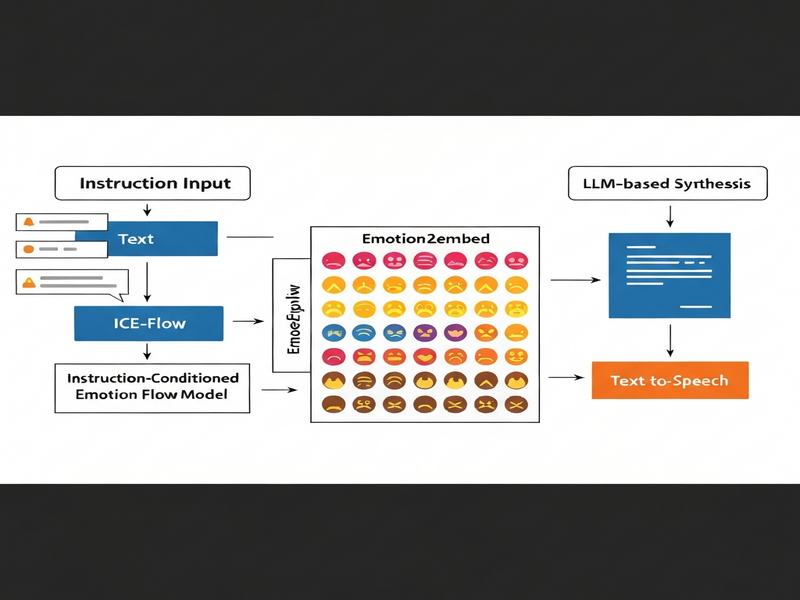
The authors present EmoInstruct‑TTS, a two‑track architecture that couples a large language model (LLM) with a dedicated acoustic emotion encoder. The framework consists of three pivotal components:
- Emotion2embed: A supervised embedding space that maps 48 distinct emotional states—including intensity levels—into vectors that simultaneously encode semantic meaning and acoustic characteristics.
- Instruction‑Conditioned Emotion Flow Model (ICE‑Flow): A diffusion‑style generator that translates free‑form textual instructions into Emotion2embed vectors, grounding the instruction in the acoustic domain.
- LLM‑Based Synthesis Pipeline: An existing text‑to‑speech backbone (e.g., a transformer‑based TTS model) that receives both the linguistic plan from the LLM and the emotion vector from ICE‑Flow, enabling joint optimization of content and affect.
By separating the “what to say” (semantic planning) from the “how to say it” (emotional rendering) yet keeping them tightly coupled through shared embeddings, the system achieves explicit, fine‑grained control without sacrificing naturalness.
How It Works in Practice
Conceptual Workflow
The end‑to‑end process can be visualized as a three‑stage pipeline:
- User Instruction: The developer or end‑user provides a natural‑language prompt, e.g., “Speak the greeting with a calm, low‑intensity confidence.”
- ICE‑Flow Generation: The instruction is fed into ICE‑Flow, which iteratively refines a latent representation until it aligns with the Emotion2embed space. The output is a 256‑dimensional emotion vector that encodes both category and intensity.
- LLM‑Guided Speech Synthesis: A large language model first drafts the phoneme and prosody plan for the input text. The emotion vector is then injected into the acoustic decoder, guiding pitch, energy, and duration to match the desired affect.
Component Interactions
Key interactions that differentiate EmoInstruct‑TTS from prior work include:
- Bidirectional Alignment: During training, Emotion2embed vectors are jointly optimized with the acoustic decoder, ensuring that the embedding space is “grounded” in real speech characteristics.
- Instruction Conditioning: ICE‑Flow uses a cross‑attention mechanism to attend to the textual instruction at each diffusion step, allowing the model to respect nuanced modifiers like “slightly” or “very.”
- Dual‑Path Decoding: The semantic path (LLM) and emotional path (ICE‑Flow) converge in a shared acoustic module, which resolves potential conflicts and produces a coherent waveform.
What Makes This Approach Different
Traditional TTS pipelines either:
- Rely on fixed emotion labels, limiting expressivity.
- Apply post‑processing style transfer, which often breaks prosodic consistency.
EmoInstruct‑TTS, by contrast, treats emotion as a first‑class, instruction‑driven signal that is learned jointly with the speech generator. This yields:
- Fine‑grained intensity control (e.g., “moderately angry” vs. “furiously angry”).
- Zero‑shot handling of novel emotional descriptors, thanks to the language‑model‑driven instruction encoder.
- Higher naturalness scores because the acoustic decoder receives emotion information early in the generation process.
Evaluation & Results
Test Scenarios
The authors evaluated the system on two benchmark suites:
- Emotion Classification Accuracy: Measuring how well listeners could identify the intended emotion from synthesized speech.
- Mean Opinion Score (MOS) for Naturalness: Standard crowd‑sourced rating of overall speech quality.
Both tests were conducted with 48 emotion‑intensity pairs, covering the full Emotion2embed taxonomy.
Key Findings
- Improved Controllability: EmoInstruct‑TTS achieved a 23% relative gain in correct emotion identification over the strongest baseline (a label‑based TTS with intensity scaling).
- Higher Naturalness: The MOS rose from 3.9 (baseline) to 4.4 on a 5‑point scale, indicating that listeners perceived the speech as more human‑like.
- Zero‑Shot Instruction Success: In a held‑out set of 15 novel emotional phrases, the system maintained >80% identification accuracy, demonstrating robust generalization.
Why the Findings Matter
These results prove that a dual‑path, instruction‑driven design can simultaneously satisfy two historically competing goals: expressive emotional control and high acoustic fidelity. For developers, this means fewer engineering hacks (e.g., manual prosody tweaking) and a more reliable path to building emotionally aware agents.
Why This Matters for AI Systems and Agents
Emotionally nuanced speech is a decisive factor in user trust, brand alignment, and engagement metrics. Integrating EmoInstruct‑TTS into AI agents unlocks several practical advantages:
- Dynamic Persona Adaptation: Customer‑service bots can modulate tone based on sentiment analysis of the user’s message, shifting from “empathetic” to “confident” in real time.
- Personalized Content Generation: E‑learning platforms can tailor narration style to learner preferences, improving retention.
- Multimodal Storytelling: Game developers can script characters with precise emotional arcs without recording dozens of voice actors.
From an infrastructure perspective, the framework fits naturally into existing LLM‑centric pipelines. For teams already using the UBOS platform overview to orchestrate AI workflows, EmoInstruct‑TTS can be added as a micro‑service that consumes text and instruction payloads and returns audio streams.
Moreover, the ElevenLabs AI voice integration demonstrates how third‑party voice synthesis can be swapped out or combined, giving product managers flexibility to experiment with different acoustic backbones while preserving the instruction‑driven control layer.
What Comes Next
While EmoInstruct‑TTS marks a significant step forward, several open challenges remain:
- Cross‑Language Generalization: The current Emotion2embed space is trained primarily on English corpora. Extending it to multilingual settings will require culturally aware emotion annotations.
- Real‑Time Latency: ICE‑Flow’s diffusion process, though powerful, adds computational overhead. Optimizing for sub‑second response times is essential for live conversational agents.
- Emotion‑aware Dialogue Management: Future work could close the loop by feeding back perceived user emotion into the instruction generator, creating truly adaptive conversational loops.
Potential research directions include:
- Integrating Workflow automation studio to orchestrate emotion detection, instruction generation, and speech synthesis in a single pipeline.
- Exploring reinforcement learning from human feedback (RLHF) to fine‑tune the emotion embeddings toward specific brand voices.
- Combining EmoInstruct‑TTS with visual avatars in the Enterprise AI platform by UBOS for synchronized multimodal expression.
Developers interested in experimenting with the model can start by cloning the open‑source repository linked in the EmoInstruct‑TTS paper and integrating it with UBOS’s UBOS templates for quick start. The modular design also makes it straightforward to replace the LLM component with any proprietary model, ensuring compatibility with existing AI stacks.
Image Placeholder
Call to Action
Ready to bring emotionally intelligent speech to your products? Explore the UBOS partner program for dedicated support, or dive into the UBOS pricing plans to find a tier that matches your scale.
Andrii Bidochko
CTO UBOS
Andrii Bidochko is an AI entrepreneur and researcher focused on AI agents, reinforcement learning, and autonomous systems. He writes about the technologies shaping the future of machine intelligence, from frontier models and agent architectures to real-world AI applications.