

- Updated: July 1, 2026
- 7 min read
Delay-Adaptive Speculation Control for Low-Latency Edge-Cloud LLM Inference
Direct Answer
The paper introduces Delay‑Adaptive Speculation Control, a mathematically grounded algorithm that dynamically selects the optimal length of speculative token drafts for edge‑cloud large language model (LLM) inference. By adapting to real‑time network latency, it cuts per‑token response time by up to 22 % compared with static speculation strategies, making high‑quality LLM services viable on latency‑sensitive edge devices.
Background: Why This Problem Is Hard
Edge‑cloud deployments of LLMs promise the best of both worlds: the compute power of a data‑center GPU and the low‑latency proximity of an edge node. In practice, however, the communication round‑trip between edge and cloud becomes the dominant bottleneck. Speculative decoding—a technique that lets a lightweight draft model generate candidate tokens while the heavyweight target model validates them—mitigates this delay, but only if the draft length is chosen wisely.
- Long drafts amortize the round‑trip cost across many tokens, but each extra token increases the chance that the target model will reject the draft, forcing a rollback and extra verification steps.
- Short drafts keep acceptance rates high, yet they trigger more frequent network exchanges, eroding the latency benefit.
- Network conditions on the edge are rarely static; wireless jitter, congestion, and load‑balancing can shift round‑trip times by tens of milliseconds within seconds.
Existing speculation controllers either fix the draft length at design time or rely on heuristics that cannot guarantee optimality under varying delay. This mismatch leads to sub‑optimal latency, especially when service‑level agreements (SLAs) demand sub‑100 ms response times for interactive AI agents.
What the Researchers Propose
The authors formulate the draft‑length selection as a ratio‑type optimal stopping problem. In this view, each additional speculative token yields a marginal benefit (reduced communication rounds) but also incurs a marginal cost (lower acceptance probability). The optimal policy is proven to be a finite, delay‑monotone threshold:
- If the observed network delay is below a critical value, the controller issues a single‑token draft (the “single‑token speculation” regime).
- Above that threshold, the optimal draft length grows logarithmically with delay, ensuring that extra latency is offset by fewer round‑trips.
To handle time‑varying channels, the model is extended to a Markov‑modulated setting, yielding a state‑dependent threshold policy. When the environment is unknown, the paper introduces UCB‑SpecStop, an online learning algorithm that balances exploration (testing different draft lengths) and exploitation (using the best‑known length). The algorithm enjoys both gap‑free and gap‑dependent regret bounds, guaranteeing near‑optimal performance even in non‑stationary networks.
How It Works in Practice
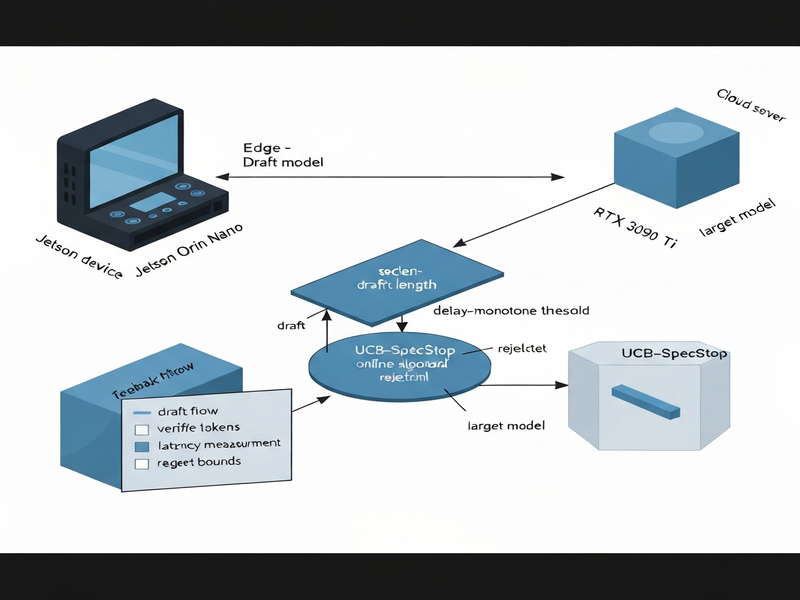
The practical system consists of three tightly coupled components:
- Edge Draft Engine: A lightweight LLM (e.g., Qwen‑tiny) runs on the edge device, generating a speculative token sequence of length L as instructed by the controller.
- Cloud Target Engine: A powerful LLM (e.g., Llama‑2‑70B) resides on a GPU‑rich server. It receives the draft, validates each token in parallel, and returns the longest prefix that matches its own predictions.
- Delay‑Adaptive Controller (UCB‑SpecStop): Continuously measures round‑trip latency, updates its belief over the optimal draft length, and issues the next L to the edge draft engine.
The workflow for each inference step is:
- Edge measures current network delay d (e.g., via ping or ACK timestamps).
- Controller consults its threshold table (or UCB‑SpecStop’s confidence bounds) to select L(d).
- Draft engine emits L tokens and sends them to the cloud.
- Target engine validates tokens, returns the accepted prefix, and optionally the next hidden state.
- Edge appends the accepted tokens to the output stream and repeats the cycle.
This loop runs entirely asynchronously, so the edge never idles while waiting for the cloud; it can pre‑fetch the next draft as soon as the previous verification completes.
Evaluation & Results
The authors built a real‑world testbed comprising a Jetson Orin Nano (edge) and an RTX 3090 Ti (cloud). Two draft–target pairs were evaluated: Qwen (draft) → Qwen‑large (target) and Llama (draft) → Llama‑2‑70B (target). Experiments spanned a delay grid from 20 ms to 200 ms, emulating diverse edge‑cloud conditions.
Key findings include:
- Phase Transition Validation: The measured acceptance rate sharply drops around 83 ms (Qwen) and 111 ms (Llama), matching the theoretical critical delay predicted by the ratio‑type stopping analysis.
- Latency Reduction: UCB‑SpecStop outperforms the state‑of‑the‑art SpecDec++ by up to 22.4 % per token, especially in the communication‑dominated regime (delay > 100 ms).
- Near‑Oracle Performance: In high‑delay scenarios, the adaptive controller stays within 0.2–2.4 % of an offline oracle that knows the exact delay distribution.
- Robustness to Drift: When network latency drifts during a run, static‑tuned controllers suffer a 14–18 % slowdown, whereas UCB‑SpecStop automatically re‑optimizes and recovers the lost performance.
- Contextual Gains: Providing the controller with channel‑state information (e.g., Wi‑Fi vs. LTE) yields an additional 3–6 % latency improvement.
These results demonstrate that a mathematically principled, online‑learning controller can reliably adapt speculation length, delivering consistent low‑latency LLM responses across heterogeneous edge environments.
Why This Matters for AI Systems and Agents
Interactive AI agents—chatbots, digital assistants, and autonomous decision‑makers—are increasingly deployed at the edge to meet user expectations for instant feedback. The latency introduced by remote LLM inference can break the conversational flow, leading to user disengagement and reduced trust.
Delay‑Adaptive Speculation Control directly addresses this pain point:
- Predictable Responsiveness: By guaranteeing that draft length scales with measured delay, system architects can provision SLAs with confidence.
- Resource Efficiency: Shorter drafts in low‑latency networks reduce unnecessary GPU work on the cloud, lowering operational costs.
- Scalable Multi‑Agent Orchestration: When dozens of agents share a cloud endpoint, the controller’s online learning naturally balances load, preventing congestion spikes.
- Integration Simplicity: The controller is a thin software layer that can be wrapped around existing inference pipelines without retraining the underlying models.
Enterprises looking to embed LLM‑powered features into their products can therefore achieve “cloud‑grade” intelligence on edge devices without sacrificing user experience. For teams building on the UBOS platform overview, the adaptive controller can be incorporated as a plug‑in to the Workflow automation studio, enabling rapid prototyping of latency‑aware AI services.
What Comes Next
While the study establishes a solid theoretical foundation, several avenues remain open:
- Multi‑Draft Coordination: Extending the model to handle parallel drafts from multiple edge nodes could further amortize latency in large‑scale deployments.
- Hybrid Model Ensembles: Investigating how heterogeneous draft models (different sizes, quantizations) interact with the threshold policy may unlock additional speed‑accuracy trade‑offs.
- Energy‑Aware Adaptation: Incorporating power consumption metrics into the stopping criterion would benefit battery‑constrained IoT devices.
- Robustness to Packet Loss: Future work should explore how unreliable transport (e.g., UDP, lossy wireless) impacts the acceptance probability and how the controller can compensate.
- Full‑Stack Integration: Embedding the controller into an Enterprise AI platform by UBOS would provide end‑to‑end monitoring, auto‑scaling, and policy enforcement for production workloads.
Researchers can also build on the Markov‑modulated analysis to model more complex network dynamics, such as bursty traffic or mobile handovers. From a product perspective, offering a managed “Speculation‑Control as a Service” could democratize low‑latency LLM inference for startups and SMBs alike.
References
Sun, K., Li, J., Chen, X., He, J., & Guo, M. (2026). Delay‑Adaptive Speculation Control for Low‑Latency Edge‑Cloud LLM Inference. arXiv preprint arXiv:2606.20591.
Andrii Bidochko
CTO UBOS
Andrii Bidochko is an AI entrepreneur and researcher focused on AI agents, reinforcement learning, and autonomous systems. He writes about the technologies shaping the future of machine intelligence, from frontier models and agent architectures to real-world AI applications.