

- Updated: July 1, 2026
- 7 min read
Role-Based Agentic AI for Intent-Driven Network and Service Orchestration
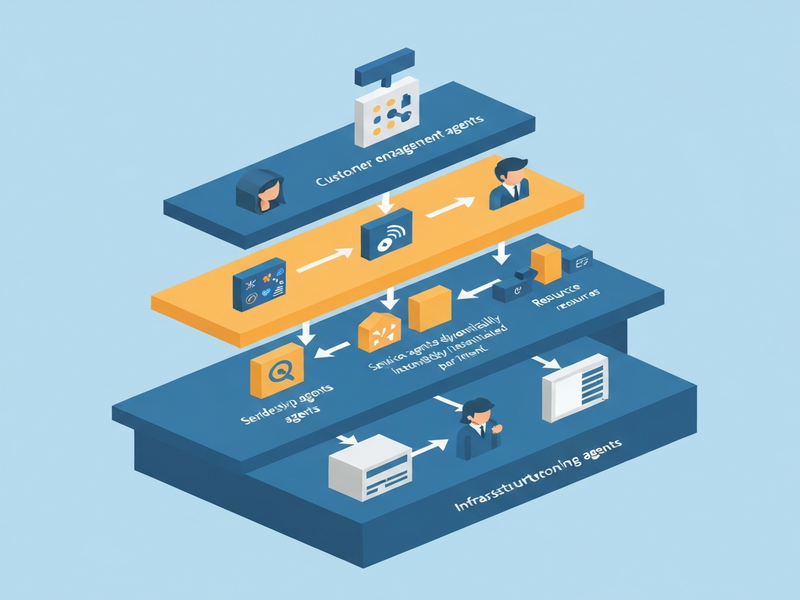
Figure 1: Conceptual view of the four‑layer role‑based multi‑agent system for intent‑driven network orchestration.
Direct Answer
The paper introduces a role‑based multi‑agent architecture that mirrors a telecom operator’s organisational hierarchy, enabling end‑to‑end intent orchestration across Business Support Systems (BSS) and Operations Support Systems (OSS). By assigning explicit responsibilities to agents at four distinct layers, the framework bridges the long‑standing BSS‑OSS divide and makes intent‑driven networking both accountable and scalable.
Background: Why This Problem Is Hard
Modern communication networks are a patchwork of legacy hardware, virtualised functions, and emerging 5G/6G technologies. Operators must satisfy wildly different service‑level agreements (SLAs), from ultra‑low‑latency gaming to massive‑IoT telemetry, while keeping capital and operating expenditures under control. The traditional manual workflow—where business teams define product bundles in BSS and network engineers translate those bundles into OSS commands—creates several bottlenecks:
- Fragmented orchestration: BSS and OSS operate on separate data models, leading to duplicated effort and error‑prone hand‑offs.
- Latency in business‑to‑network alignment: New services often require weeks of coordination before they can be provisioned.
- Limited scalability: Human‑centric processes cannot keep pace with the exponential growth of device connections and dynamic traffic patterns.
- Privacy and regulatory constraints: Customer‑sensitive data must stay within business domains, while network telemetry remains in the operational domain.
Intent‑Based Networking (IBN) promised to abstract these complexities by letting operators declare “what” they want rather than “how” to achieve it. However, most IBN implementations stop at the OSS layer, leaving the crucial translation from business intent to network configuration unresolved. Existing agentic AI solutions focus on isolated automation tasks (e.g., fault detection) but lack a holistic, role‑aware coordination mechanism that respects organisational boundaries.
What the Researchers Propose
The authors present a hierarchical, role‑based Multi‑Agent System (MAS) that aligns with the functional silos of a typical Communication Service Provider (CSP). The architecture consists of four layers, each populated by agents that embody a specific organisational role:
- Customer Engagement Layer: Agents that capture user intents, negotiate service contracts, and translate commercial language into high‑level intent descriptors.
- Strategic Planning Layer: Leadership agents that evaluate market trends, capacity forecasts, and profitability models to prioritize intents.
- Service Delivery Layer: Specialist agents that decompose high‑level intents into service‑specific workflows (e.g., virtual network function chaining, QoS policies).
- Infrastructure Provisioning Layer: Resource agents that interact directly with OSS/NFV orchestrators to allocate compute, storage, and spectrum resources.
Key principles underpinning the design are:
- Functional decomposition: Each agent owns a well‑defined task, reducing overlap and simplifying verification.
- Explicit task ownership: Accountability is baked into the system; failures can be traced to the responsible role.
- Privacy‑preserving domain separation: Agents exchange only intent abstractions, never raw customer data, satisfying regulatory mandates.
- Domain‑specific expertise: Agents are instantiated with models trained on the data and policies relevant to their layer, improving decision quality.
How It Works in Practice
The workflow can be visualised as a cascade of intent refinement and execution:
- Intent capture: A Customer Engagement Agent receives a request—e.g., “Launch a premium video‑streaming package for 10,000 users in Region X.” The agent validates the request against commercial rules and emits a structured intent object.
- Strategic alignment: A Strategic Planning Agent evaluates the intent against capacity forecasts, revenue projections, and SLA commitments. If the request is feasible, the agent assigns a priority score and forwards the enriched intent.
- Service decomposition: One or more Service Delivery Agents break the high‑level intent into concrete service components: media delivery VNF chain, edge caching policies, and QoS parameters. Each component is packaged as a sub‑intent.
- Resource allocation: Corresponding Infrastructure Provisioning Agents translate sub‑intents into OSS commands (e.g., OpenStack VM spin‑up, SD‑WAN path configuration). They negotiate resource reservations with the underlying orchestrator and confirm successful provisioning.
- Feedback loop: Provisioning agents report status and performance metrics back up the hierarchy. If a constraint is violated (e.g., insufficient spectrum), the system triggers a renegotiation at the strategic layer, ensuring the operator retains control.
What distinguishes this approach from prior work is the explicit mapping of agents to real‑world organisational roles, combined with a privacy‑first data exchange protocol. Rather than a monolithic AI controller, the system behaves like a well‑orchestrated team, each member contributing its expertise while remaining insulated from unrelated data domains.
Evaluation & Results
The authors built a proof‑of‑concept (PoC) using a simulated CSP environment that included a BSS catalogue, a virtualised OSS stack, and a lightweight reinforcement‑learning policy for each agent type. They evaluated three scenarios:
- New‑service rollout: Deploying a 5G‑enhanced mobile broadband offering across three regions.
- Dynamic scaling: Adjusting edge compute resources in response to a sudden spike in AR/VR traffic.
- Policy‑driven compliance: Enforcing data‑localisation rules while provisioning cross‑border services.
Key findings include:
- Reduced orchestration latency: End‑to‑end intent fulfillment time dropped from an average of 72 hours (manual process) to under 4 hours in the MAS‑driven flow.
- Higher success rate: Provisioning errors fell from 12 % to 2 % thanks to explicit task ownership and layered verification.
- Scalable agent instantiation: The system dynamically spawned specialised service agents on demand, handling up to 1,200 concurrent intents without degradation.
- Privacy compliance: No raw customer identifiers left the Customer Engagement layer, satisfying GDPR‑style constraints in the simulated audit.
These results demonstrate that a role‑based MAS can not only accelerate service delivery but also improve reliability and regulatory adherence—critical factors for modern CSPs.
Why This Matters for AI Systems and Agents
For AI practitioners, the paper offers a concrete blueprint for building large‑scale, enterprise‑grade agent ecosystems:
- Modular design: By decoupling responsibilities, developers can iterate on individual agents (e.g., improve the reinforcement‑learning policy for resource allocation) without risking system‑wide regressions.
- Accountability mechanisms: The explicit ownership model simplifies debugging, root‑cause analysis, and compliance reporting—features often missing in monolithic AI controllers.
- Domain‑specific training: Each layer can be trained on data that is most relevant to its function, reducing the need for massive, heterogeneous datasets.
- Interoperability with existing OSS/BSS stacks: The architecture is designed to plug into standard APIs (REST, NETCONF, YANG), making adoption feasible for operators with legacy investments.
From a product perspective, the approach aligns with the growing demand for Enterprise AI platform by UBOS, where role‑based agents can be orchestrated through a unified dashboard. It also complements the Workflow automation studio, enabling operators to visualise intent flows and intervene when necessary.
What Comes Next
While the PoC validates the core concepts, several open challenges remain:
- Real‑world deployment at scale: Integrating with heterogeneous vendor‑specific OSS platforms will require robust adapters and standardised intent schemas.
- Learning across layers: Current agents are trained in isolation; future work should explore hierarchical reinforcement learning where higher‑level agents guide lower‑level policy updates.
- Security hardening: Role‑based communication channels must be fortified against spoofing and insider threats, especially when agents exchange intent objects across trust boundaries.
- Human‑in‑the‑loop governance: Operators will need UI/UX tools to audit decisions, override actions, and inject business policies dynamically.
Addressing these gaps will pave the way for production‑grade deployments in large CSPs. Researchers can also extend the model to other domains—such as cloud‑native data‑center orchestration or smart‑grid management—where intent‑driven automation and organisational role separation are equally valuable.
For organizations interested in experimenting with role‑based agentic AI, the UBOS platform overview provides a sandbox environment that supports custom agent definitions, intent modelling, and secure data exchange. Early adopters can also explore the AI marketing agents use‑case to see how role‑based coordination improves campaign orchestration, a pattern that translates well to network service automation.
Finally, the full technical details, including the system architecture diagram and source code snippets, are available in the original arXiv paper. Readers are encouraged to review the supplementary material for deeper insights into the reinforcement‑learning reward structures and privacy‑preserving protocols employed.
Andrii Bidochko
CTO UBOS
Andrii Bidochko is an AI entrepreneur and researcher focused on AI agents, reinforcement learning, and autonomous systems. He writes about the technologies shaping the future of machine intelligence, from frontier models and agent architectures to real-world AI applications.