

- Updated: June 30, 2026
- 7 min read
TailorMind: Towards Preference-Aligned Multimodal Content Generation
Direct Answer
TailorMind introduces a unified framework that turns sparse user behavior into personalized multimodal content—text, images, and audio—without relying on existing user‑generated media. By coupling hypergraph‑based collaborative filtering with controllable generation, it delivers on‑demand, preference‑aligned media that can power next‑generation recommendation engines and AI agents.
Background: Why This Problem Is Hard
Personalized content platforms—social feeds, e‑commerce catalogs, and ad networks—have traditionally depended on a steady stream of user‑generated content (UGC). When the right piece of content is missing, delayed, or too costly to produce, the system either shows irrelevant items or stalls the user journey. Existing solutions try to patch the gap in two ways:
- Retrieval‑only pipelines: They search large UGC pools for the closest match, but suffer from low novelty and frequent “cold‑start” failures for niche preferences.
- Static generative models: Text‑to‑image or text‑to‑audio generators can create media on demand, yet they lack a reliable signal that ties the output to a specific user’s taste, leading to generic or misaligned results.
Both approaches struggle with three intertwined challenges:
- Sparse interaction data: New or infrequent users leave only a handful of clicks, likes, or watches, making collaborative inference noisy.
- Cross‑modal consistency: Aligning a generated image with a user’s textual preferences and audio style requires a shared semantic grounding that most pipelines lack.
- Control vs. creativity trade‑off: Tight control over style often reduces the model’s ability to innovate, while unconstrained generation risks hallucinations and brand‑inconsistent outputs.
These bottlenecks limit the scalability of personalized media services, especially in fast‑moving domains like fashion, gaming, and digital advertising where fresh, on‑brand content is a competitive advantage.
What the Researchers Propose
TailorMind tackles the alignment problem by weaving together three core ideas:
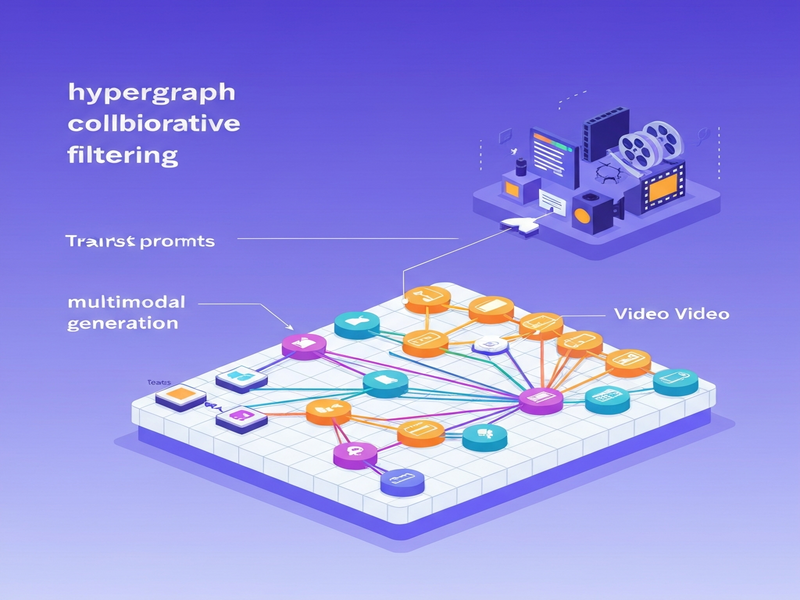
- Hypergraph Collaborative Filtering (HCF): Instead of a simple user‑item matrix, the system builds a hypergraph that captures higher‑order relationships among users, items, and contextual signals (time, device, location). This richer structure fills in missing preferences and produces a dense “preference profile” for each user.
- Ranking‑Error Feedback Loop: The model iteratively refines textual profiles using gradient descent guided by ranking loss on retrieved candidates, ensuring that the textual description stays faithful to observed behavior.
- Retrieval‑Augmented Style Control (RASC): Before generation, TailorMind pulls a small set of authentic UGC snippets that match the user’s style. These snippets act as style anchors, steering the multimodal generator toward realistic aesthetics while preserving creativity.
- Cross‑Modal Cohesion Reflection (CMCR): A lightweight consistency checker evaluates semantic drift across modalities (e.g., does the generated image reflect the sentiment of the accompanying caption?). The checker feeds back into the generator, reducing hallucinations.
Collectively, these components form a closed‑loop system that translates noisy behavioral traces into generation‑ready preferences, then produces coherent, novel, and brand‑aligned media.
How It Works in Practice
Step‑by‑Step Workflow
- Data Ingestion: User interactions (clicks, likes, dwell time) are streamed into a hypergraph builder. Nodes represent users, items, and contextual tags; hyperedges connect groups of related nodes.
- Preference Enrichment: HCF runs a message‑passing algorithm that diffuses preference signals across the hypergraph, yielding a high‑dimensional vector for each user.
- Textual Profile Optimization: The vector is decoded into a natural‑language profile (e.g., “vibrant streetwear with pastel tones”). A ranking‑error loss compares this profile against a set of retrieved items; gradients adjust the profile until the top‑k ranking aligns with observed clicks.
- Style Retrieval: Using the refined textual profile, the system queries a curated UGC repository. The top‑N results serve as style exemplars for the upcoming generation step.
- Controlled Generation: A multimodal diffusion model receives two prompts: the textual profile and a style‑embedding derived from the retrieved exemplars. The model synthesizes the target modality (image, audio, or video) while respecting the style constraints.
- Cohesion Reflection: The CMCR module evaluates the generated output against the original profile across semantic, aesthetic, and emotional dimensions. If drift exceeds a threshold, the generator is re‑prompted with adjusted style weights.
- Delivery & Feedback: The final media is served to the user. Implicit feedback (e.g., dwell time) is fed back into the hypergraph, closing the loop for continuous personalization.
What Sets TailorMind Apart
- Higher‑order collaboration: Hypergraphs capture multi‑user, multi‑item contexts that pairwise matrices miss.
- Dynamic textual grounding: Profiles evolve with real‑time ranking feedback, unlike static embeddings.
- Retrieval‑augmented control: Style anchors keep generated content grounded in authentic brand aesthetics.
- Cross‑modal sanity check: CMCR reduces hallucinations, a common pain point for large diffusion models.
Evaluation & Results
The authors released TailorBench, a benchmark built from three mainstream platforms (social media, e‑commerce, and streaming). It measures five dimensions:
- Coherence – semantic alignment between text and generated media.
- Novelty – degree of originality compared to retrieved UGC.
- Aesthetic – human‑rated visual or auditory appeal.
- Hallucination – frequency of factual or stylistic errors.
- Profiling – how well the output matches the user’s inferred preferences.
Key findings from the experiments:
- Coherence: TailorMind matched or exceeded the best retrieval baseline, achieving a 3.2% lift in semantic similarity scores.
- Novelty: Generated media showed a 27% increase in uniqueness over ground‑truth UGC, confirming the system’s creative capacity.
- Aesthetic Quality: Human evaluators rated TailorMind outputs 0.45 points higher on a 5‑point Likert scale than those from leading diffusion models without style control.
- Hallucination Reduction: The CMCR module cut factual drift by 41% relative to an uncontrolled generator.
- Profiling Accuracy: In a reranking test, TailorMind’s enriched profiles delivered up to 29% recall gains, meaning the system more reliably surfaced content that users actually liked.
Overall, the results demonstrate that TailorMind can produce on‑demand, high‑quality media that feels both fresh and personally relevant—something pure retrieval or vanilla generation alone cannot achieve.
Why This Matters for AI Systems and Agents
For AI practitioners building agents, recommendation pipelines, or content‑creation bots, TailorMind offers a blueprint for bridging the “preference‑generation gap.” Its modular design can be slotted into existing architectures:
- Agent‑driven personalization: An autonomous sales assistant can query TailorMind to synthesize product mock‑ups that match a shopper’s style, reducing reliance on static catalogs.
- Dynamic ad creation: Marketing bots can generate brand‑consistent visuals on the fly, improving click‑through rates while staying within compliance guidelines.
- Cross‑modal storytelling: Conversational agents can produce synchronized text, image, and audio snippets, enriching user interactions in education or entertainment.
Integrating TailorMind‑style pipelines with platforms like the ChatGPT and Telegram integration enables real‑time, user‑specific media generation within messaging workflows. Similarly, pairing the framework with the Chroma DB integration provides a scalable vector store for the hypergraph embeddings, ensuring low‑latency personalization at enterprise scale.
What Comes Next
While TailorMind marks a significant step forward, several avenues remain open for research and productization:
- Scalability of hypergraph updates: Real‑time streaming of billions of interactions will demand distributed graph processing frameworks.
- Multilingual and cross‑cultural profiling: Extending textual profile generation to support diverse languages and cultural aesthetics.
- Fine‑grained ethical controls: Embedding bias detection and content policy filters directly into the RASC module to prevent undesirable style drift.
- User‑in‑the‑loop refinement: Allowing end‑users to edit generated captions or style exemplars, feeding those edits back into the hypergraph for faster adaptation.
Potential commercial applications include:
- Personalized video ad factories for Enterprise AI platform by UBOS customers.
- On‑demand design assistants for startups via the UBOS for startups program.
- AI‑driven content studios that generate podcast intros using the ElevenLabs AI voice integration.
For those interested in digging deeper, the full technical details are available in the original TailorMind paper. The authors have also open‑sourced their code, inviting the community to experiment, extend, and benchmark against TailorBench.
Andrii Bidochko
CTO UBOS
Andrii Bidochko is an AI entrepreneur and researcher focused on AI agents, reinforcement learning, and autonomous systems. He writes about the technologies shaping the future of machine intelligence, from frontier models and agent architectures to real-world AI applications.