

- Updated: June 30, 2026
- 6 min read
SPIRAL: Learning to Search and Aggregate
Direct Answer
SPIRAL (Sequential‑Parallel‑Aggregative Reinforcement Learning) is a new training framework that teaches large language models to generate multiple reasoning traces in parallel, then combine them into a single, higher‑quality answer. By optimizing the whole pipeline end‑to‑end, SPIRAL unlocks scalable inference compute and delivers up to 15 % better performance on complex reasoning benchmarks.
Background: Why This Problem Is Hard
Modern language models excel at “chain‑of‑thought” (CoT) prompting, where a model produces a step‑by‑step reasoning trace before answering. However, two practical bottlenecks limit real‑world deployment:
- Sequential compute limits: CoT reasoning runs in a single thread, so adding more reasoning steps directly increases latency.
- Single‑trace brittleness: A single reasoning path can wander off‑track, leading to incorrect conclusions even when the model has enough knowledge.
Researchers have tried two workarounds. First, they run many independent CoT traces in parallel and vote on the majority answer, but the model is never trained to produce a set of complementary traces. Second, they use post‑hoc aggregation heuristics (e.g., self‑consistency) that treat the aggregator as a fixed function, missing the chance to learn a better combination strategy. Both approaches leave a gap: the model is optimized only for sequential reasoning inside one trace, while the inference pipeline can exploit parallelism and aggregation.
What the Researchers Propose
The SPIRAL framework expands the training objective to cover three primitives that mirror the full inference pipeline:
- Sequential reasoning: Each trace follows a classic chain‑of‑thought process.
- Parallel generation: The model simultaneously produces a set of independent traces.
- Aggregative reasoning: A dedicated aggregation trace consumes the entire set and synthesizes the final answer.
To teach the model these behaviors, SPIRAL combines two reinforcement‑learning (RL) signals:
- Set‑RL rewards the collection of parallel traces for their collective usefulness to the aggregator.
- Standard RL rewards the final aggregation trace for the quality of the answer it produces.
In effect, the model learns not only how to think step‑by‑step, but also how to think “together” with its peers and how to be a good summarizer of their joint insights.
How It Works in Practice
The SPIRAL inference pipeline can be visualized as a three‑stage workflow:
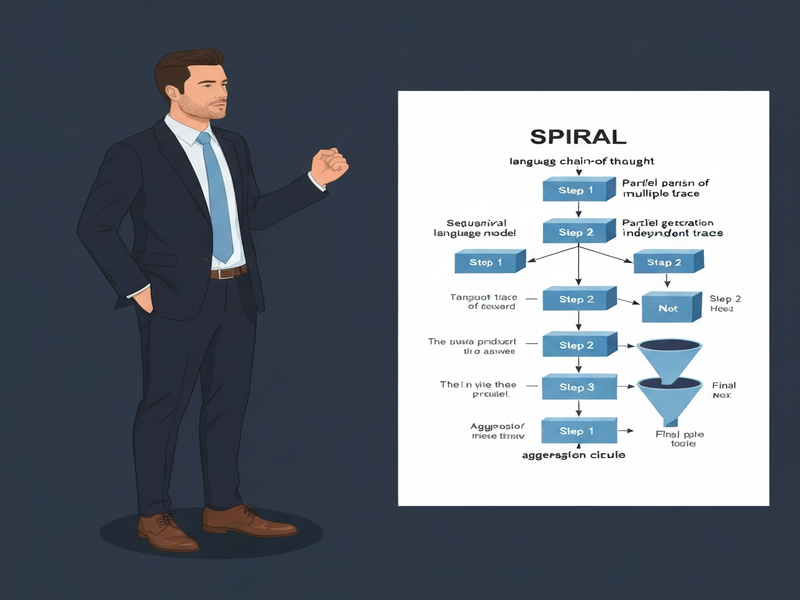
Stage 1 – Parallel Trace Generation
The model receives the original problem prompt and spawns k independent workers. Each worker runs a standard CoT chain, producing a reasoning trace T_i. Because the workers are independent, they explore different solution paths, hypotheses, or decomposition strategies.
Stage 2 – Set‑Level Reinforcement
After all k traces are collected, a set‑level reward function evaluates how well the ensemble covers the solution space. The reward is higher when the traces are diverse yet collectively informative, encouraging the model to avoid redundant reasoning.
Stage 3 – Aggregation Trace
A fourth “aggregator” model receives the full set {T_1,…,T_k} as context and generates a final answer trace A. This trace can reference specific steps from any of the parallel traces, weigh conflicting evidence, and produce a concise conclusion. Standard RL then optimizes A against the ground‑truth answer.
What distinguishes SPIRAL from earlier self‑consistency methods is that the aggregator is a learnable component, and the parallel traces are explicitly trained to be useful to it, rather than being an after‑the‑fact ensemble.
Evaluation & Results
The authors benchmarked SPIRAL on several reasoning‑heavy datasets, including mathematical problem solving, logical deduction, and multi‑step commonsense tasks. Key experimental dimensions were:
- Compute scaling: Varying the number of parallel traces (1 → 16) while keeping total wall‑clock time roughly constant.
- Baseline comparisons: Standard CoT, self‑consistency voting, and the recent GRPO method.
- Reward metrics: Exact match accuracy and a calibrated confidence score.
Findings:
- When all three primitives were scaled, SPIRAL achieved up to 15 % higher accuracy than the best baseline at comparable compute budgets.
- Its scaling efficiency was 11× better than GRPO, meaning that each additional unit of inference compute yielded a larger performance jump.
- Ablation studies showed that removing either the set‑RL signal or the learnable aggregator reduced gains by more than 6 %, confirming that both components are essential.
These results demonstrate that training a model to think in parallel and to aggregate its own thoughts can translate into tangible improvements on real‑world reasoning tasks.
Why This Matters for AI Systems and Agents
For practitioners building AI agents, SPIRAL offers a concrete recipe to turn raw model capacity into scalable, reliable reasoning pipelines:
- Reduced latency variance: Parallel trace generation can be distributed across multiple GPUs or edge devices, allowing system architects to meet strict response‑time SLAs while still benefiting from deep reasoning.
- Improved robustness: By learning to aggregate diverse viewpoints, agents become less prone to single‑point failures caused by a stray reasoning path.
- Better orchestration: SPIRAL’s three‑stage design maps naturally onto workflow‑automation platforms. For example, the Workflow automation studio can spin up parallel reasoning jobs, collect their outputs, and feed them into a custom aggregator node.
- Seamless integration with existing tools: The OpenAI ChatGPT integration can be extended to run multiple ChatGPT instances in parallel, then invoke a downstream summarizer trained with SPIRAL’s set‑RL objective.
- Enterprise‑grade scalability: Companies that already use the Enterprise AI platform by UBOS can embed SPIRAL as a native reasoning service, leveraging existing compute clusters and monitoring dashboards.
In short, SPIRAL transforms a theoretical insight about parallel reasoning into a production‑ready pattern that aligns with modern AI infrastructure.
What Comes Next
While SPIRAL marks a significant step forward, several open challenges remain:
- Diversity vs. redundancy trade‑off: The set‑RL reward encourages useful diversity, but finding the optimal balance for different domains (e.g., legal reasoning vs. code synthesis) is still an open research question.
- Dynamic trace budgeting: Current experiments fix the number of parallel traces ahead of time. Future work could let the model decide on‑the‑fly how many traces to spawn based on problem difficulty.
- Cross‑modal aggregation: Extending the aggregator to handle multimodal inputs (images, tables, code) would broaden SPIRAL’s applicability to vision‑language agents.
- Human‑in‑the‑loop feedback: Incorporating user corrections into the set‑RL loop could further improve alignment with real‑world expectations.
Potential application avenues include:
- AI‑driven marketing agents that generate multiple campaign concepts in parallel and synthesize the most persuasive copy.
- Customer‑support bots that run parallel diagnostic traces before presenting a unified solution, reducing escalation rates.
- Scientific discovery platforms that explore alternative hypothesis chains simultaneously, then aggregate the most promising conclusions.
Developers interested in experimenting with SPIRAL can start by prototyping the three‑stage pipeline using the UBOS platform overview and its built‑in reinforcement‑learning utilities.
References
SPIRAL: Learning to Search and Aggregate (arXiv)
Andrii Bidochko
CTO UBOS
Andrii Bidochko is an AI entrepreneur and researcher focused on AI agents, reinforcement learning, and autonomous systems. He writes about the technologies shaping the future of machine intelligence, from frontier models and agent architectures to real-world AI applications.