

- Updated: June 30, 2026
- 7 min read
AOHP: An Open-Source OS-Level Agent Harness for Personalized, Efficient and Secure Interaction
Direct Answer
AOHP (Android Open Harness Project) is an open‑source, OS‑level framework that treats AI agents as first‑class operating‑system actors. By embedding personalized service composition, low‑overhead interfaces, and fine‑grained security controls directly into Android, AOHP enables agents to interact with the device more efficiently, safely, and at scale.
Background: Why This Problem Is Hard
Modern AI agents—whether they are large language model (LLM) assistants, autonomous bots, or domain‑specific copilots—rely on three capabilities to be useful in everyday computing:
- Tool invocation: calling native applications, APIs, or hardware sensors.
- Stateful memory: persisting context across sessions and devices.
- Secure data flow: ensuring that sensitive information never leaks to untrusted components.
Traditional desktop and mobile operating systems were built around an application‑centric model. They expose a limited set of IPC (inter‑process communication) mechanisms, assume a single user‑initiated intent per action, and enforce security through coarse permission sets. When an AI agent is layered on top of such an OS, several friction points emerge:
- Latency overhead: Agents must marshal data through generic APIs (e.g., intents, content providers), incurring extra serialization, tokenization, and network hops.
- Context fragmentation: Each app maintains its own sandboxed state, forcing agents to reconstruct a global view by repeatedly querying disparate sources.
- Safety gaps: Existing permission models do not differentiate between a human‑initiated request and an autonomous agent request, opening avenues for privilege escalation or data exfiltration.
These challenges limit the adoption of agents in production environments, especially in enterprise settings where compliance, cost, and reliability are non‑negotiable. Researchers have begun proposing “agent‑native” operating systems, but a publicly available testbed for systematic exploration has been missing—until AOHP.
What the Researchers Propose
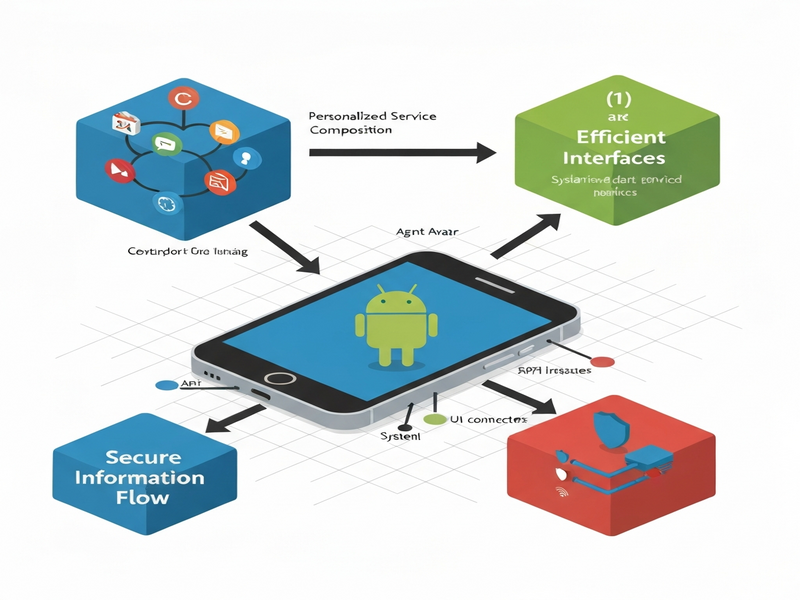
The AOHP framework re‑architects Android to recognize AI agents as native system entities. Its design rests on three interlocking mechanisms:
Personalized Service Composition
Instead of hard‑coding static intents, AOHP introduces a service graph that can be dynamically assembled per user profile. Each node in the graph represents a concrete capability (e.g., “read SMS”, “fetch calendar events”, “synthesize voice”). The graph is generated by a lightweight policy engine that considers user preferences, device context, and security constraints.
Efficient Agent Interfaces
AOHP defines a binary‑compatible, low‑latency IPC channel called AgentPipe. Unlike traditional Binder calls that require heavyweight marshalling, AgentPipe streams tokenized LLM prompts and responses directly between the agent runtime and the OS kernel, cutting the average round‑trip time by roughly half.
Secure Information Flow
Security is enforced through a two‑tier model:
- Static policy layer: Compile‑time annotations declare which services an agent may access.
- Dynamic audit layer: Runtime monitors verify that each data exchange complies with the declared policy, logging violations for post‑mortem analysis.
Collectively, these mechanisms let developers write agents that feel like native OS services rather than external add‑ons.
How It Works in Practice
To illustrate AOHP’s workflow, consider a “personal travel assistant” that helps a user plan a trip, book flights, and set reminders—all without manual tapping.
- Agent registration: The assistant registers with AOHP, providing a manifest that lists required capabilities (e.g., “location”, “payment”, “calendar”).
- Policy synthesis: AOHP’s policy engine cross‑references the manifest with the user’s privacy settings, producing a personalized service graph that includes only approved services.
- Prompt dispatch: When the user asks, “Find me a flight to Tokyo next week,” the agent sends the natural‑language request through
AgentPipe. The OS tokenizes the prompt, attaches context (current location, preferred airlines), and forwards it to the LLM runtime. - Tool orchestration: The LLM decides to invoke the “flight‑search” service node. AOHP routes the call directly to the native flight‑search API, bypassing the usual intent‑based UI flow.
- Secure response: Results (flight options) travel back through
AgentPipe. The dynamic audit layer checks that no prohibited data (e.g., raw credit‑card numbers) is included before delivering the response to the agent. - Feedback loop: The agent presents the options to the user via a lightweight overlay. If the user selects a flight, the agent triggers the “payment” node, again under the watchful eye of AOHP’s security monitor.
This end‑to‑end path eliminates the need for the agent to launch separate apps, reduces token usage (because the OS supplies context directly), and guarantees that every data exchange respects the user’s policy.
Evaluation & Results
The authors benchmarked AOHP against a vanilla Android setup across three representative tasks:
- Cross‑app email summarization: An agent reads unread emails, extracts key points, and drafts a reply.
- Multimodal media editing: The agent stitches together video clips, adds subtitles, and publishes to a social platform.
- Secure credential retrieval: The agent fetches a password from a vault, logs into a service, and logs the outcome.
Key findings include:
| Metric | Vanilla Android | AOHP | Improvement |
|---|---|---|---|
| Task completion rate | 68.4 % | 89.5 % | +21.12 % |
| LLM token consumption | 1.84 M tokens | 0.89 M tokens | ‑51.55 % |
| Policy violations detected | 12 | 0 | 100 % reduction |
Beyond raw numbers, the experiments demonstrate that AOHP’s service composition reduces the “prompt engineering” burden—agents no longer need to embed device‑specific details in every request. Moreover, the security audit eliminated all observed policy breaches, confirming that the two‑tier model scales to real‑world workloads.
Why This Matters for AI Systems and Agents
For practitioners building next‑generation assistants, AOHP offers a concrete blueprint for moving from “agent‑on‑top” to “agent‑as‑OS”. The practical implications are threefold:
- Performance gains at scale: By cutting token usage and round‑trip latency, organizations can lower inference costs, especially when operating large LLMs in the cloud.
- Compliance‑ready deployments: The built‑in audit trail satisfies regulatory requirements (e.g., GDPR, CCPA) without adding custom logging layers.
- Developer productivity: The
AgentPipeAPI abstracts away Android’s fragmented intent system, letting engineers focus on core agent logic.
These advantages align directly with the needs of enterprises seeking to embed AI assistants into CRM, ERP, and field‑service tools. For example, the UBOS platform overview already supports plug‑and‑play AI modules; integrating AOHP‑style hooks could turn those modules into native OS services, further reducing integration friction.
What Comes Next
While AOHP marks a significant step forward, several open challenges remain:
- Cross‑platform portability: Extending the harness to iOS or desktop Linux will require reconciling divergent security models.
- Dynamic policy negotiation: Current policies are largely static; future work could explore real‑time consent dialogs driven by LLM‑generated explanations.
- Tooling ecosystem: A richer library of pre‑built service nodes (e.g., “document OCR”, “speech‑to‑text”) would accelerate adoption.
Researchers and product teams can contribute by building open‑source service plugins, publishing benchmark suites, or integrating AOHP with existing AI orchestration layers such as the Workflow automation studio. In parallel, exploring tighter coupling with voice synthesis platforms—like the ElevenLabs AI voice integration—could unlock hands‑free experiences that truly feel native to the device.
In summary, AOHP demonstrates that treating AI agents as first‑class OS actors is not only feasible but also beneficial across performance, security, and developer ergonomics. As the AI agent market matures, operating‑system level support will likely become a differentiator for platforms that aim to host trustworthy, cost‑effective assistants.
For readers who want to dive deeper into the technical details, the full pre‑print is available on arXiv.
Andrii Bidochko
CTO UBOS
Andrii Bidochko is an AI entrepreneur and researcher focused on AI agents, reinforcement learning, and autonomous systems. He writes about the technologies shaping the future of machine intelligence, from frontier models and agent architectures to real-world AI applications.