- Updated: June 29, 2026
- 6 min read
Abstract representational geometry supports inference in large language models
Direct Answer
The paper introduces a neuroscientifically inspired framework that reveals how large language models (LLMs) develop low‑dimensional, approximately orthogonal manifolds—called abstract representational geometry—to support inference from sparse data. This matters because it links a concrete geometric signature inside LLMs to the kind of flexible, task‑general reasoning that underpins human intelligence, offering a new lever for building more reliable AI agents.
Background: Why This Problem Is Hard
Human cognition excels at extracting hidden task structure from just a few observations, a capability that emerges from hippocampal dynamics that organize experiences into abstract, disentangled manifolds. Replicating this ability in artificial systems faces two intertwined challenges:
- Opacity of LLM internals: Modern transformers contain billions of parameters, making it difficult to determine whether they rely on genuine abstraction or on surface‑level statistical shortcuts.
- Evaluation gap: Traditional benchmarks measure accuracy on fixed test sets but rarely probe whether a model can infer latent rules when the environment changes.
Existing interpretability tools—attention visualizations, probing classifiers, and activation atlases—provide snapshots of feature importance but do not capture the global geometry that would indicate a model’s capacity for systematic inference. Consequently, developers lack actionable diagnostics for steering LLMs toward human‑like reasoning.
What the Researchers Propose
To bridge this gap, the authors adapt a classic contextual reversal‑learning task into a purely textual format and then examine both behavior and internal representations of humans and LLMs. Their core proposal consists of three intertwined components:
- Task‑driven language modeling: The model is exposed to a sequence of context‑dependent prompts that require it to infer a hidden rule (e.g., “if the cue is red, choose A; if blue, choose B”) and then reverse that rule after a few trials.
- Representational geometry analysis: Using dimensionality reduction and manifold alignment, the authors quantify how stimulus identity, context, and inferred rule are encoded across layers, looking for low‑dimensional, near‑orthogonal subspaces.
- Intervention experiments: They manipulate training objectives (adding a geometric regularizer) and data ordering (task‑sequence pre‑training) to test whether shaping geometry directly improves inference performance.
In essence, the framework treats abstract geometry as a mechanistic hypothesis: if a model’s hidden states form clean, separable manifolds for context and rule, it should be able to generalize inference beyond the training distribution.
How It Works in Practice
The experimental pipeline can be broken down into a clear workflow that any research team could replicate:
1. Textual Reversal‑Learning Environment
- Define a set of stimuli (e.g., words or symbols) and a hidden context rule that maps each stimulus to a response.
- Present the model with a short trial block (3‑5 examples) where the rule holds, then flip the rule without explicit notification.
- Collect the model’s predictions on the post‑flip trials to assess inference.
2. Layer‑wise Representation Extraction
- Record hidden states after each token for every layer of the transformer.
- Apply Principal Component Analysis (PCA) followed by Canonical Correlation Analysis (CCA) to isolate subspaces that correspond to stimulus identity versus contextual rule.
- Measure orthogonality between these subspaces; higher orthogonality indicates cleaner disentanglement.
3. Geometric Regularization (Optional)
- Introduce an auxiliary loss that penalizes overlap between the stimulus and context subspaces during fine‑tuning.
- Monitor the loss alongside standard language‑model perplexity to ensure performance does not degrade.
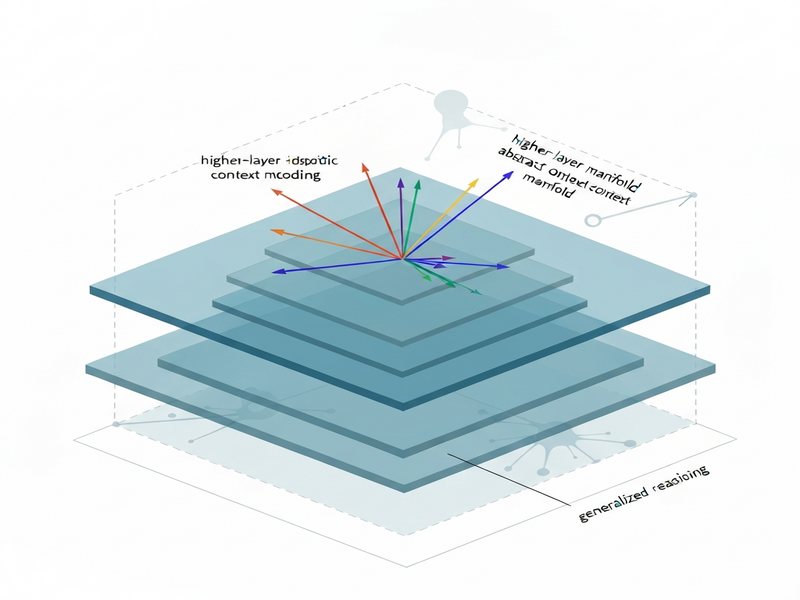
What sets this approach apart is the hierarchical focus on depth: lower layers are expected to lock in raw token identity, while higher layers should progressively sculpt the abstract context geometry. By explicitly measuring and, if desired, shaping this hierarchy, practitioners gain a concrete handle on a model’s reasoning capacity.
Evaluation & Results
The authors evaluated three families of models—GPT‑2‑small, GPT‑Neo‑1.3B, and a custom 6‑layer transformer—against human participants on the same reversal‑learning task. Evaluation comprised two axes:
Behavioral Performance
- Humans achieved >90% correct inference after the rule reversal, reflecting robust latent‑structure extraction.
- LLMs displayed a bimodal distribution: roughly 30% of runs matched human performance, while the remainder failed to adapt, defaulting to the original rule.
Representational Geometry
- In successful LLM runs, higher layers exhibited a clear separation between stimulus and context subspaces (average orthogonality >0.85), mirroring hippocampal recordings from rodent studies.
- Unsuccessful runs showed tangled representations, with orthogonality dropping below 0.4 and no discernible functional band.
- Geometric regularization increased the proportion of successful runs from 30% to 55% without harming next‑token prediction quality.
These findings demonstrate that abstract geometry is not a by‑product of scale alone; it can be induced and measured, and it correlates strongly with the ability to perform flexible inference.
Why This Matters for AI Systems and Agents
For practitioners building AI agents that must operate in dynamic environments—such as autonomous customer‑support bots, adaptive recommendation engines, or real‑time decision‑making assistants—the paper offers two actionable takeaways:
- Diagnostic tooling: By integrating a lightweight geometry‑analysis module into the model‑monitoring stack, engineers can flag when an LLM’s internal states are drifting toward entangled representations, pre‑empting performance degradation.
- Design lever: Incorporating task‑sequence pre‑training or a modest geometric regularizer can systematically improve an agent’s capacity to infer hidden rules, reducing the need for extensive fine‑tuning on every new domain.
These capabilities align directly with the needs of UBOS platform overview, where modular AI pipelines benefit from transparent, controllable reasoning components. Moreover, agents that can reliably infer latent structure are better suited for AI marketing agents, which must adapt campaign logic on the fly based on sparse user signals.
From an operational standpoint, the hierarchical geometry insight also informs Workflow automation studio designs: developers can route high‑level context processing to deeper transformer blocks while keeping lower layers dedicated to token fidelity, leading to more efficient compute allocation.
What Comes Next
While the study opens a promising path, several limitations remain:
- Scale dependence: The experiments focused on models up to 1.3 B parameters; it is unclear how geometry behaves in multi‑billion‑parameter systems.
- Task diversity: Reversal learning is a narrow proxy for inference; broader curricula (e.g., causal reasoning, analogical mapping) need to be examined.
- Real‑world deployment: Translating geometric regularization into production pipelines requires careful balancing of latency and training cost.
Future research directions include:
- Extending the framework to multimodal models (vision‑language, audio‑text) to see if similar hippocampal‑like manifolds emerge across modalities.
- Developing automated geometry‑monitoring dashboards that surface orthogonality metrics in real time, enabling ChatGPT and Telegram integration alerts for model drift.
- Exploring curriculum‑learning schedules that progressively increase task complexity while preserving disentangled geometry, potentially accelerating the emergence of inference capabilities.
Practitioners interested in experimenting with these ideas can start by adding the OpenAI ChatGPT integration to their existing pipelines, then layering a custom geometry‑regularizer on top of the fine‑tuning loop. For teams focused on rapid prototyping, the Telegram integration on UBOS offers a low‑friction channel to collect user feedback and trigger on‑the‑fly geometry checks.
Overall, the convergence of neuroscience‑inspired representation analysis and modern LLM engineering promises a new class of agents that can reason about the unseen, adapt with minimal data, and do so with a measurable internal signature that engineers can audit and improve.
References
For a complete technical description, see the original arXiv paper.