

- Updated: June 29, 2026
- 7 min read
Some Results about the Expressivity of Preference-Incomplete Structured Argumentation Frameworks
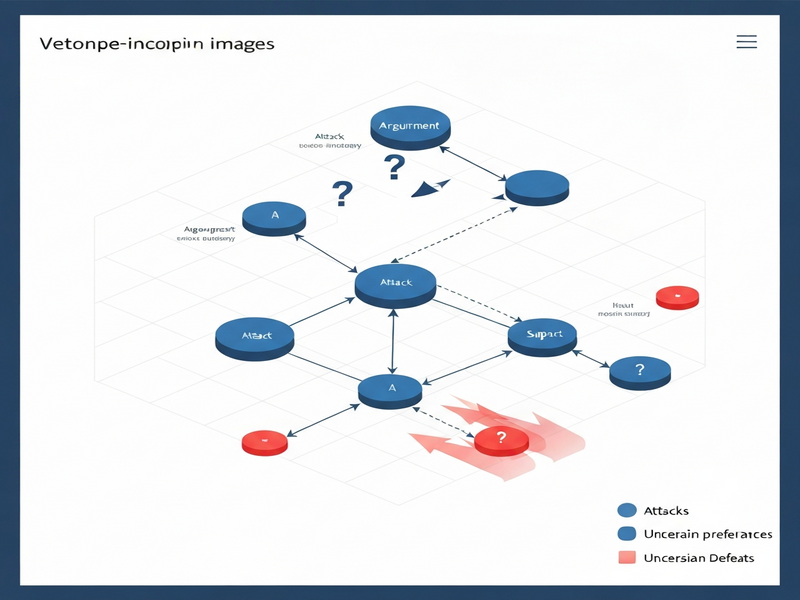
Direct Answer
The paper introduces a systematic study of how ASPIC+ argumentation frameworks behave when the underlying preference ordering among arguments is left partially unspecified, revealing surprising limits on their expressive power. This matters because it clarifies which kinds of uncertain reasoning can (or cannot) be captured by popular structured argumentation tools, guiding both theoreticians and system builders toward more reliable AI reasoning components.
Background: Why This Problem Is Hard
Structured argumentation frameworks such as ASPIC+ have become a cornerstone for modeling defeasible reasoning, legal reasoning, and multi‑agent negotiation. Their strength lies in two layers:
- Argument construction: premises, inference rules, and conclusions are assembled into a graph.
- Defeat resolution: a preference ordering decides which arguments outrank others when conflicts arise.
In real‑world deployments, however, the exact preference ordering is rarely known in advance. Preferences may be derived from incomplete stakeholder input, noisy sensor data, or evolving business policies. Existing research typically assumes a fully specified total order, which sidesteps the core difficulty: how to reason soundly when preferences are only partially known.
Current approaches to “uncertain defeats” either:
- Introduce probabilistic weights, which complicates the semantics and often requires heavy sampling.
- Adopt abstract frameworks that treat defeats as nondeterministic, but lose the tight connection to the underlying logical structure of ASPIC+.
Both strategies struggle to answer a fundamental question: What kinds of argumentation scenarios can be faithfully represented when preferences are incomplete? The answer determines whether a given AI system can guarantee consistency, explainability, and tractable computation under uncertainty.
What the Researchers Propose
Antonio Yuste‑Ginel proposes a comparative expressivity analysis that treats ASPIC+ with preference‑incomplete profiles as a candidate language for representing a family of abstract defeat‑uncertainty formalisms. The core idea is to map three well‑known abstract frameworks—each allowing “uncertain defeats”—onto ASPIC+ instances where the preference relation is left partially ordered.
The proposal hinges on three conceptual components:
- Preference‑Incomplete Structured Argumentation (PISA): an ASPIC+ instance where the preference relation is a partial order, possibly leaving many argument pairs incomparable.
- Abstract Uncertain Defeat Models (AUDM): formalisms such as “defeat‑uncertain abstract argumentation” that encode uncertainty directly at the defeat level without referencing underlying rules.
- Expressivity Mapping: a formal translation that attempts to preserve the set of acceptable extensions (e.g., stable, preferred) between a PISA instance and an AUDM.
The research asks: for each AUDM, can we find a PISA configuration that reproduces exactly the same reasoning outcomes? If yes, the ASPIC+ framework is said to be at least as expressive as the abstract model; if not, a gap in expressive power is identified.
How It Works in Practice
To operationalize the comparison, the authors follow a step‑by‑step workflow:
- Model Extraction: From a given AUDM, extract its set of arguments, attacks, and the uncertainty pattern governing defeats.
- Partial Preference Construction: Build a partial preference order over the same arguments that mirrors the uncertainty pattern. In practice this means declaring two arguments incomparable whenever the AUDM leaves their defeat relationship undecided.
- ASPIC+ Instantiation: Feed the arguments, inference rules, and the constructed partial order into an ASPIC+ engine. The engine then generates the standard defeat graph based on the incomplete preferences.
- Extension Comparison: Compute extensions (e.g., admissible, grounded) under both the original AUDM semantics and the ASPIC+ semantics. Equality of these sets indicates successful expressivity preservation.
What makes this approach distinct is its focus on negative results. Rather than only showcasing successful translations, the paper deliberately searches for counter‑examples where no partial preference can replicate the abstract model’s behavior. This “proof‑by‑failure” methodology uncovers hidden assumptions in both ASPIC+ and the abstract frameworks.
Evaluation & Results
The experimental section is not a benchmark of runtime performance but a systematic exploration of the theoretical landscape. The authors evaluate three representative AUDMs:
- Uncertain Defeat Abstract Argumentation (UDAA): where each attack may or may not be a defeat.
- Probabilistic Defeat Frameworks (PDF): which assign probabilities to defeats but are examined here in a binary “possible/impossible” view.
- Preference‑Free Argumentation (PFA): which completely omits any ordering, treating all attacks as potential defeats.
For each model, the authors construct families of argument graphs that stress‑test the translation process. The key findings are:
- Negative Expressivity Gaps: In UDAA and PDF, there exist argument configurations where no partial preference can reproduce the exact set of extensions. The gaps arise from cycles of attacks that require a global ordering to break, which a partial order cannot provide.
- Unexpected Theoretical Limits: Even when the abstract model seems “weaker” (e.g., PFA), ASPIC+ with incomplete preferences sometimes over‑approximates the extensions, leading to spurious admissible sets.
- Conjectured Positive Threshold: The authors hypothesize that once the number of incomparable pairs crosses a certain combinatorial threshold, ASPIC+ regains full expressivity for a broad subclass of AUDMs. Preliminary combinatorial arguments support this claim, though a full proof remains open.
These results matter because they delineate the exact circumstances under which ASPIC+ can serve as a drop‑in replacement for more abstract uncertainty models, and where it cannot.
Why This Matters for AI Systems and Agents
For practitioners building AI agents that must negotiate, explain decisions, or comply with legal norms, the choice of an argumentation engine is not merely academic. The paper’s insights translate into concrete design guidelines:
- Predictable Conflict Resolution: If an application can guarantee that preference incompleteness stays below the identified threshold, developers can safely rely on ASPIC+ without adding a separate uncertainty layer.
- Modular Architecture: Systems can embed ASPIC+ as the core reasoning module while delegating “hard” uncertainty cases to a specialized probabilistic defeat component, preserving performance and explainability.
- Compliance & Auditing: Knowing the exact expressive limits helps auditors verify that an AI system’s reasoning aligns with regulatory expectations, especially in domains where partial preferences model stakeholder ambiguity.
These practical takeaways dovetail with existing UBOS solutions that enable rapid assembly of AI agents:
- Explore the UBOS platform overview for a low‑code environment that can host ASPIC+ engines alongside custom uncertainty modules.
- Leverage the Workflow automation studio to orchestrate preference updates from user feedback or sensor streams.
- Integrate with AI marketing agents that already employ argumentation for campaign justification, ensuring they respect the identified expressivity boundaries.
What Comes Next
While the paper makes substantial progress, several open challenges remain:
- Formal Proof of the Positive Threshold: A rigorous combinatorial proof would solidify the conjecture and provide a clear design rule for system architects.
- Algorithmic Construction of Minimal Partial Preferences: Developing tools that automatically generate the smallest partial order needed to match a given AUDM would streamline implementation.
- Empirical Validation on Real‑World Datasets: Applying the theory to legal case databases, policy negotiation logs, or multi‑robot coordination scenarios would test its practical robustness.
- Hybrid Semantics: Investigating mixed semantics that combine ASPIC+ with probabilistic defeat models could bridge the identified expressivity gaps.
Future research may also explore cross‑domain applications such as:
- Dynamic policy engines for Enterprise AI platforms, where preferences evolve with market conditions.
- Legal‑tech assistants that must reason under incomplete statutes, benefitting from a clarified expressivity landscape.
- Collaborative robotics where human operators provide partial preference feedback in real time.
For developers eager to experiment, the original arXiv paper provides the full formal definitions and proof sketches needed to prototype a PISA‑based reasoning engine.
Andrii Bidochko
CTO UBOS
Andrii Bidochko is an AI entrepreneur and researcher focused on AI agents, reinforcement learning, and autonomous systems. He writes about the technologies shaping the future of machine intelligence, from frontier models and agent architectures to real-world AI applications.