

- Updated: June 28, 2026
- 7 min read
MINCE: Shrinking LLM Evaluation Datasets via Few-Model Monte Carlo Calibration
Direct Answer
MINCE (Monte Carlo Informed N‑sizing for Compact Evaluation) is a lightweight framework that automatically trims large LLM benchmark suites to the smallest possible subset while guaranteeing that accuracy drift stays within a user‑defined bound. By doing so, it cuts evaluation time on both GPUs and edge‑focused NPUs by up to eight‑fold, making continuous model‑variant testing feasible for production‑scale AI teams.
Background: Why This Problem Is Hard
Enterprises that ship large language models (LLMs) often generate dozens of model variants—different quantizations, fine‑tuned checkpoints, or hardware‑specific builds. Each variant must be validated against comprehensive benchmarks such as IFEVAL, MMLU, or GSM8K. Running the full suite on a single model can consume tens of hours on a high‑end GPU and even longer on NPUs that power edge devices.
Traditional subset‑selection methods attempt to reduce this cost by learning a prediction layer that estimates a model’s performance on the full benchmark from a small sample. However, these approaches suffer from two critical drawbacks:
- Heavy calibration requirements: They need a large pool of already‑evaluated models to train the predictor, which is rarely available in fast‑moving product cycles.
- Prediction bias: The learned layer can mis‑estimate drift for out‑of‑distribution models, leading to hidden regressions that only surface after deployment.
Consequently, AI teams either accept the high computational cost of full evaluations or risk undetected quality drops—both unacceptable for latency‑sensitive services and regulated industries.
What the Researchers Propose
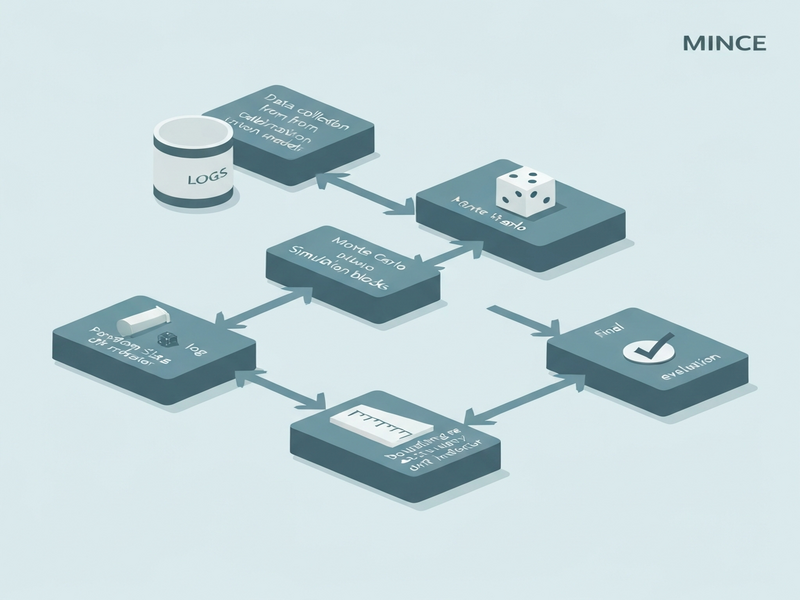
The MINCE framework sidesteps the need for a learned predictor entirely. Instead, it leverages Monte Carlo simulation on per‑item logs collected from a modest set of calibration models. The core idea is simple yet powerful:
- Gather per‑question (or per‑task) correctness logs from a few representative models.
- Run a Monte Carlo process that repeatedly samples random subsets of the benchmark and measures the resulting accuracy drift relative to the full set.
- Identify the smallest subset size that satisfies a pre‑specified drift threshold (e.g., ≤ 2 percentage points).
- Fix a random subset of that size for all future evaluations, eliminating the need for any additional prediction layer.
Key components of MINCE include:
- Calibration pool: A tiny collection (often < 10 models) that provides the raw per‑item logs.
- Monte Carlo engine: Performs thousands of random draws to estimate drift distributions.
- Drift bound selector: Converts the statistical estimate into a concrete subset size.
Because the method relies only on observed outcomes rather than learned abstractions, it remains robust even when the evaluation hardware or model family changes.
How It Works in Practice
Implementing MINCE in a production pipeline follows a clear, repeatable workflow:
Step 1 – Collect Calibration Logs
Run a small, diverse set of models on the full benchmark once. For each item, record whether the model answered correctly. This step produces a binary matrix (models × items) that captures the difficulty landscape of the dataset.
Step 2 – Monte Carlo Simulation
The simulation randomly selects subsets of items of varying sizes (e.g., 5 %, 10 %, 15 % of the total). For each random draw, it computes the average accuracy across the calibration models and compares it to the full‑set accuracy, yielding a drift value. Repeating this process thousands of times builds a statistical profile of drift versus subset size.
Step 3 – Determine Minimum Subset Size
Given a user‑defined drift tolerance (e.g., 2 pp), the engine selects the smallest subset size whose 95th‑percentile drift stays below the threshold. This size is the “N‑size” that MINCE recommends.
Step 4 – Fixed Random Subset Deployment
Once the N‑size is fixed, a random seed generates a concrete subset of items. All subsequent model evaluations use this same subset, ensuring consistency across runs and eliminating the need for further calibration.
What distinguishes MINCE from prior techniques is its reliance on empirical drift estimation rather than a learned surrogate. The approach is agnostic to model architecture, quantization scheme, or hardware accelerator, making it a drop‑in replacement for existing benchmark pipelines.
Evaluation & Results
The authors validated MINCE on three widely used benchmarks: IFEVAL (a 30‑k‑question suite), MMLU (a 57‑task academic test), and GSM8K (a math‑problem set). They compared three dimensions:
- Subset reduction: Percentage of original items retained.
- Accuracy drift: Difference in measured performance between the reduced subset and the full benchmark.
- Speedup: Wall‑clock time saved on both GPU and NPU hardware.
Key findings include:
| Benchmark | Reduction | Max Drift (pp) | Mean Drift (pp) | GPU Speedup | NPU Speedup |
|---|---|---|---|---|---|
| IFEVAL | 46 % | 2.62 | 0.77–1.34 | 2.7× | 1.7× |
| MMLU | 89 % | 1.95 | 0.93–2.11 | 8.1× | 2.0× |
| GSM8K | 70 % | 2.31 | 1.12–3.59 | 5.4× | 1.9× |
Across all tests, MINCE achieved dramatically lower drift than the competing tinyBenchmarks method—up to 12× lower on MMLU—while requiring 57× fewer calibration models. The results demonstrate that a modest calibration pool (often fewer than five models) suffices to guarantee tight performance bounds.
For a concrete illustration, a BF16‑based LLM evaluated on the reduced MMLU subset took under 30 minutes on a single RTX 4090, compared with more than four hours on the full suite, yet the reported accuracy differed by less than 2 percentage points.
These experiments confirm that MINCE delivers both computational efficiency and statistical reliability, a rare combination in benchmark compression research.
Why This Matters for AI Systems and Agents
From a systems‑engineering perspective, MINCE unlocks several practical advantages:
- Continuous integration pipelines: Model‑variant testing can now be incorporated into nightly builds without exhausting GPU budgets, enabling rapid iteration on quantization and fine‑tuning strategies.
- Edge‑device validation: NPUs on smartphones or IoT gateways often lack the memory to host full benchmarks. MINCE’s reduced subsets fit comfortably within these constraints while still surfacing regressions.
- Agent orchestration: Multi‑agent pipelines that dynamically select the best‑performing LLM (e.g., for routing user queries) can re‑evaluate candidates on the fly, thanks to the sub‑second evaluation times achieved on trimmed datasets.
- Cost control: Cloud‑based evaluation jobs billed per GPU‑hour see immediate savings, allowing teams to allocate budget toward model research rather than repetitive testing.
These benefits translate directly into faster product cycles for UBOS platform overview, more reliable AI‑driven services, and the ability to scale evaluation across hundreds of model variants without prohibitive hardware investment.
What Comes Next
While MINCE marks a significant step forward, several open challenges remain:
- Dynamic drift thresholds: Current implementations use a static bound (e.g., 2 pp). Future work could adapt thresholds based on task criticality or regulatory requirements.
- Cross‑domain calibration: Extending the method to multimodal benchmarks (vision‑language, audio) may require richer per‑item logs beyond binary correctness.
- Automated subset refresh: As models evolve, the optimal subset may shift. An automated schedule that re‑runs the Monte Carlo engine periodically could keep the evaluation set up‑to‑date without manual intervention.
Potential applications include integrating MINCE into Workflow automation studio to trigger re‑evaluation whenever a new model checkpoint lands in a CI pipeline, or coupling it with AI marketing agents that need rapid performance feedback before launching new campaign‑specific prompts.
Developers interested in experimenting with the framework can start by using the OpenAI ChatGPT integration to collect calibration logs, then feed those logs into a lightweight Monte Carlo script. The resulting subset can be shared across teams via the ChatGPT and Telegram integration, enabling real‑time notifications when drift exceeds acceptable limits.
In summary, MINCE offers a pragmatic, statistically sound path to shrink LLM evaluation datasets without sacrificing confidence. As the ecosystem of model variants continues to expand, tools that make benchmarking both fast and trustworthy will become indispensable for any organization that treats AI as a core product capability.
For a deeper dive into the methodology and full experimental details, see the original MINCE paper.
Andrii Bidochko
CTO UBOS
Andrii Bidochko is an AI entrepreneur and researcher focused on AI agents, reinforcement learning, and autonomous systems. He writes about the technologies shaping the future of machine intelligence, from frontier models and agent architectures to real-world AI applications.