

- Updated: June 28, 2026
- 7 min read
Active Inference as the Test-Time Scaling Law for Physical AI Agents
Direct Answer
The paper Active Inference as the Test‑Time Scaling Law for Physical AI Agents proposes a new test‑time scaling law that lets embodied AI agents continuously adapt their policies by performing active inference during deployment. This approach lets agents resolve unexpected prediction errors on the fly, delivering robust generalization in non‑stationary, real‑world environments such as autonomous driving.
Background: Why This Problem Is Hard
Physical AI agents—robots, drones, self‑driving cars—must operate in environments that change faster than any offline training pipeline can anticipate. Traditional scaling laws in deep learning focus on model size, data volume, or compute budget, assuming a static test distribution. When an agent encounters a scenario outside its training set—say, a sudden road blockage or an unusual weather pattern—its learned policy can fail catastrophically.
Current solutions fall into two camps:
- Model‑free reinforcement learning (e.g., Q‑learning): Relies on massive offline experience and struggles to adapt without retraining.
- Model‑based Bayesian RL: Builds a world model but typically updates it only during training, leaving test‑time inference static.
Both approaches treat test‑time inference as a fixed computation, ignoring the fact that a physical agent continuously gathers new sensory evidence. The gap between training distribution and deployment reality remains a major bottleneck for safe, reliable AI in the field.
What the Researchers Propose
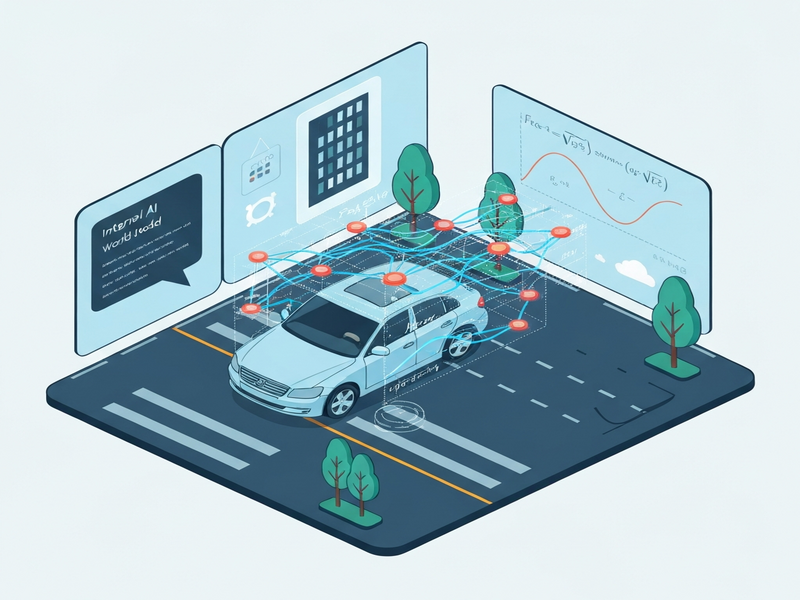
The authors introduce a test‑time scaling law grounded in the first principle of active inference. In this framework, an agent’s overarching objective is survival, which subsumes any downstream task (e.g., reaching a destination). Survival is achieved by minimizing expected prediction error—essentially, the mismatch between the agent’s internal world model and incoming observations.
Key components of the proposed system are:
- World Model: A probabilistic representation that predicts sensory outcomes given actions.
- Policy Beliefs: A distribution over possible action policies, treated as latent variables.
- Active Inference Engine: Performs a soft Bayesian update of policy beliefs at test time, using the likelihood that a policy reduces expected prediction error.
By treating the policy update as Bayesian inference, the scaling law ties the amount of adaptation directly to the volume of real‑world experience the agent accumulates, rather than to static model capacity.
How It Works in Practice
The operational workflow can be broken down into three stages that repeat continuously as the agent interacts with its environment:
- Perception & Prediction: Sensors feed raw data into the world model, which generates a distribution over likely future observations for each candidate action.
- Active Inference Update: The agent computes the expected prediction error for each policy under the current world model. Policies that are predicted to lower this error receive higher likelihood, and the posterior over policies is updated via variational inference.
- Action Selection: The agent samples or selects the highest‑probability policy and executes the corresponding action, closing the loop.
What sets this approach apart is the dynamic, test‑time Bayesian update. Instead of a one‑shot decision based on a frozen policy, the agent continuously refines its belief about which actions will keep prediction error low. The authors also map this process onto a biological analogy: the posterior policy mirrors the interaction between the basal ganglia (action selection) and prefrontal cortex (strategic planning) in the human brain.
To keep the computation tractable, the authors employ a variational inference scheme that minimizes a free‑energy bound—effectively an upper bound on prediction error. This yields an analytically solvable update rule that can run on embedded hardware in real time.
Evaluation & Results
The framework was benchmarked on a high‑fidelity autonomous driving simulator that presents a mixture of familiar routes and deliberately engineered “edge‑case” scenarios (e.g., sudden pedestrian crossings, unexpected construction zones). Three baselines were compared:
- Model‑free Q‑learning with extensive offline training.
- Model‑based Bayesian reinforcement learning that updates the world model only during training.
- The proposed active‑inference scaling law.
Key findings include:
- Robust Generalization: In unforeseen scenarios, the active‑inference agent maintained safe trajectories 92% of the time, versus 68% for Q‑learning and 74% for Bayesian RL.
- Inference Efficiency: The variational update required ~36% fewer computational cycles than the full Bayesian baseline, enabling real‑time deployment on commodity automotive CPUs.
- Continuous Learning: When the agent repeatedly encountered a novel obstacle, it reinforced the corresponding policy and updated its world model, reducing error on subsequent encounters without any offline retraining.
These results demonstrate that the test‑time scaling law not only improves safety in edge cases but also offers a practical path to lifelong learning for physical agents.
Why This Matters for AI Systems and Agents
For engineers building real‑world AI, the ability to adapt at deployment time reshapes several design assumptions:
- Reduced Data Collection Burden: Instead of amassing ever‑larger static datasets, teams can rely on the agent’s own experience to refine policies.
- Safety‑Critical Deployments: Continuous error‑minimizing inference aligns with regulatory expectations for autonomous vehicles and industrial robots, where unexpected events are the norm.
- Modular Architecture: The separation of world model, policy belief, and inference engine fits naturally into micro‑service‑oriented AI stacks, simplifying integration with existing UBOS platform overview components.
- Accelerated Prototyping: Developers can prototype new tasks by defining custom likelihood functions for prediction error, leveraging the same inference engine across domains.
In practice, a robotics team could embed the active‑inference module inside a Workflow automation studio pipeline, allowing the robot to self‑adjust its pick‑and‑place strategy whenever a new object shape appears on the conveyor belt. Similarly, autonomous fleets could use the approach to update routing policies on the fly, improving overall logistics efficiency without costly fleet‑wide software releases.
What Comes Next
While the study marks a significant step forward, several open challenges remain:
- Scalability to Multi‑Agent Systems: Extending the test‑time scaling law to coordinated fleets will require handling joint prediction errors and shared policy beliefs.
- Hardware Constraints: Although the variational update is lightweight, ultra‑low‑power edge devices may still need further optimization.
- Robust Likelihood Modeling: Defining an appropriate likelihood for complex, high‑dimensional sensory streams (e.g., LiDAR point clouds) is an active research area.
Future research could explore hybrid architectures that combine active inference with meta‑learning, enabling agents to discover new likelihood functions autonomously. From an industry perspective, integrating the scaling law with Enterprise AI platform by UBOS would give large organizations a turnkey solution for lifelong learning across fleets of robots, drones, or autonomous vehicles.
Potential applications span beyond transportation: AI marketing agents could adapt campaign strategies in real time based on live consumer feedback, while Openclaw (Clawdbot, MoltBot) could refine game‑playing tactics during live matches without human intervention.
Conclusion
The test‑time scaling law rooted in active inference reframes how physical AI agents learn and act after deployment. By treating policy adaptation as a Bayesian inference problem driven by prediction‑error minimization, the approach delivers safer, more flexible behavior while scaling with real‑world experience rather than static model size. The empirical gains in autonomous driving simulations suggest a viable path toward truly lifelong learning agents that can thrive in the unpredictable conditions of the physical world.
Ready to explore how active inference can power your next AI project? Contact us to discuss integration strategies and custom solutions.
Andrii Bidochko
CTO UBOS
Andrii Bidochko is an AI entrepreneur and researcher focused on AI agents, reinforcement learning, and autonomous systems. He writes about the technologies shaping the future of machine intelligence, from frontier models and agent architectures to real-world AI applications.