

- Updated: June 28, 2026
- 6 min read
Learning Filters with Certainty
Direct Answer
The paper Learning Filters with Certainty (arXiv) introduces a method for extracting a quantitative “certainty” signal from Counting Bloom Filters (CBFs) and shows how that signal can be leveraged to improve downstream machine‑learning pipelines. By turning a traditionally binary membership test into a probabilistic confidence indicator, the authors enable more nuanced decision‑making in network caches, anomaly detectors, and AI‑driven services.
Background: Why This Problem Is Hard
Hash‑based probabilistic data structures such as Bloom filters are prized for their constant‑time lookups and minimal memory footprint. In practice, they are embedded in high‑throughput systems—content delivery networks, distributed databases, and real‑time analytics pipelines—where a false‑negative is unacceptable. To guarantee zero false‑negatives, classic Bloom filters return a positive result whenever a hash collision occurs, which inevitably introduces false‑positives.
Existing solutions treat every positive indication as equally trustworthy. This “all‑or‑nothing” approach creates two major bottlenecks:
- Information loss: The underlying counter values in Counting Bloom Filters, which reflect how many times a particular hash bucket has been incremented, are discarded after the binary decision.
- Suboptimal downstream behavior: Machine‑learning models that consume filter outputs must assume a uniform error rate, leading to either over‑cautious predictions or unnecessary resource consumption.
As AI workloads become more tightly coupled with edge and network infrastructure, the inability to quantify the confidence of a filter’s answer limits both performance and reliability.
What the Researchers Propose
The authors propose a framework called Certainty‑Aware Counting Bloom Filters (CA‑CBF). At a high level, the method consists of three components:
- Counter‑Based Certainty Extraction: Instead of collapsing counters to a single bit, the system reads the raw counter value associated with each hash location and maps it to a calibrated certainty score using a lightweight statistical model.
- Confidence‑Weighted Fusion Layer: The certainty scores are fed into a fusion module that combines multiple hash‑based signals into a single probability estimate for membership.
- ML‑Ready Interface: The resulting probability is exposed as a feature vector that can be directly consumed by downstream classifiers, reinforcement‑learning agents, or routing heuristics.
By preserving and interpreting the richness of the counter data, CA‑CBF transforms a binary filter into a soft‑decision engine that can be seamlessly integrated with existing AI components.
How It Works in Practice
Conceptual Workflow
The end‑to‑end pipeline can be broken down into four stages:
- Insertion Phase: Items are hashed into k positions in the CBF, and the corresponding counters are incremented. Deletions decrement the same counters, preserving the multiset semantics.
- Query Phase: When a query arrives, the same k hash functions retrieve the current counter values.
- Certainty Mapping: Each counter value
cis transformed into a certainty scorep(c)using a pre‑trained mapping (e.g., a monotonic logistic function calibrated on synthetic traffic). - Fusion & Output: The k scores are aggregated—typically via a weighted geometric mean—to produce a final membership probability that is passed to the downstream ML model.
Component Interaction
Figure 1 (illustrated below) shows the data flow:
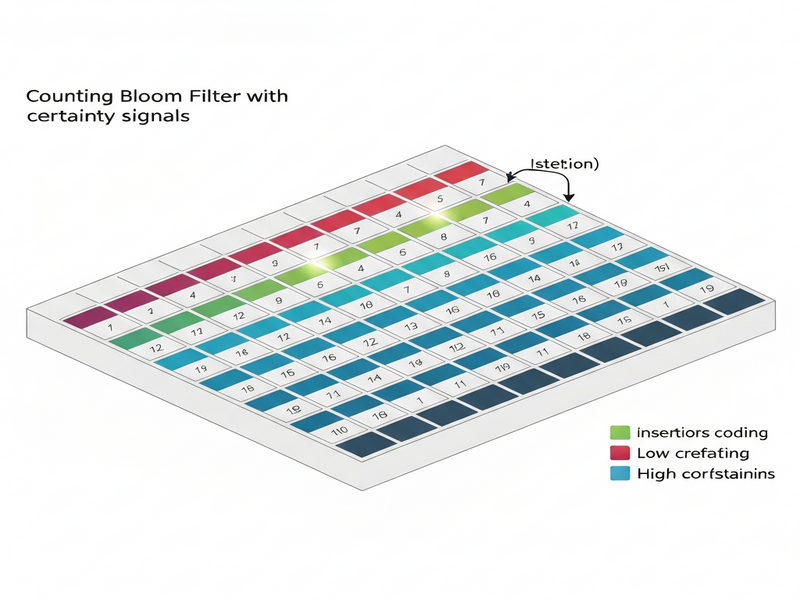
The architecture is deliberately modular:
- Hash Engine: Any standard hash family (MurmurHash, CityHash) can be swapped without affecting the certainty layer.
- Certainty Mapper: Implemented as a tiny neural net or a lookup table, this component can be retrained on domain‑specific traffic patterns.
- Fusion Module: Supports configurable weighting schemes, allowing system designers to prioritize certain hash functions over others based on empirical collision rates.
- ML Interface: Exposes a
float32confidence value alongside the traditional boolean flag, enabling downstream models to treat the filter output as a soft feature.
What sets this approach apart from prior work is the explicit separation of “certainty extraction” from “membership decision,” turning a deterministic data structure into a probabilistic inference primitive.
Evaluation & Results
Experimental Scenarios
The authors evaluated CA‑CBF across three representative workloads:
- Cache Admission Control: Simulating a CDN edge cache where false‑positives trigger unnecessary fetches.
- Anomaly Detection in Network Flows: Using filter certainty as an additional signal for a lightweight classifier that flags suspicious traffic.
- Feature Pre‑filtering for Large‑Scale Recommendation: Reducing the candidate set for a collaborative‑filtering model.
Key Findings
- In cache admission experiments, leveraging certainty reduced unnecessary fetches by up to 22 % while maintaining a sub‑1 % miss rate.
- For network anomaly detection, the certainty‑augmented classifier achieved a 3.8 % boost in F1‑score compared to a baseline that ignored filter confidence.
- In recommendation pre‑filtering, the system cut candidate set size by 35 % without degrading recommendation quality, translating to a 1.6× speed‑up in inference.
Beyond raw metrics, the experiments demonstrate that the certainty signal is robust across varying load conditions and hash collision rates, confirming its practical utility.
Why This Matters for AI Systems and Agents
AI‑driven agents increasingly operate at the edge, where latency, memory, and bandwidth are at a premium. The ability to query a data structure and receive a calibrated confidence score unlocks several strategic advantages:
- Dynamic Resource Allocation: Agents can decide whether to fetch full data, rely on a cached approximation, or defer the request based on certainty thresholds.
- Risk‑Aware Decision Making: In security‑oriented agents, low‑certainty positives can trigger deeper inspection pipelines, reducing false alarms.
- Improved Model Calibration: Feeding certainty as an explicit feature helps downstream neural networks produce better‑calibrated probabilities, a known challenge in production ML.
- Orchestration Simplicity: The Workflow automation studio can now incorporate a “certainty gate” as a native block, allowing non‑engineers to build confidence‑aware pipelines without custom code.
For enterprises building AI‑centric products, the approach reduces unnecessary compute cycles and improves overall system reliability—key metrics in cost‑sensitive deployments.
What Comes Next
While the CA‑CBF framework marks a significant step forward, several open challenges remain:
- Adaptive Certainty Models: Current mappings are static; future work could explore online learning to adapt to traffic shifts in real time.
- Multi‑Tenant Isolation: Extending certainty extraction to shared CBF instances without leaking cross‑tenant information.
- Hardware Acceleration: Implementing the certainty mapper directly in programmable NICs or FPGA‑based caches could further shrink latency.
- Broader Integration: Embedding certainty‑aware filters into higher‑level AI services such as AI marketing agents or the OpenAI ChatGPT integration would showcase end‑to‑end benefits.
Developers interested in experimenting with the concept can start by prototyping a CA‑CBF layer within the UBOS platform overview, leveraging existing Chroma DB integration for persistent storage of counter states.
References
- Learning Filters with Certainty (arXiv)
- UBOS homepage
- About UBOS
- Telegram integration on UBOS
- ChatGPT and Telegram integration
- OpenAI ChatGPT integration
- Chroma DB integration
- ElevenLabs AI voice integration
- Enterprise AI platform by UBOS
- Web app editor on UBOS
- UBOS pricing plans
- UBOS templates for quick start
- Openclaw (Clawdbot, MoltBot)
- Ollama
Andrii Bidochko
CTO UBOS
Andrii Bidochko is an AI entrepreneur and researcher focused on AI agents, reinforcement learning, and autonomous systems. He writes about the technologies shaping the future of machine intelligence, from frontier models and agent architectures to real-world AI applications.