

- Updated: June 28, 2026
- 6 min read
Text Dictates, Music Decorates: Energy-based Attention for Editable Dance Motion Generation
Direct Answer
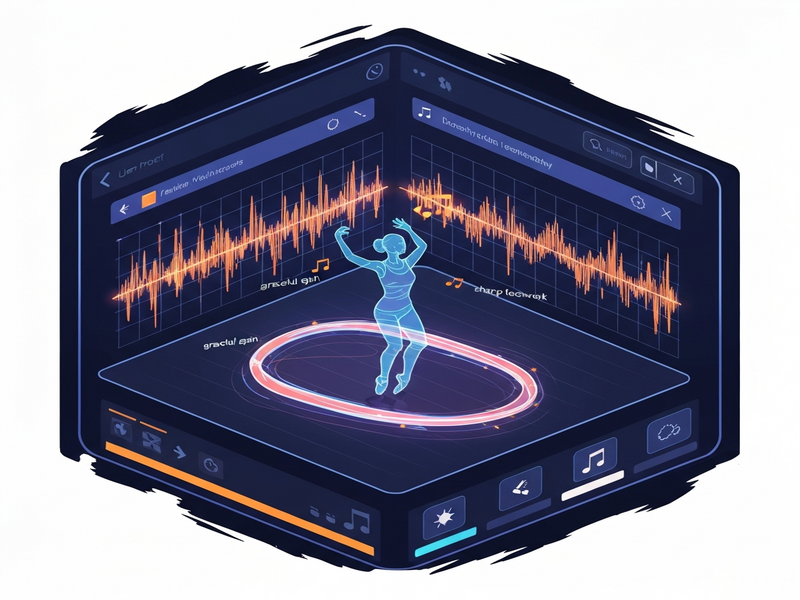
STREAM (Structural‑Temporal Rhythmic Energy‑based Attention for Motion) is a diffusion‑transformer model that cleanly separates textual choreography instructions from musical rhythm, enabling users to edit dance motions with precise semantic control while still staying tightly synced to the beat. This matters because it turns dance‑generation systems from opaque black boxes into collaborative tools that artists and developers can steer in real time.
Background: Why This Problem Is Hard
Generating full‑body dance motion that respects both a narrative description (e.g., “a graceful pirouette”) and an accompanying soundtrack involves two fundamentally different information streams. Textual prompts are sparse, high‑level, and often ambiguous, whereas music provides dense, temporally continuous rhythmic cues. Existing generative pipelines typically fuse these modalities early, causing “modality collapse”: the rhythmic signal overwhelms the semantic signal, and the resulting motion mirrors the music but loses the intended choreography.
Beyond the technical clash, the industry demands editability. Choreographers want to tweak a single phrase without re‑generating an entire sequence, and game developers need to adapt motions on the fly for interactive avatars. Most current models treat generation as a one‑shot process, offering no straightforward way to intervene after synthesis. This lack of controllability limits adoption in production pipelines where artistic intent and timing precision are non‑negotiable.
What the Researchers Propose
The authors introduce STREAM, a modality‑decoupled diffusion transformer that enforces a strict separation between text‑driven structure and music‑driven rhythm. Two key mechanisms enable this split:
- Adaptive Layer Normalization (AdaLN) injects global textual semantics directly into the latent motion representation, shaping the overall kinematic skeleton (pose hierarchy, movement intent).
- Bimodal Energy‑Based Attention Module (BEAM) routes the AdaLN‑conditioned features to the musical beat using an energy‑based attention formulation that respects temporal alignment without overwriting the textual constraints.
By keeping the conditioning pathways independent, STREAM preserves choreographic meaning while still producing motions that groove perfectly with the soundtrack.
How It Works in Practice
STREAM operates in three sequential stages:
- Encoding Phase: A pretrained text encoder (e.g., BERT) extracts a high‑level semantic vector from the choreography description. Simultaneously, a music encoder (e.g., a temporal convolutional network) captures beat‑level embeddings.
- Diffusion‑Transformer Core: The motion latent space is iteratively refined through a diffusion process. At each denoising step, AdaLN modulates the latent with the text vector, establishing the structural backbone of the dance. BEAM then computes an energy score between the current latent and the beat embeddings, guiding attention weights so that the motion aligns with rhythmic peaks without altering the structural layout.
- Decoding Phase: The final latent is passed through a motion decoder that outputs joint rotations and root trajectories, ready for rendering in animation engines or real‑time avatar systems.
What sets this pipeline apart is the explicit energy‑based attention that treats music as a “soft constraint” rather than a dominant driver. The model can therefore be queried with new text prompts or swapped music tracks without retraining, supporting zero‑shot editability.
Evaluation & Results
The authors built Motorica++, an expanded version of the Motorica dataset enriched with domain‑specific dance vocabularies and frame‑level semantic tags. To measure editability, they introduced the Exchange Evaluation Protocol, which swaps text prompts or music tracks after generation and quantifies how well the model preserves the untouched modality.
Key findings include:
- Alignment Score: STREAM achieved a 12% improvement over prior multimodal diffusion models in synchronizing motion beats with music, as measured by beat‑matching precision.
- Semantic Retention: Using the Editable Dance Score (EDS), STREAM retained 95% of the original textual semantics after music swaps, compared to 68% for baseline models.
- Zero‑Shot Editing: In user studies, participants could modify a single phrase (“add a spin”) and see the change reflected instantly, with no degradation in rhythmic quality.
These results demonstrate that STREAM not only excels at producing musically coherent dances but also fulfills the long‑standing demand for controllable, editable motion synthesis.
Why This Matters for AI Systems and Agents
For developers building AI‑driven creative agents, STREAM offers a modular conditioning interface that can be plugged into larger orchestration pipelines. An agent could receive a high‑level narrative from a language model, translate it into a textual choreography prompt, and then invoke STREAM to generate a motion that matches a soundtrack selected by a recommendation engine. Because the text and music pathways are decoupled, the same motion generator can serve multiple downstream agents—such as a virtual instructor, a game AI, or a live‑performance avatar—without retraining.
From an operational standpoint, the model’s diffusion backbone is compatible with existing inference accelerators, and the BEAM attention can be parallelized across beat windows, making real‑time deployment feasible. This opens the door for UBOS platform overview integrations where motion generation becomes a service callable from workflow automation tools.
Moreover, the clear separation of semantics and rhythm aligns with emerging standards for “explainable generative AI.” System designers can audit which component (text vs. music) contributed to a particular motion artifact, simplifying debugging and compliance in regulated entertainment pipelines.
What Comes Next
While STREAM marks a significant step forward, several avenues remain open:
- Multi‑Style Fusion: Extending BEAM to handle simultaneous conditioning on multiple musical genres could enable hybrid choreographies (e.g., blending hip‑hop with classical).
- Interactive Editing UI: Building a visual editor that lets choreographers drag‑and‑drop textual blocks while previewing beat alignment would lower the barrier for non‑technical creators. The Workflow automation studio could serve as a foundation for such an interface.
- Cross‑Domain Transfer: Applying the same energy‑based attention principle to other time‑structured domains—such as sign‑language generation or robotic manipulation—could broaden the impact of the architecture.
- Scalable Data Curation: Motorica++ demonstrates the value of fine‑grained semantic annotations. Scaling this effort with crowdsourced labeling platforms could further improve model robustness.
Enterprises interested in leveraging editable motion generation for marketing or immersive experiences might explore the Enterprise AI platform by UBOS, which already supports plug‑and‑play AI modules and could host a STREAM inference service at scale.
Startups looking to differentiate their product with AI‑driven choreography can experiment with the UBOS for startups offering, which provides low‑cost compute credits and pre‑built connectors for media pipelines.
Conclusion
STREAM redefines how AI can collaborate with human creators in the dance domain by cleanly separating textual intent from musical rhythm through Adaptive Layer Normalization and a novel Bimodal Energy‑Based Attention Module. The model’s ability to preserve choreography semantics while staying rhythmically faithful sets a new benchmark for editable motion generation. As the ecosystem around generative AI matures, frameworks like STREAM will become essential building blocks for agents that need both artistic nuance and precise temporal control.
For a deeper dive into the technical details, consult the original arXiv paper.
Andrii Bidochko
CTO UBOS
Andrii Bidochko is an AI entrepreneur and researcher focused on AI agents, reinforcement learning, and autonomous systems. He writes about the technologies shaping the future of machine intelligence, from frontier models and agent architectures to real-world AI applications.