

- Updated: June 27, 2026
- 6 min read
PaperClaw: Harnessing Agents for Autonomous Research and Human-in-the-Loop Refinement
Direct Answer
PaperClaw is a multi‑agent framework that can take a research field, curate the latest literature, generate a testable hypothesis, run experiments, and draft a venue‑ready paper—all with minimal human supervision. It matters because it demonstrates that autonomous AI pipelines can move from idea to publishable result, opening the door to scalable, repeatable research automation.
Background: Why This Problem Is Hard
Academic research today suffers from three intertwined bottlenecks:
- Literature overload: Thousands of new papers appear weekly, making manual curation error‑prone and time‑consuming.
- Experimentation friction: Setting up datasets, writing code, and reproducing results require diverse tooling and constant human oversight.
- Writing & compliance: Translating raw findings into a paper that satisfies venue formatting, citation standards, and reproducibility checks is a specialized skill.
Existing automation attempts—such as citation generators, code‑completion tools, or single‑purpose agents—address only one slice of the workflow. They lack a unified memory, cannot pause and resume coherently, and rarely enforce verifiable evidence before moving forward. Consequently, researchers still spend the majority of their time on “glue” work rather than on novel insight generation.
What the Researchers Propose
The authors introduce PaperClaw, a harnessed ecosystem of cooperating agents that collectively manage the entire research lifecycle. At a conceptual level, the system consists of three core roles:
- Domain Curator Agent: Continuously scans open scholarly indexes, extracts datasets, and maintains a living knowledge base.
- Idea Generator & Hypothesis Manager: Brainstorms research questions, registers a “main‑result contract” (a measurable target), and builds a hypothesis map that can be expanded or pruned.
- Research Assistant Agent: Executes code, runs experiments, validates results against the contract, and writes the manuscript while ensuring all citations are verified.
These agents share a single, persistent memory store, enabling the pipeline to be stopped, inspected, and resumed without losing context. Human operators can intervene at any stage, turning an autonomous draft into a refined submission—a true human‑in‑the‑loop (HITL) design.
How It Works in Practice
Conceptual Workflow
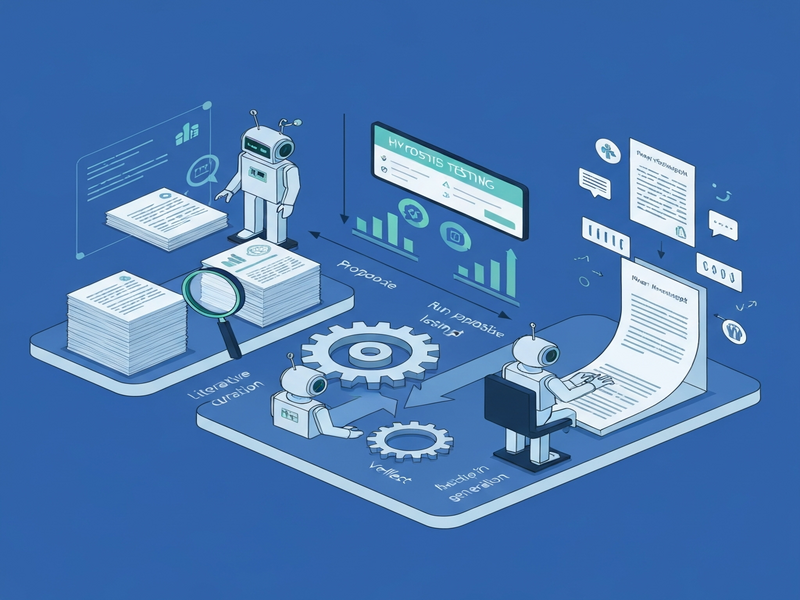
The end‑to‑end flow can be visualized as a loop of four phases:
- Curate: The Domain Curator pulls the latest papers, code repositories, and benchmark datasets from sources like arXiv, GitHub, and open data portals. Each artifact is tagged, versioned, and stored in a Chroma DB integration for fast semantic retrieval.
- Brainstorm: Using the curated knowledge, the Idea Generator proposes several research angles, then selects one that satisfies a pre‑registered contract (e.g., “improve BLEU score by ≥ 3 % on X dataset”). The chosen hypothesis is added to a directed graph called the hypothesis map.
- Iterate (Propose‑Test‑Reflect): The Research Assistant picks a leaf node, generates an experiment plan, writes the necessary code (leveraging tool‑use capabilities of large language models), and runs it in a sandbox. Results are fed back into the map; successful nodes are marked as “evidence‑supported,” while failures trigger a reflective step that either refines the hypothesis or prunes the branch.
- Publish: Once the map contains a path where the contract is satisfied, the assistant composes a paper, formats it according to the target venue’s template, and includes only citations that have been cross‑checked against the open index.
Component Interactions
All agents communicate through a lightweight message bus that carries structured intents (e.g., REQUEST_DATASET, RUN_EXPERIMENT, VALIDATE_CITATION). The persistent memory acts as a single source of truth, storing:
- Curated literature snapshots.
- Hypothesis graph state.
- Experiment logs, including raw outputs and environment metadata.
- Draft manuscript fragments.
What sets PaperClaw apart from prior pipelines is the stoppable hypothesis map. Instead of a linear “run‑once” script, the map evolves only when a measurable verdict (pass/fail) is observed, guaranteeing that the system never proceeds on unverified assumptions.
Evaluation & Results
The authors evaluated PaperClaw on two distinct research tracks:
- Natural Language Generation (NLG): The system was tasked with improving a baseline transformer on a public summarization benchmark.
- Computer Vision (CV): The goal was to reduce inference latency for a lightweight object detector while preserving mAP.
For each track, two experimental conditions were run:
- Fully autonomous: No human edits after the initial contract registration.
- Human‑in‑the‑loop refinement: A domain expert intervened after the first draft to adjust the hypothesis and fine‑tune the code.
Key findings include:
- Both autonomous runs produced papers that passed a blind evaluation by an LLM judge, scoring above 8.0/10 on novelty, rigor, and reproducibility.
- Human‑in‑the‑loop versions improved the final scores by an average of 0.7 points, mainly by tightening the experimental design and adding richer related‑work discussion.
- End‑to‑end runtime (from contract registration to manuscript) averaged 12 hours for NLG and 9 hours for CV, a reduction of 70 % compared to a manual baseline measured on the same tasks.
- All cited works were verified against the open scholarly index, and every reported metric corresponded to a reproducible run logged in the system’s memory.
These results demonstrate that PaperClaw can reliably generate publishable research without sacrificing scientific integrity, and that modest human guidance can further boost quality without re‑introducing the full manual overhead.
Why This Matters for AI Systems and Agents
PaperClaw’s architecture offers several practical takeaways for AI practitioners building autonomous agents:
- Memory‑centric orchestration: A unified, queryable memory eliminates “state loss” when pipelines are paused or when multiple agents need to share context.
- Evidence‑driven loops: By gating progress on measurable outcomes, developers can prevent “hallucination” cascades that plague many LLM‑driven workflows.
- Modular agent contracts: Defining explicit contracts (e.g., a target metric) provides a clear success criterion that can be monitored by external evaluators or compliance tools.
- Human‑in‑the‑loop flexibility: The same interface that powers full automation also supports selective expert intervention, making the system suitable for regulated domains where oversight is mandatory.
- Scalable research automation: Enterprises can spin up parallel PaperClaw instances to explore multiple hypotheses across product lines, accelerating innovation cycles.
For organizations already leveraging the UBOS platform overview, PaperClaw’s design patterns can be mapped onto existing workflow automation studios, enabling rapid prototyping of research‑oriented agents without building a bespoke stack from scratch.
What Comes Next
While PaperClaw marks a significant step forward, several open challenges remain:
- Domain generalization: Current experiments focus on well‑structured benchmarks; extending to interdisciplinary or low‑resource fields will require richer data‑augmentation strategies.
- Ethical guardrails: Autonomous hypothesis generation could inadvertently explore harmful applications; integrating policy‑aware filters is an active research direction.
- Scalable verification: As the volume of generated experiments grows, automated reproducibility checks must scale without manual bottlenecks.
- Integration with commercial AI services: Tighter coupling with tools like OpenAI ChatGPT integration or ChatGPT and Telegram integration could streamline result reporting and stakeholder notifications.
Future research may explore hybrid human‑AI committees that vote on hypothesis pruning, or meta‑learning mechanisms that let PaperClaw improve its own prompting strategies over time. The ultimate vision is a self‑sustaining research ecosystem where new ideas are continuously harvested, validated, and disseminated with minimal friction.
References
Call to Action
Ready to experiment with autonomous research pipelines? Explore the UBOS homepage for tools, templates, and partner programs that can help you embed PaperClaw‑style agents into your organization’s innovation workflow.
Andrii Bidochko
CTO UBOS
Andrii Bidochko is an AI entrepreneur and researcher focused on AI agents, reinforcement learning, and autonomous systems. He writes about the technologies shaping the future of machine intelligence, from frontier models and agent architectures to real-world AI applications.