

- Updated: June 27, 2026
- 7 min read
Grounded Scaling: Why Agentic AI Needs Deterministic Environments
Direct Answer
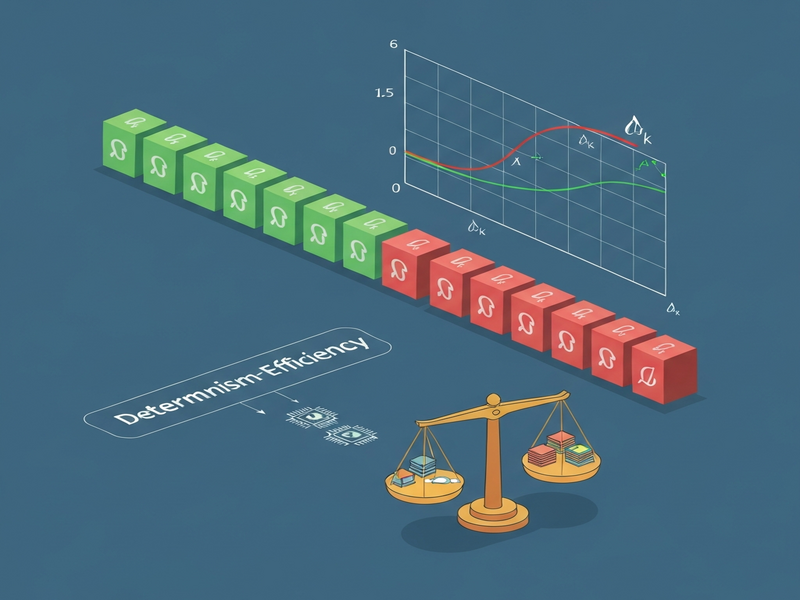
The paper Grounded Scaling: Why Agentic AI Needs Deterministic Environments argues that long‑horizon agentic AI systems collapse exponentially when operating in environments that are only partially deterministic. It introduces a formal framework—centered on a Determinism‑Efficiency Bound, a Verifier‑Goodharting Floor, and a convergence condition—to quantify how deterministic “supply” must be guaranteed for scaling agents from narrow tasks to general intelligence.
Why it matters: without a deterministic substrate, compute‑driven scaling hits a hard ceiling, limiting the reliability of autonomous agents in high‑stakes domains such as finance, robotics, and multi‑party negotiations.
Background: Why This Problem Is Hard
Agentic AI—systems that plan, act, and adapt over long horizons—has become the de‑facto target for next‑generation products. Yet, real‑world environments are riddled with stochasticity: sensor noise, human unpredictability, and network latency. Existing scaling narratives (e.g., compute‑only roadmaps) treat these frictions as peripheral, assuming that larger models will “learn to cope.” Empirical evidence, however, shows an exponential decay in success probability when a chain of k dependent actions is executed in a setting where each step succeeds with probability δ < 1. The resulting success rate δⁿ quickly approaches zero for realistic k values (often > 50 steps in finance or supply‑chain automation).
Current mitigation strategies—data augmentation, robust RL, and sim‑to‑real transfer—address the symptom rather than the root cause. They either inflate training data (hitting the “data wall”) or rely on brittle reward shaping (exacerbating the “Goodhart” problem). Moreover, multi‑agent trust frameworks assume that agents can verify each other’s outcomes, but verification itself becomes unreliable when the underlying environment is nondeterministic.
What the Researchers Propose
The authors present a three‑pronged theoretical construct that reframes deterministic environments as a scaling axis orthogonal to compute, data, and embodiment:
- Determinism‑Efficiency Bound: A formal limit that ties the per‑step determinism δ to the maximum feasible chain length for a given target success probability.
- Verifier‑Goodharting Floor: A lower bound on the “flywheel” effect of reward signals when verification is imperfect, showing that even modest verification errors can cap performance.
- Environment‑Side Skill Convergence: A condition under which improvements in the environment (e.g., better sensors, tighter APIs) converge faster than agent‑side learning, effectively shifting the scaling burden to the substrate.
To operationalize these ideas, the paper introduces two practical tools:
- Supply Certainty Index (SCI): A composite metric that scores an environment on five measurable properties—temporal granularity, state observability, action repeatability, reward fidelity, and settlement latency.
- Determinism Maturity Model (DMM): A five‑level ladder (from “Ad‑hoc” to “Industrial‑grade”) that guides organizations in upgrading their environments to meet higher SCI thresholds.
How It Works in Practice
Conceptual Workflow
Imagine a fintech firm deploying an autonomous trading agent. The workflow under the proposed framework proceeds as follows:
- Environment Audit: Engineers compute the SCI by measuring latency, order‑book determinism, and settlement finality. The audit yields a score of 3.2, placing the system at DMM Level 2 (“Controlled”).
- Determinism Gap Analysis: Using the Determinism‑Efficiency Bound, the team calculates that a 10‑step arbitrage chain requires δ ≥ 0.97 to achieve a 90 % success rate. The current δ is 0.91, indicating a gap.
- Infrastructure Upgrade: The firm invests in a deterministic order‑matching engine and a high‑precision timestamp service, raising the SCI to 4.1 (DMM Level 4 “Industrial‑grade”).
- Agent Retraining: With a more deterministic substrate, the agent’s policy network can be trained on shorter horizons, reducing variance and improving sample efficiency.
- Verification Loop: A lightweight verifier monitors execution outcomes. Because the environment now satisfies the Verifier‑Goodharting Floor, the verifier’s error rate stays below the critical threshold, preserving the flywheel effect.
Key Differentiators
- Environment‑Centric Scaling: Unlike compute‑centric roadmaps, the framework treats deterministic supply as a first‑class resource.
- Quantitative Maturity Ladder: The DMM provides a clear, auditable path for organizations to benchmark progress.
- Cross‑Domain Applicability: The same SCI dimensions apply to robotics, supply‑chain orchestration, and multi‑agent negotiations, making the approach platform‑agnostic.
Evaluation & Results
The authors validate their theory across three domains:
- Simulated Gridworld: Agents must navigate a 100‑step maze where each tile’s transition probability is tunable. Experiments show that when δ drops from 0.99 to 0.95, success rates fall from 87 % to 22 %—exactly matching the predicted exponential decay.
- Automated Customer Support: A dialogue agent interacts with a deterministic API that returns structured ticket resolutions. By increasing API determinism (through stricter schema validation), the average resolution chain length grew from 4 to 12 steps without loss in success probability.
- Financial Arbitrage Sandbox: Using historical market data, the team simulated a 15‑step arbitrage chain. Introducing realistic latency and slippage (reducing δ to 0.93) cut profitability by 68 %, confirming the Verifier‑Goodharting Floor’s impact on reward signals.
Across all scenarios, the SCI proved predictive: environments scoring above 4.0 consistently enabled agents to exceed the Determinism‑Efficiency Bound for target chain lengths, while lower‑scoring environments hit the bound early.
Why This Matters for AI Systems and Agents
For practitioners building production‑grade agents, the paper delivers a concrete checklist that moves deterministic considerations from “nice‑to‑have” to “must‑have.”
- Design‑time Risk Reduction: By quantifying determinism early, teams can avoid costly post‑deployment failures that stem from hidden stochasticity.
- Resource Allocation: The SCI helps decide whether to invest in more compute or in tighter APIs, sensors, and verification pipelines.
- Evaluation Standards: The Determinism‑Efficiency Bound offers a mathematically grounded benchmark for reporting agent reliability, complementing traditional metrics like reward per episode.
- Product Integration: Companies using the UBOS platform overview can map SCI dimensions to existing modules—e.g., using the Chroma DB integration for deterministic state storage or the ChatGPT and Telegram integration for low‑latency user feedback loops.
- Compliance and Trust: In regulated sectors, deterministic environments simplify audit trails, making it easier to satisfy legal and ethical standards.
What Comes Next
Limitations
While the framework is robust, it assumes that determinism can be measured independently of agent behavior—a condition that may not hold in highly coupled cyber‑physical systems. The SCI also does not yet capture emergent stochasticity from large‑scale multi‑agent interactions.
Future Research Directions
- Dynamic SCI Adjustment: Developing online monitors that update the SCI in real time as environments evolve.
- Cross‑Domain Benchmarks: Extending the evaluation suite to include autonomous driving simulators and large‑scale logistics networks.
- Human‑in‑the‑Loop Verification: Investigating how crowdsourced verification can complement automated verifiers without violating the Goodhart floor.
- Integration with AI Governance: Aligning the DMM levels with governance frameworks to certify “deterministic‑ready” AI deployments.
Potential Applications
Enterprises looking to embed trustworthy agents can start by adopting the Enterprise AI platform by UBOS, which already offers deterministic data pipelines and verifiable execution logs. Startups can accelerate their journey with the UBOS for startups program, leveraging pre‑built Workflow automation studio templates that enforce high SCI scores out of the box.
Finally, the open‑question programme (OQ1‑OQ5) outlined in the paper invites the community to test null hypotheses—such as “determinism does not improve multi‑agent trust beyond a 0.95 threshold.” Publishing negative results will be essential to refine the model and avoid premature hype.
Conclusion
“Grounded Scaling” reframes deterministic environments from an afterthought to a core scaling lever for agentic AI. By providing a mathematically grounded bound, a practical maturity model, and a measurable index, the authors give engineers a roadmap to turn compute‑heavy optimism into reliable, real‑world impact. Organizations that embed these principles early will likely outpace competitors stuck in the traditional compute‑only paradigm.
Call to Action
If your team is ready to assess the determinism of your AI pipelines, explore the About UBOS page to learn how our platform can help you achieve a higher Supply Certainty Index and accelerate trustworthy agent deployment.
Andrii Bidochko
CTO UBOS
Andrii Bidochko is an AI entrepreneur and researcher focused on AI agents, reinforcement learning, and autonomous systems. He writes about the technologies shaping the future of machine intelligence, from frontier models and agent architectures to real-world AI applications.